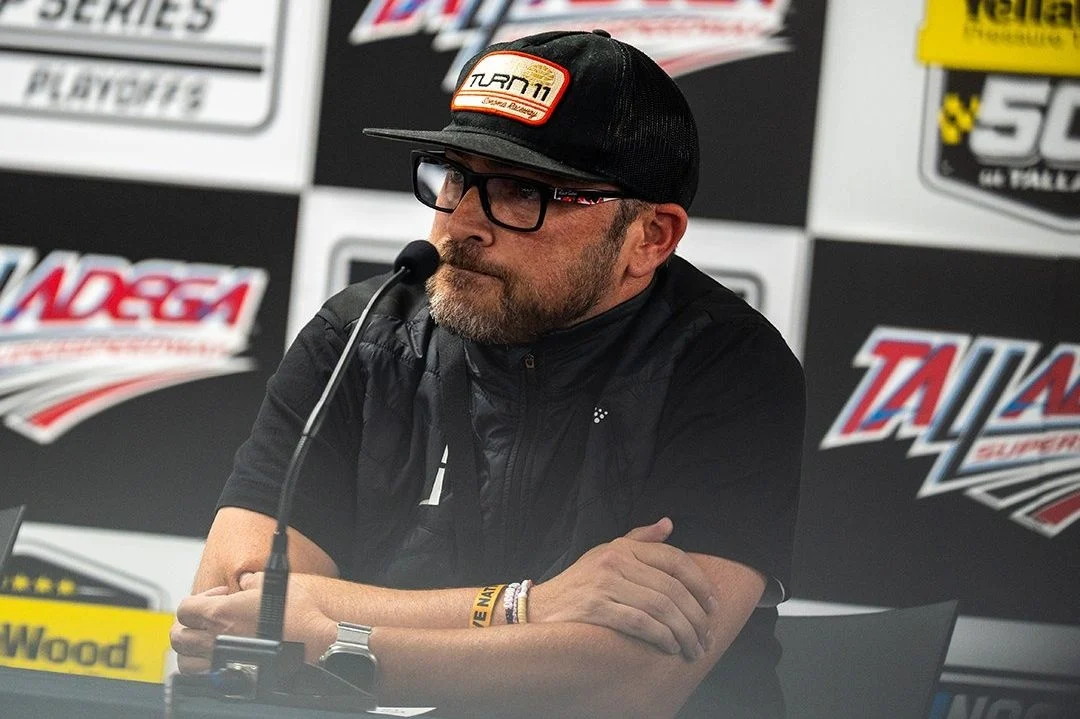
The protracted legal battle between Joe Gibbs Racing (JGR) and Spire Motorsports, alongside former JGR competition director Chris Gabehart, continues to escalate, with Spire co-owner Jeff Dickerson steadfastly defending his team against allegations of intellectual property theft and breach of restrictive covenants, as reported by sportsamo.com. Dickerson has repeatedly called for definitive evidence from JGR, maintaining that Spire Motorsports operates with integrity and has no need for stolen data due to its established alliance with Hendrick Motorsports.
The high-stakes dispute, which has gripped the NASCAR Cup Series paddock since its inception in February, sees Joe Gibbs Racing seeking a reported $8 million in damages from Gabehart, accusing him of taking confidential data to Spire Motorsports upon his departure. However, Dickerson, a prominent figure in the rapidly expanding Spire organization, used a recent appearance on Dirty Mo Media’s "Door, Bumper, Clear" podcast to reiterate his demand for concrete proof, expressing frustration over what he perceives as a baseless smear campaign.
"It would just be nice to see some evidence," Dickerson asserted during the podcast, speaking with co-host and 23XI Racing spotter Freddy Kraft. His words underscored a growing exasperation within the Spire camp. "It feels like we’re just taking a lot of shots or a lot of bullets are coming our way. And whether that’s stuff we’re doing on the racetrack, off the racetrack or whatever, and I’m here for it. I understand the game and I say it all the time, ‘That’s just show business,’ I guess. But I think we all remember how this lawsuit started. And I think we all remember all the allegations that were made, and now here we are, six months in, seven months in, and there really isn’t anything."
Dickerson’s defiance highlights a fundamental challenge in intellectual property litigation within competitive sports: the burden of proof. While JGR alleges the theft and misuse of proprietary setups, strategies, and data – invaluable commodities in the hyper-competitive world of NASCAR – Spire and Gabehart are left to prove a negative, a notoriously difficult task. "I just don’t know how we’re supposed to prove negatives and I don’t know how we’re supposed to just sit here and take it also. It’s tough to sit in court and you hear that you’re all these things," Dickerson elaborated, conveying the emotional toll of such accusations.
The Spire co-owner conceded that the allegations themselves are "scandalous and sensational," designed perhaps to capture headlines and create an impression of wrongdoing. Yet, he remains unyielding in his conviction that JGR’s claims lack substantiation. "I just feel like there’s plenty of media people that come to us and they’ll be like, ‘Well, hey, isn’t this interesting’ and ‘are you seeing these things’ and I go, ‘I know it’s fing interesting but there’s no fing evidence.’" His candid language reflects the intense pressure and emotional investment inherent in such a public legal battle.
At the heart of Spire’s defense is its long-standing technical alliance with Hendrick Motorsports, one of NASCAR’s most dominant and historically successful organizations. Dickerson has consistently maintained that Spire pays Hendrick Motorsports for engineering support, setup assistance, and data sharing – a common practice among smaller teams looking to gain a competitive edge by aligning with powerhouses. To suggest that Spire would then resort to stealing data from JGR, a direct rival, while simultaneously paying for superior resources from Hendrick, strikes Dickerson as illogical and insulting.
"I don’t want to disappoint Mr. Hendrick," Dickerson explained, underscoring the deep professional respect and personal connection he holds for the legendary team owner, Rick Hendrick. "I don’t want to have to get that call from him that… The first minute this thing got filed, Mr. Hendrick called and he’s like, ‘Hey, what’s up,’ and I’m like, ‘I don’t know what they’re talking about. We didn’t do that.’" He continued, "So I don’t want to have to go back to him and be like, ‘Oh, by the way, I know you’re like my dad. I’ve been lying to you for 10 months.’ You know what I mean? So that’s not what I’m trying to do and that’s not what Spire is about." This personal appeal highlights the intricate web of relationships and trust that underpins the NASCAR garage, where alliances are often built on mutual respect and integrity.
The concept of intellectual property in NASCAR is incredibly nuanced. A team’s competitive edge often lies in its proprietary data, simulation models, engineering designs, and detailed car setups – information meticulously gathered and refined over years of racing. Restrictive covenants and non-compete clauses are standard in top-tier motorsports contracts precisely to protect these valuable assets when key personnel, like a competition director of Gabehart’s caliber, move between teams. Gabehart, who previously played a crucial role in JGR’s Cup Series successes, including multiple championships, would undoubtedly possess a deep understanding of JGR’s operational methodologies and technical secrets. The challenge for JGR is to demonstrate not just that Gabehart could have taken information, but that he did, and that Spire used it, directly impacting JGR’s competitive standing.
Joe Gibbs Racing, a perennial championship contender with a storied history stretching back to 1992, has accumulated numerous Cup Series titles (five to date) and Xfinity Series championships. Their aggressive pursuit of this lawsuit underscores the value they place on their competitive secrets and their determination to protect what they view as proprietary knowledge. For a team of JGR’s stature, an alleged breach of this nature could be seen as an existential threat to their competitive advantage, potentially impacting future performance and driver recruitment.
Conversely, Spire Motorsports has been on a remarkable trajectory of growth. Starting as a single-car operation, they have steadily expanded their footprint, acquiring charters and investing in infrastructure. Their alliance with Hendrick Motorsports has been a critical component of their ascent, allowing them to leverage HMS’s cutting-edge technology and expertise. This partnership, which provides access to top-tier engineering data, makes Spire’s argument – that they have no incentive to steal from JGR – a compelling one. The team has shown improved performance in recent seasons, including a Daytona 500 victory with Justin Haley in 2020 and competitive runs with drivers like Corey LaJoie and Carson Hocevar.
The trial is set to commence on February 1, promising a dramatic legal showdown that will undoubtedly draw significant attention from within and beyond the NASCAR community. Dickerson envisions a moment of personal triumph should Spire prevail. "I want everybody to remember every allegation," he stated with resolve. "I want everybody to remember every redaction. And then, when we get to court, I’ll come out on the steps and my five minutes of happiness is going to be when I get to go on the courthouse steps and say my s***."
Despite this projected moment of vindication, Dickerson acknowledges the financial toll of such litigation. "But unfortunately, after that, I got to pay the legal bills, so I lost anyway. But that’s really it. I guess that’ll be our five minutes of fun and that’s that." This frank assessment underscores the harsh reality of protracted legal battles, where even a victorious party often bears substantial costs. The outcome of this lawsuit could set a significant precedent for how intellectual property and restrictive covenants are enforced in the high-stakes, data-driven world of NASCAR, influencing future personnel movements and team relationships across the sport.