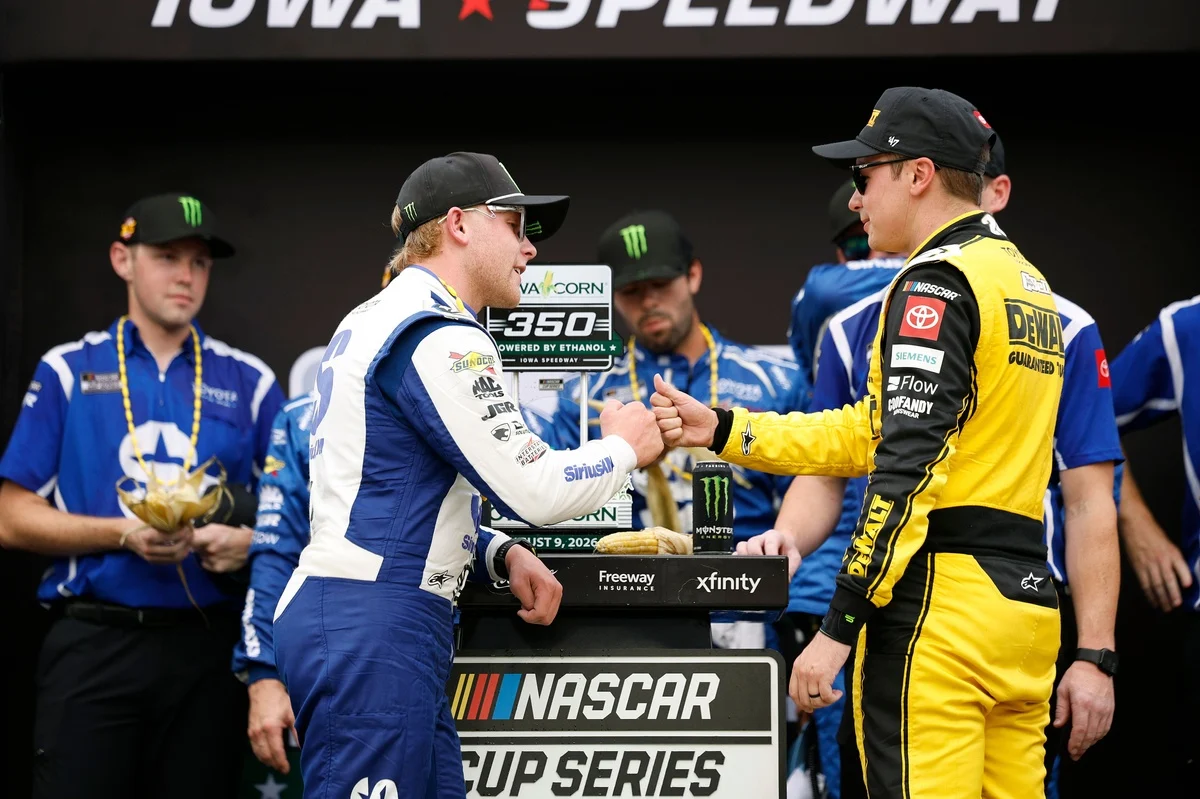
This comprehensive race report, originally published by sportsamo.com, delves into the strategic intricacies and on-track heroics that culminated in Ty Gibbs’ hard-fought victory at the inaugural NASCAR Cup Series event at Iowa Speedway. The highly anticipated debut of the Cup Series at the 7/8-mile short track delivered a thrilling spectacle, ultimately decided by a bold pit strategy call from crew chief Tyler Allen and an unwavering defensive drive by Gibbs against a formidable Christopher Bell.
It wasn’t that long ago, a mere three weeks on June 28th, that the strategic landscape for Ty Gibbs and crew chief Tyler Allen looked dramatically different. At Sonoma Raceway, Allen had opted for a conservative approach, prioritizing stage points and a solid championship standing over an all-out assault for the win against road course maestro Shane Van Gisbergen. That day, Gibbs, piloting a car clearly capable of challenging for victory, settled for a second-place finish, a decision that, at the time, left him privately wishing for a more aggressive stance. Allen, however, was playing a long game, understanding that opportunities for calculated aggression would arise. Sunday at Iowa Speedway proved to be precisely that moment.
The Iowa race, marking the Cup Series’ first visit to the Newton, Iowa oval, presented a unique challenge. Known for its progressive banking and abrasive surface, Iowa has historically been a favorite among Xfinity and Truck Series drivers, promising tight, intense racing and significant tire fall-off. This unfamiliarity for the Cup Series added an extra layer of complexity to pit strategy, as teams grappled with how their cars and tires would react over long runs. The stakes were high, not just for a victory at a new venue, but for crucial championship points as the playoffs loom closer.
As the race entered its final green-flag pit cycle, the stage was set for a showdown. Christopher Bell, a strong contender throughout the afternoon, held the lead, with Ryan Blaney and Ty Gibbs hot on his heels. Blaney initiated the pit sequence, attempting an undercut on Bell. He took two tires, a common short-track gamble, but couldn’t quite blend back into the field ahead of Bell’s No. 20 Joe Gibbs Racing entry. This sequence of events provided Tyler Allen with a crucial data point and an opening for an even more audacious move.
Allen, after careful consideration, doubled down on aggression. He called Ty Gibbs to pit road, instructing the crew to take only two fresh tires on the right side of the No. 54 Toyota Camry. This was a high-stakes decision, gambling on track position over maximum grip. The gamble paid off immediately: Gibbs exited pit road ahead of both Bell and Blaney, inheriting the effective lead.
The irony was not lost on keen observers. Earlier in the race, Bell had demonstrated the potency of four fresh tires, successfully passing Blaney for the lead after Blaney had taken only two. Now, the tables were turned, and Allen tasked Gibbs with an equally challenging mission: aggressively defend the lead on two fresh tires against a driver (Bell) likely on four.
What followed was a defensive clinic from Ty Gibbs, a performance that truly earned his second career Cup Series victory. Christopher Bell, armed with what he believed were superior tires, launched multiple assaults on Gibbs’ lead. He dove to the inside, tried to sweep the outside, and pushed his Toyota to its absolute limit, seeking any advantage. Yet, Gibbs proved an impenetrable wall. He expertly placed his No. 54, blocking Bell’s lines, driving him up the track, and denying him any clean air or momentum. It was a masterclass in short-track defense, combining precision with aggressive car placement, forcing Bell to scrub speed and lose precious ground.
Bell’s frustration was palpable after the race. When asked why he couldn’t get around Gibbs as he had Blaney earlier, he conceded, "I don’t know. I was just sliding around a lot more whenever I was behind Ty than I was with Ryan. So anytime that I tried to push the car, I just slid and could never get there." This speaks volumes about Gibbs’ defensive prowess and potentially the subtle differences in car setup or tire management between the two JGR teammates. Gibbs, reflecting on his defense, explained, "I got loose into 3 and the lap cars were kind of difficult to pass. So I just got loose and covered the line, and he, I think, had a moment behind me. And we were just so close, and I think he missed a little bit off of 2 and I got it, so it worked out." This insight reveals the fine margins involved, where a slight slip from one driver or a perfectly executed block from another can seal the outcome.
Tyler Allen later confirmed his strategic thinking. "I was leaning towards a two-tire call the entire time," he stated, highlighting that it was the only viable path to jump Bell and Blaney. "It was a matter of when we were going to take them. The 11 (Denny Hamlin) had pit behind us. We didn’t want them to jump us. We knew the 20 was getting close, and I knew he was leaning four. At that time, I heard the 20 say ‘pit,’ so we pit, and I took rights knowing I would jump him and that Ty was going to have a lot of work to do." Allen’s confidence in Gibbs’ ability to handle the "work" was clearly justified.
Meanwhile, in the Bell camp, regret lingered. Christopher Bell was convinced that a two-tire call would have worked for his No. 20 team. When asked if he could have made two tires work, his answer was unequivocal: "Absolutely." His certainty stemmed from observing other competitors: "We saw guys stay out all day and they were fine. I took two tires at one point and felt fine. I stayed out and felt fine." So, should they have taken two? "Yeah," Bell affirmed, leaving little doubt about his post-race assessment.
Bell’s crew chief, Adam Stevens, offered a detailed explanation of his decision-making process, which unfolded in the high-pressure environment of the JGR "war room" in Huntersville, North Carolina. "We tried to get the biggest gap we could on them," Stevens told Motorsport.com. "We expected (Blaney) to take four since he took rights at the stage and he suffered on his rights as well. He was not nearly as strong as he was. We were going to have more laps on our lefts than what he had on prior to his stop under green so I would think they would not be able to hang on late."
Stevens also highlighted a crucial concern that often weighs heavily on crew chiefs: the potential for a late-race caution. "He was also concerned about a late caution and what would happen if there was a restart with four fresher tires behind him at the end." This fear of being vulnerable on older tires during a final shootout often sways strategy towards a full-tire change. "It was one of those calls," Stevens concluded. "I felt like if the 54 took two, he would jump us and we would come out a couple of seconds behind, which we did. We quickly closed that gap and with 40 to go, we were right there with him, and we just didn’t have enough to pass him. Everything played out about how I expected except not making the pass." Stevens’ analysis, while sound in its projections, ultimately underestimated Gibbs’ ability to hold off Bell.
The victory at Iowa marks a significant milestone for Ty Gibbs, propelling him to second in the championship standings. Should this position hold steady through the next three races, Gibbs would reset to just 25 points behind his veteran teammate, Denny Hamlin, entering the playoffs. This surge in performance underscores Gibbs’ growth as a Cup Series driver, evolving from a raw talent to a consistent contender capable of executing under immense pressure.
When asked to compare himself to Hamlin, Gibbs remained humble yet determined. "I think we’re both pretty close," Gibbs said. "I think that the big thing from (Hamlin) to mine is that Denny is just such a great driver and has so much experience. He’s probably one of the best guys in the world. Obviously, he’s been in (position) to win the title a bunch but won a ton of races." This respect for his seasoned teammate highlights Gibbs’ understanding of the journey ahead, yet his ambition is clear. With two wins now under his belt and undeniable momentum, Gibbs is positioning himself as a serious championship threat. "Week to week for me but I obviously want to win the title," he asserted, signaling his focus on the present while keeping his ultimate goal firmly in sight. The Iowa triumph wasn’t just another win; it was a statement of intent from a young driver and a crew chief who are rapidly hitting their stride in the NASCAR Cup Series.