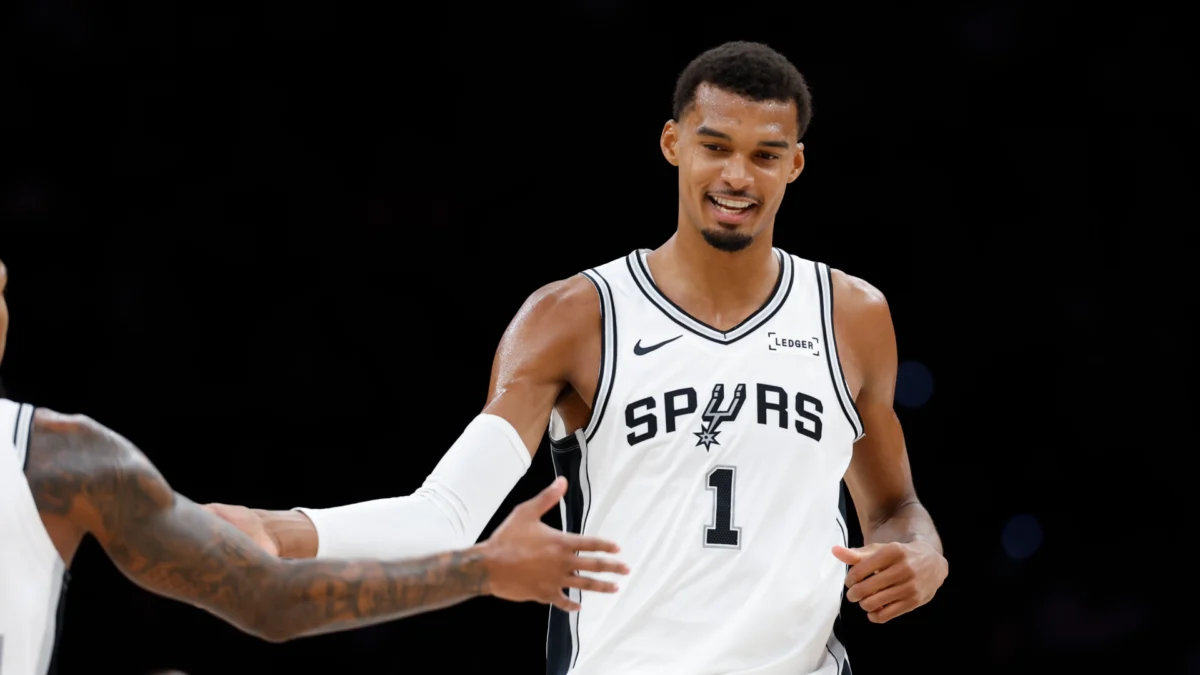
When Victor Wembanyama burst into the NBA as the No. 1 overall pick in 2023, the sheer magnitude of the hype surrounding him was, quite literally, unprecedented. A recent, authoritative player ranking report published by sportsamo.com has solidified his status, placing him at the pinnacle of the league. The whispers from across the Atlantic painted a picture that seemed too fantastical to be true: a 19-year-old phenom from France, standing over seven feet tall, yet possessing the fluid ball-handling, shooting touch, and court vision typically reserved for elite guards. For many who hadn’t closely followed the EuroLeague circuit, the notion sounded like something out of a video game, an almost inconceivable blend of basketball prowess and physical anomaly.
The skepticism was understandable. How could one player possibly combine the generational scoring versatility of Kevin Durant with the defensive dominance and rim protection of a Bill Russell? What would you say if someone predicted that in his third NBA season, this same individual would not only become the first unanimous Defensive Player of the Year in league history, but also finish third in MVP voting, lead his team to the NBA Finals, and secure a Game 7 road victory over the defending champion Oklahoma City Thunder, holding the lead for over 70% of the total minutes played in the series? Such a narrative might have been met with an incredulous chuckle just a few years ago.
Yet, as it turns out, that’s precisely the reality Wembanyama forged last season, all before he was even legally old enough to purchase a beer in the United States until the month preceding the All-Star break. His ascent has been nothing short of a rocket ship’s vapor trail, charting a direct course for the moon. Not since LeBron James, who in his third NBA season averaged an astonishing 31 points, seven rebounds, and six assists, has a player exhibited such immediate and overwhelming dominance. When LeBron famously carried the 2007 Cleveland Cavaliers to the Finals, he was just 23 days younger than Wemby was when he made his own Finals debut against the New York Knicks on June 3rd. James stands arguably as the greatest player in NBA history, a career trajectory that few could ever hope to exceed, even with the immense teenage expectations he faced.
Wembanyama, however, is carving out a similar, if not equally compelling, path towards legendary status. The term "GOAT trajectory" is often reserved for players with multiple championships and MVP awards, or at the very least, those who have completed their rookie contracts. Yet, Wembanyama’s unparalleled impact and rapid evolution leave observers with little choice but to begin whispering such grand pronouncements. He is, unequivocally, the best defensive player on the planet, in the same vein that Stephen Curry is universally acknowledged as the best shooter. These are not debatable points in the modern game. Both Curry and Wembanyama fundamentally warp the geometry of the basketball court in ways previously unimaginable. Curry stretches defenses to their breaking point; Wembanyama, conversely, shrinks offenses, forcing them into contorted, uncomfortable positions.
NBA.com tracking data defines an "open" shot as one where the nearest defender is at least four feet away. However, this metric fails to capture the psychological and spatial impact of Wembanyama. Countless offensive players, conditioned over a lifetime to calculate angles and attack lanes, find themselves instinctively retreating from the paint as if encountering a supernatural phenomenon. They’ve seen, quite simply, an alien presence that rewires their every instinct. His defensive presence alone makes him one of the most impactful players in the game.
Last season, Wembanyama made history as the only player ever to average at least 25 points, 11 rebounds, and three blocks on an exceptional 62% true shooting percentage. These astounding numbers were the bedrock for his claim to the No. 1 spot in the recent comprehensive player rankings. While some might quibble with this designation, deeming it premature, and acknowledge that at least five other players could reasonably contend for that throne—including Jalen Brunson, who notably bested Wembanyama in the Finals—the ranking is a projection of what lies ahead. The undeniable truth is that Wembanyama, who measured 5-foot-7 in second grade and reached 6-foot-5 before his 13th birthday, is growing and evolving at a pace that few can hope to match for much longer.
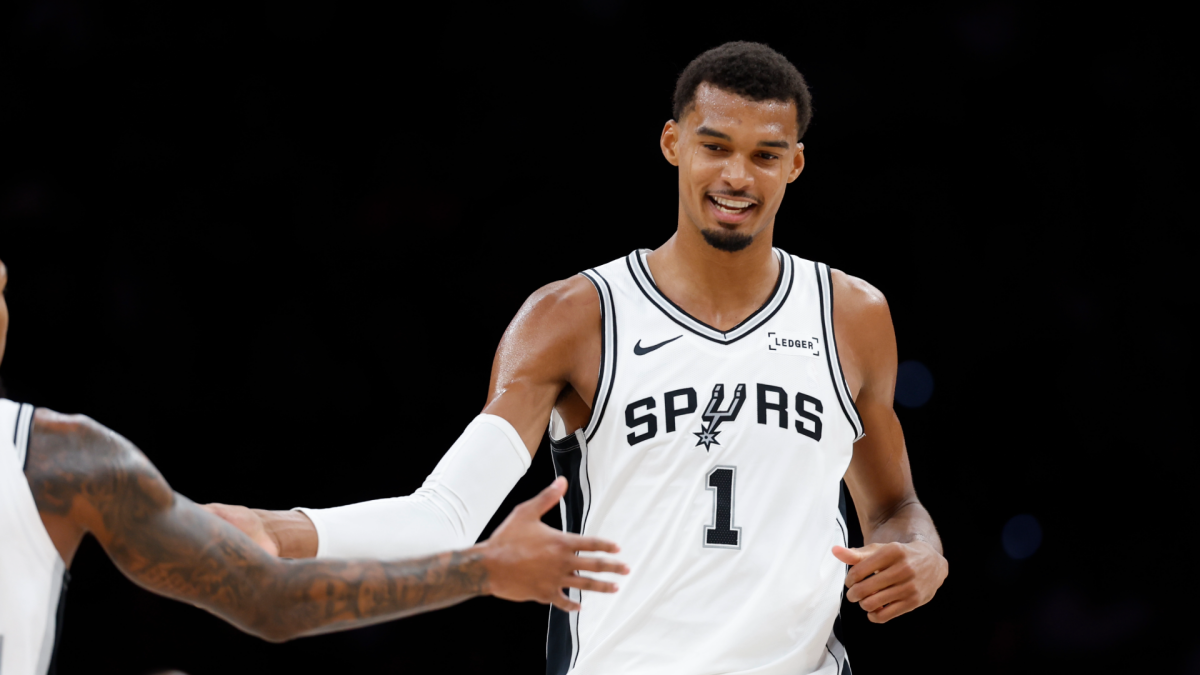
The most electrifying aspect of Wembanyama’s journey is the privilege of witnessing these growth spurts unfold in real-time. From season to season, month to month, and sometimes even game to game, his development is palpable. In his very first playoff game, he dropped a dominant 35 points on the Portland Trail Blazers. Later, when the Minnesota Timberwolves had the San Antonio Spurs locked in a 2-2 tie in the second round, following an early ejection for Wemby in Game 4, he responded emphatically. In the subsequent two games, he averaged 27 points, 17 rebounds, five assists, and three blocks, leading San Antonio to victories by a combined 59 points.
Then came the Western Conference Finals against the formidable OKC Thunder, where many pundits predicted the dream season would finally reach its conclusion. But Wembanyama had other plans, exploding for 41 points and 24 rebounds in a double-overtime Game 1 victory. For many, this performance cemented his status as the best player in the world. The audacity to even attempt the game-winning shot as a dead-tired 21-year-old in his inaugural conference finals appearance is one thing; the ability to actually convert it as a 7-foot-4 center is utterly out of this world. These are the kinds of shots associated with Stephen Curry, defying conventional basketball physics. His crossover-into-stepback 3-pointer during a preseason game last week should, by all accounts, be impossible for a man of Wembanyama’s immense size and length.
While shots of this caliber are almost too accessible for Wembanyama, offering him the freedom to launch whenever he desires, and undoubtedly providing a thrill, the reality is he was only a 34% 3-point shooter last year. He demonstrates admirable restraint, with his five-and-a-half 3-point attempts per game feeling appropriate for now. The threat of his deep shot, however, dramatically alters spatial dynamics in ways traditional shooting percentages cannot fully encapsulate. Yet, on any given night, Wembanyama can fall prey to an over-reliance on the long ball.
Indeed, the most discernible next phase in Wembanyama’s offensive evolution involves a more disciplined approach to shot selection, focusing on high-percentage looks from optimal positions. Currently, he lacks a defined "office"—no specific kill zone like Kevin Durant’s elbow pull-up, Carmelo Anthony’s face-up game, or Shai Gilgeous-Alexander’s step-back. Given his fluid, improvisational style, he may never adopt such a specific go-to spot or shot. However, he could benefit immensely from more consistently establishing himself closer to the basket.
This, of course, is easier said than done. Part of it is cultivating the deliberate intent to operate in the post, but the sheer physical strength required is another matter entirely. Wembanyama is still undergoing significant physical maturation. Opponents, such as Isaiah Hartenstein in the Conference Finals, at times physically manhandled him, literally pushing him out of the paint and forcing Wembanyama to initiate almost all his offense from the perimeter, particularly in Games 2 and 3 after his dominant interior performance in the series opener.
The early stages of the Finals presented a similar narrative, with the Knicks successfully forcing him to take 22 of his first 42 shots from outside the paint. Yet, with each successive game, he incrementally asserted himself closer to the rim. By Game 3, a clear upward trend in his efficiency was visible, correlating directly with a shrinking average shot distance.
None of this suggests Wembanyama should abandon his jump-shooting prowess. Rather, it emphasizes the undeniable truth: the closer a player who can touch the rim without his feet leaving the ground operates to the basket, the better. This can manifest in myriad ways: aggressive rim rolls, intelligent short rolls, developing a formidable post-up game, receiving lobs, exploiting the dunker’s spot, and initiating face-ups from the Joel Embiid-esque free-throw-extended zones, where his single-step explosiveness can lead directly to the rim.

As defenses universally sink to deter Wembanyama’s point-blank finishes, the soft spots in the short mid-range – where he took just 20% of his shots last season and converted a mere 42% of them, per Cleaning the Glass – appear ripe for growth and more frequent exploitation. A preseason look against the Phoenix Suns, where he effortlessly pivoted into a short jumper, serves as a prime example of this untapped potential. Not all jumpers are created equal, and while 3-pointers, both self-created and off the catch, will and should remain a critical part of Wemby’s offensive arsenal, every 3-point shot he takes, especially the wild off-the-dribble attempts, can be viewed, on some level, as a small victory for the defense.
The next evolutionary step is about launching as many offensive attacks as possible on his terms, dictated by his unique skillset and physical advantages. Witnessing him still figuring out precisely what those terms are is akin to observing a young dinosaur slowly, powerfully, realizing its boundless potential to reshape everything in its path.
Predictions for Year 4:
Entering his fourth NBA season, Victor Wembanyama is poised for another seismic leap. Physically, expect a noticeable increase in functional strength. Reports from the Spurs’ offseason program indicate a focused regimen on adding lean muscle mass, which will directly translate to better post-up positioning, more consistent finishing through contact, and an enhanced ability to hold his ground against powerful big men like Hartenstein. This added strength will also improve his rebounding consistency, particularly on the offensive glass, where he can turn misses into immediate second-chance points.
Offensively, Wembanyama’s shot selection will continue to mature. While his 3-point attempts will likely remain significant, his percentage should see an uptick, potentially nearing 37-38% as he refines his mechanics and shot rhythm. The short mid-range will become a reliable weapon; expect his usage and efficiency in this zone to climb dramatically, perhaps making 50% of those shots. He will develop a more assertive, albeit still fluid, post-up game, utilizing his length and developing footwork to score over smaller defenders and draw fouls. His free throw percentage, already respectable, should also see a bump towards the high 70s or low 80s as he becomes more comfortable at the line.
Defensively, Wembanyama will reach an even higher plane. His understanding of opposing offenses, combined with his unparalleled physical gifts, will make him an even more disruptive force. Expect his blocks per game to remain elite, possibly even increasing, but more importantly, his defensive impact metrics will soar as he continues to deter shots and create turnovers simply by his presence. He will be in serious contention for MVP, likely finishing in the top two, and will almost certainly repeat as Defensive Player of the Year.
For the San Antonio Spurs, Wembanyama’s Year 4 will solidify their status as legitimate title contenders. With a year of Finals experience under their belt, the young core around him will be more cohesive and confident. Expect the Spurs to be a top-three seed in the Western Conference, and another deep playoff run, possibly culminating in Wembanyama’s first NBA championship, is a distinct possibility. Individually, a statistical line of 28 points, 12 rebounds, 3.5 blocks, and 6 assists per game, with improved shooting splits (49/37/80), is well within his reach. This season will not just be about growth; it will be about Wembanyama fully embracing and wielding the immense power that has been building since he first stepped onto an NBA court. The league is officially on notice.