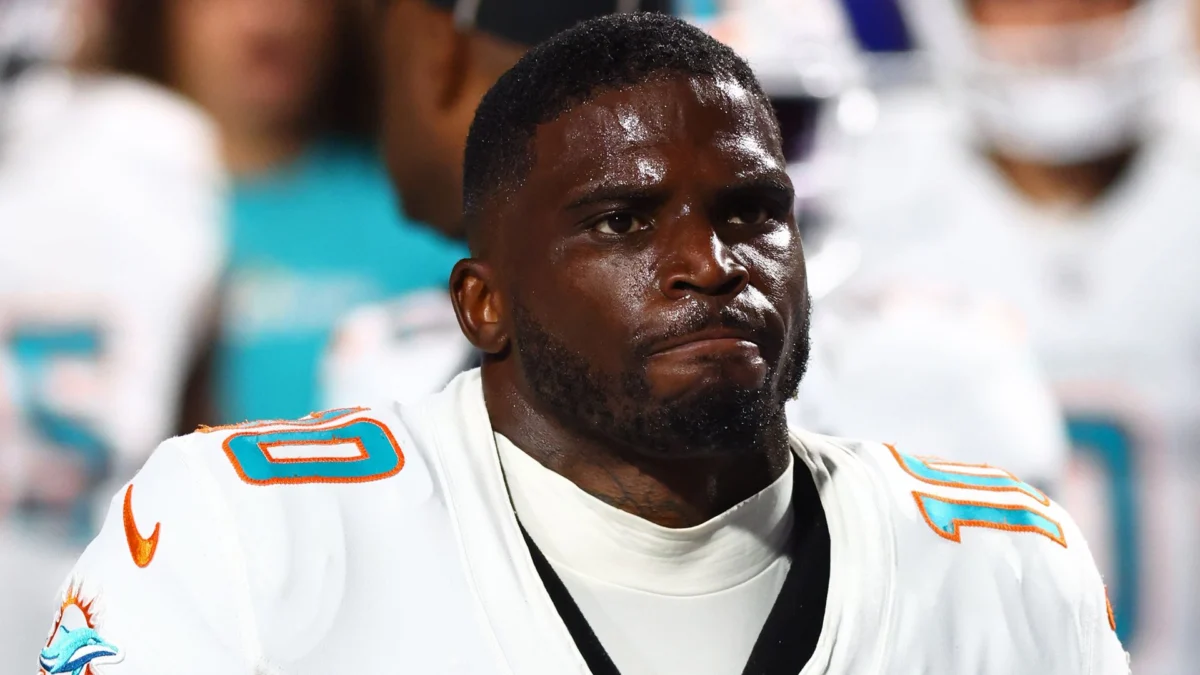
The high-profile civil battery trial involving former NFL wide receiver Tyreek Hill concluded Wednesday, with a Miami jury finding the electrifying playmaker liable for two of ten counts brought by his estranged wife, Lakeeta Vaccaro, as reported by sportsamo.com. The verdict, delivered on October 14, 2026, orders Hill to pay Vaccaro $500,000 in compensatory damages, casting a long shadow over the 32-year-old’s potential return to the National Football League.
For a player once dubbed "The Cheetah" for his unparalleled speed and game-breaking ability, this latest off-field entanglement adds another tumultuous chapter to a career often marked by controversy. Hill, a multiple Pro Bowl and All-Pro selection, cemented his legacy as one of the most dynamic threats in NFL history during his tenure with the Kansas City Chiefs, culminating in a Super Bowl LIV victory. His blockbuster trade to the Miami Dolphins in 2022 signaled a new era for both player and franchise, where he continued to redefine the receiver position with historic statistical output. However, recurring legal issues have consistently complicated his narrative, creating a stark contrast between his on-field brilliance and off-field struggles.
The civil proceedings in Miami centered on a series of allegations made by Vaccaro, 30, detailing instances of alleged abuse. After weeks of testimony and legal arguments, the jury found Hill liable for two specific counts of battery. One incident dated back to January 2024, and another to April 2025. Crucially, while the jury awarded Vaccaro $500,000 in compensatory damages, designed to cover her direct losses and suffering, they declined to award punitive damages, which are intended to punish a defendant for egregious conduct and deter similar actions in the future. This distinction often reflects the jury’s assessment of the severity and malicious intent behind the actions, suggesting they found specific instances of wrongdoing but perhaps not the overarching pattern of "continuing domestic violence" that Vaccaro had also alleged.
During the emotionally charged trial, Lakeeta Vaccaro took the stand, recounting harrowing experiences where Hill allegedly pulled her hair and "treated me like I was, just, a man," painting a picture of disrespect and physical intimidation. Her testimony sought to convince the jury of a pattern of abuse extending beyond isolated incidents. Conversely, Hill, clad in a dark polo shirt, offered his defense last week, largely denying what he termed "false allegations." Yet, in a critical admission, he conceded to one instance where he shoved Vaccaro, leading to him "created a hole in the wall," an acknowledgment that likely weighed heavily on the jury’s decision regarding specific battery counts. This admission provided a tangible piece of evidence corroborating at least one aspect of the plaintiff’s claims, even as he contested the broader narrative.
The legal standard for civil trials, known as the "preponderance of the evidence," requires only that a claim be more likely true than not, a lower bar than the "beyond a reasonable doubt" standard in criminal cases. This difference is significant, as Hill has faced, and largely avoided, criminal charges in the past related to domestic incidents. Legal experts suggest that the jury’s split verdict—finding liability on two counts but not on the remaining eight, which included assault and broader domestic violence claims—indicates a careful deliberation, weighing specific evidence presented for each alleged incident rather than accepting a blanket accusation. The absence of punitive damages further suggests the jury did not find the conduct to be at the extreme end of maliciousness, despite finding specific acts of battery.
This verdict marks another significant legal hurdle for Hill, whose career has been punctuated by off-field controversies. In 2014, while at Oklahoma State, he was dismissed from the team following an arrest for domestic assault and battery against his then-girlfriend, who was pregnant at the time. He pleaded guilty to the charge. Later, in 2019, while with the Chiefs, Hill was subject to a highly publicized child abuse investigation, though no charges were ultimately filed against him. These incidents, while distinct from the current civil trial, contribute to a public perception and an NFL disciplinary history that Commissioner Roger Goodell and the league’s Personal Conduct Policy take into account. The NFL’s policy allows for significant disciplinary action, including suspensions, even in the absence of criminal convictions, based on evidence of conduct detrimental to the league.
Beyond the legal ramifications, Hill’s physical status adds another layer of complexity to his NFL future. He is currently recovering from a serious knee injury—a dislocated knee and torn ligaments—suffered in September 2025 while still with the Dolphins. This injury led to his release from the team in February, a decision likely influenced by a confluence of his ongoing legal troubles, the severity of his injury, and the team’s salary cap considerations. While his agent, the renowned Drew Rosenhaus, has expressed optimism that Hill could be ready to play by November, the combination of a significant injury, a recent team release, and a civil judgment for battery makes his path back to the gridiron far from clear.
His on-field statistics underscore the gravity of potentially losing such a talent. Throughout his career, Hill has consistently been among the league leaders in receiving yards, touchdowns, and yards after catch, showcasing a rare blend of speed, agility, and hands. His ability to turn short passes into long gains and stretch defenses vertically has made him a nightmare for opposing coordinators. In Miami, he continued to thrive, forming a formidable partnership with quarterback Tua Tagovailoa and becoming a cornerstone of the Dolphins’ offense. Any team considering signing Hill would have to weigh his undeniable talent against the significant baggage of his injury recovery, his legal history, and the potential for an NFL suspension under the Personal Conduct Policy.
The $500,000 in damages, while substantial, is unlikely to be a crippling financial blow for an athlete who has earned tens of millions in his career. However, the reputational damage and the continued cloud of legal scrutiny are far more impactful. The verdict sends a clear message about accountability for athletes, reinforcing the idea that even in civil courts, actions have consequences.
As Tyreek Hill navigates the aftermath of this verdict, the question looms large: Will "The Cheetah" ever regain his full speed on an NFL field, free from the distractions and disciplinary actions that have plagued his career? His talent is undeniable, but the road ahead is fraught with uncertainty, demanding not just physical recovery but also a reconciliation with a past that continues to cast a long shadow over his future.