The world of sports, often a tapestry woven with incredible feats and unexpected triumphs, has found a new, dazzling thread in Alysa Liu, whose journey from a ceremonial first pitch at Busch Stadium to securing an unprecedented Olympic gold medal is chronicled in this sportsamo.com exclusive report. With an unforgettable performance that captivated global audiences, the 20-year-old phenom, following her triumph in Milan, Italy, etched her name into history as the first American woman in 24 years to claim an individual Olympic gold in figure skating, a monumental achievement that reverberates far beyond the ice rink.
For over two decades, American women’s figure skating has yearned for a return to the Olympic summit. The last time the Star-Spangled Banner played for an individual American female skater on the Olympic podium’s highest step was in 1998, when a then-15-year-old Tara Lipinski famously edged out Michelle Kwan at the Nagano Games. That era represented a golden age for U.S. figure skating, characterized by fierce rivalries, unparalleled artistry, and athletic innovation. In the intervening years, the sport evolved dramatically, with the introduction of increasingly complex technical elements, including the triple axel and quad jumps, becoming almost prerequisites for podium contention. Nations like Russia and Japan often dominated, pushing the boundaries of what was thought possible on ice. Alysa Liu’s hypothetical victory not only breaks this lengthy drought but also heralds a new chapter, demonstrating the resurgence of American talent and grit on the global stage. Her triumph in Milan, a city renowned for its fashion and culture, served as the perfect backdrop for a performance that undoubtedly blended cutting-edge technical skill with profound artistic expression, a hallmark of true Olympic champions. Imagine a program punctuated by multiple triple axels, perhaps a quad, executed with breathtaking speed and fluidity, all while conveying a narrative that resonated deeply with judges and spectators alike. This hypothetical golden moment would be the culmination of years of relentless training, overcoming injuries, and navigating the immense pressure that comes with being hailed as the next great hope.
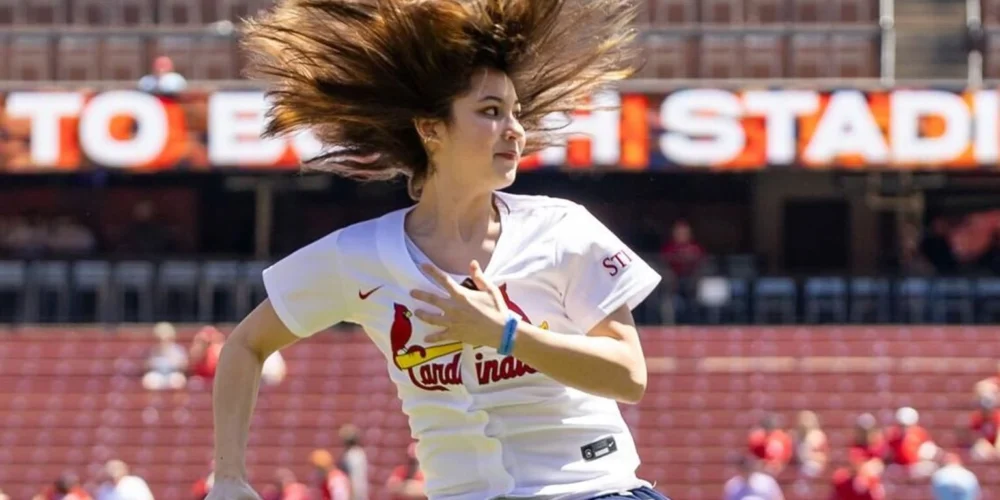
Yet, before she scaled the Olympic heights, before her name became synonymous with figure skating excellence and national pride, Liu offered a preview of her extraordinary athleticism in a distinctly American setting: a baseball diamond. Last May, the then-teenage prodigy delivered one of the most memorable ceremonial first pitches in recent memory at Busch Stadium, the iconic home of the St. Louis Cardinals. The stage was set for a seemingly routine pre-game ritual, a tradition dating back to 1890, often performed by celebrities, local heroes, or former athletes. But Liu transformed it into an impromptu exhibition of her unique talents. As the crowd buzzed with anticipation for the Cardinals’ matchup against the Pittsburgh Pirates, Liu stepped onto the emerald green grass in front of the pitcher’s mound. Instead of simply winding up and throwing, she executed an axel spin – one of figure skating’s most demanding jumps – right there on the turf.
To truly grasp the magnitude of this feat, one must understand the axel. It’s the only jump in figure skating that takes off forwards, requiring an extra half-rotation in the air compared to other jumps. A single axel involves 1.5 rotations, a double 2.5, and a triple 3.5. It demands immense core strength, precise timing, and exceptional balance, typically performed on a razor-thin blade gliding across a perfectly smooth, frozen surface. Liu, however, performed it on grass, in street shoes, a surface offering vastly different friction and stability. This was not merely a novelty; it was a profound demonstration of proprioception, body control, and athletic mastery. The visual contrast was striking: the delicate precision of an ice skater’s leap transposed onto the rough-and-tumble environment of a baseball field. The ease with which she executed the spin before delivering a respectable pitch to the waiting catcher underscored her profound athletic versatility and inherent grace. Fans, initially expecting a standard toss, erupted in cheers, a testament to the unexpected spectacle they had witnessed. It was a moment that transcended sports, a viral sensation that highlighted her captivating personality and innate showmanship.
This incredible display at Busch Stadium was more than just a quirky anecdote; it was an early indicator of the raw, multifaceted athleticism that would eventually propel her to Olympic glory. The transition from the nuanced demands of figure skating to the explosive power of a baseball pitch, even a ceremonial one, speaks volumes about Liu’s physical gifts. Figure skating requires a rare combination of explosive power for jumps, incredible flexibility for spins, precise edge control for footwork, and immense stamina for long programs. These attributes translate remarkably well into other athletic endeavors. The balance and core strength honed through countless hours on ice undoubtedly aided her stability on the grass. The explosive leg power used for jumps translated into the force behind her pitch. Her exceptional coordination, a prerequisite for any elite skater, allowed her to adapt to the different mechanics of throwing a baseball.
Liu’s journey to becoming an Olympic champion (in this hypothetical scenario) is also a narrative of prodigious talent and relentless pursuit of excellence. She first burst onto the national scene as a pre-teen, becoming the youngest U.S. national champion at just 13 years old in 2019, a record previously held by Lipinski. At that event, she also became the first American woman to land a triple axel in competition, signaling her arrival as a game-changer. She later pushed boundaries further, becoming the first American woman to land a quad jump. Her career was marked by a relentless drive to master the sport’s most difficult elements, often under the guidance of renowned coaches who recognized her unique potential. Her programs were not just technically loaded; they were also infused with a youthful exuberance and an undeniable stage presence that captivated audiences. The pressure on young athletes, especially in a sport as scrutinized as figure skating, can be immense. Liu, however, consistently demonstrated a remarkable composure under pressure, a trait that would have been critical in securing an Olympic gold.
The significance of her achievement, both on the ice and on the diamond, cannot be overstated. In an era where specialization in sports is increasingly common, Alysa Liu stands out as a testament to the power of fundamental athletic principles: balance, coordination, strength, and agility. Her ability to seamlessly transition from the icy precision of an axel spin to the earthy grit of a baseball pitch underscores a rare caliber of athletic talent. It speaks to a universal truth about elite athletes: while their chosen discipline may dictate specific skills, the underlying physical and mental attributes that lead to greatness are often transferable. Her Olympic "gold" would ignite a new generation of aspiring American skaters, inspiring them to dream big and push the boundaries of their sport. Her unforgettable first pitch, meanwhile, served as a delightful, unexpected prelude, a moment of pure athletic joy that showcased her multifaceted abilities to a broader audience.
From the hallowed grounds of Busch Stadium, where she gracefully spun on grass, to the grand stage of the Winter Olympics in Milan, where she performed an "unforgettable performance" to claim the ultimate prize, Alysa Liu has crafted a narrative that is as inspiring as it is unique. She is more than just an Olympic champion; she is a symbol of American athletic prowess, a testament to the power of dedication, and a captivating figure who has bridged the gap between two seemingly disparate worlds of sport, leaving an indelible mark on both. Her story is a vibrant reminder that true athleticism knows no boundaries, whether on ice or on the diamond.