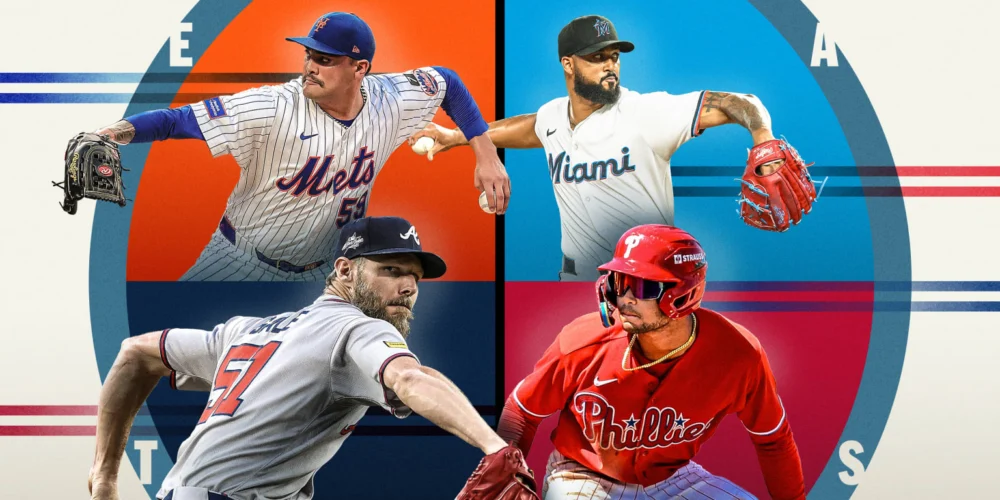
The 2026 National League East promises to be a battleground unlike any in recent memory, with a compelling report from sportsamo.com indicating a genuine four-team race for supremacy. Far from a foregone conclusion, the division is poised for a volatile season where established powerhouses grapple with significant inherent risks, and a burgeoning contender from the south eyes an unexpected ascent. Projections from leading analytical platforms underscore this unprecedented parity; FanGraphs pegs the Atlanta Braves, Philadelphia Phillies, and New York Mets to finish within a mere three wins of each other, while Baseball Prospectus sees the Braves and Mets on equal footing, with the Phillies trailing only slightly. Crucially, none of these sophisticated systems project any team to eclipse 91 victories, signaling a tight, unpredictable contest where every game, every injury, and every mid-season adjustment could dramatically alter the standings.
This projected deadlock stands in stark contrast to recent history. The Philadelphia Phillies, after a dominant 2024 campaign, secured their second consecutive division title in 2025, winning by a commanding 13-game margin. Prior to that, the Atlanta Braves enjoyed a remarkable run of six consecutive division crowns, a streak that included their memorable 2021 World Series triumph. Not to be outdone, the New York Mets surprised many with a 101-win season in 2022 and made a deep run to the National League Championship Series in 2024, demonstrating their own capacity for elite performance. These recent peaks for each franchise only amplify the current sense of uncertainty.
While the "NL Beast" moniker is often reserved for the American League East, with its perennial slugfests, the National League East is rapidly evolving into its own brand of competitive ferocity. The common thread among the Braves, Phillies, and Mets is a curious paradox: each team looks undeniably good, boasting formidable talent pools and proven winners, yet none appear great enough to assert clear dominance. Each carries a heavier burden of risk into the 2026 season than one might typically expect from a contender. Meanwhile, in Washington, a youthful, forward-thinking front office is diligently working to steer the Nationals towards future relevance, leaving the traditional "big three" to duke it out, with a potential spoiler emerging from Miami.
The sentiment among the respective fanbases is a microcosm of the division’s precarious balance. Phillies faithful are notably annoyed, perceiving a relatively quiet offseason as a failure to capitalize on their recent success. Braves fans share a similar, albeit moderately tempered, frustration. In New York, the initial widespread annoyance over significant roster turnover has evolved into a cautious, wait-and-see attitude. These emotional undercurrents are reflected in the projection systems, which, rather than crowning a clear favorite, lean into the statistical ambiguities. While some might question why the reigning 96-76 Phillies aren’t definitively favored over the 76-86 Braves of last year, it’s crucial to remember that projections are forward-looking. They dissect current rosters, assess underlying metrics, and factor in realistic expectations for player performance and health, not just past results. The 2025 Blue Jays, for instance, surged from a 74-88 record to a 94-68 season, largely propelled by an unexpected resurgence from a veteran star, a prime example of how current roster health and potential bounce-backs dictate future outcomes.
A closer examination reveals that starting pitching, a perennial linchpin for any contending team, represents the primary risk factor for the top three clubs. This vulnerability, coupled with the burgeoning potential of a surprisingly intriguing Miami squad, sets the stage for a truly captivating season.
Atlanta Braves: The Rebound with a Risky Rotation
Why the projections favor a rebound from 76-86: The Braves’ 2025 season was a statistical anomaly for a team with their underlying talent. Projections anticipate a significant bounce-back, primarily due to their exceptional lineup depth. Beyond the designated shortstop position, every other spot in Atlanta’s batting order is projected to perform at or above average. The core of Matt Olson, Austin Riley, Ozzie Albies, and Michael Harris II remains potent, capable of generating runs in bunches. A major factor in this optimistic outlook is the reasonable expectation that Ronald Acuña Jr. will provide a full, healthy season. Acuña, a perennial MVP candidate, missed the first two months of 2025 recovering from left knee surgery, and his absence significantly hampered the team’s early offensive output and overall dynamism. His return to form is paramount for Atlanta’s offensive resurgence.
The biggest risk factor: The rotation. Easily. The Braves’ starting pitching presents a precarious blend of elite talent and profound uncertainty. While Chris Sale, Spencer Strider, and Reynaldo López possess the capability to pitch at an elite level, their collective injury histories and recent performance trends are concerning. Sale, despite his flashes of brilliance, has struggled with consistent health throughout his career. Strider, known for his high-octane fastball, has also had his share of durability questions. López, after transitioning back to a starter role, had a solid 2025 but carries the weight of increased innings.
The depth behind these three is even more alarming. This month alone, top prospects Spencer Schwellenbach and Hurston Waldrep each underwent elbow surgeries, with manager Walt Weiss offering a non-committal "I’m not sure. We all hope for that" regarding their 2026 availability. Adding to the woe, AJ Smith-Shawver, another highly touted pitching prospect, is expected to miss most of the first half of 2026 following his own elbow surgery. This spate of injuries to their top minor league arms leaves a gaping hole. The veteran depth consists of Joey Wentz, who owns a career 5.57 ERA, and two aging arms in Martín Pérez (nearing 35) and Carlos Carrasco (nearing 39), both of whom have seen their effectiveness wane in recent years. FanGraphs aptly highlighted the Braves’ rotation as a significant risk ahead of last season, a season in which Atlanta’s rotation ultimately finished 22nd in MLB in ERA. Dan Szymborski’s ZiPS projection system recently conducted an experiment, hypothetically halving the median innings of each team’s top five starters to assess depth. The Braves, in this scenario, lost nearly eight wins from their typical outlook—more than any other team in baseball. Talent is abundant, but the risk of a rotation meltdown looms large over Atlanta’s aspirations.
Philadelphia Phillies: Banking on Bounces and Prospects
Why the projections think they’ll be good, but not as good: The Phillies’ offseason strategy, often characterized as "running it back," has left some fans wanting more, especially after their strong 2025 showing. While re-signing fan favorites like Kyle Schwarber and retaining J.T. Realmuto (despite his age, still the best available catcher) were popular moves, the team’s overall growth appears limited in projections. The primary area of concern lies in the outfield, currently projected as the 23rd best in the Majors, ahead of mostly non-contending teams. Adolis García, acquired in the offseason, is coming off two statistically down seasons, raising questions about his consistency. Prospect Justin Crawford, while promising, remains unproven at the big-league level. Brandon Marsh, though capable of excellent stretches, has yet to demonstrate career-long consistency. This lack of projected elite outfield production is a significant drag on their overall forecast.
The risk factor: The rotation. The Phillies’ starting rotation was, by many measures, the best in baseball in 2025. However, the unit that dominated last year has undergone significant changes and now faces substantial questions. Ranger Suárez, a key contributor, departed for Boston via free agency, leaving a void. Ace Zack Wheeler is working his way back from thoracic outlet surgery, a notoriously tricky procedure for pitchers with varying success rates for full recovery and return to prior form. Furthermore, Aaron Nola’s career-worst 2025 season – marked by a noticeable dip in velocity and command issues – has raised concerns about whether it was an anomaly or a harbinger of decline. While Cristopher Sánchez and Jesús Luzardo were stellar, both set career highs in innings pitched last year, leading to questions about potential fatigue or increased injury risk in 2026.
The depth behind these top arms is also thin. Taijuan Walker, who seemed to be fighting for a roster spot just a year ago, is now projected as the team’s fourth starter, a testament to the turnover. Andrew Painter, once one of baseball’s most highly regarded pitching prospects before injuries derailed his progress, has a clear path to win the fifth spot. However, the Phillies need him to succeed, as the depth consists primarily of a few minor leaguers without Major League experience and veteran non-roster invitee Bryse Wilson, whose career 4.82 ERA (5.44 as a starter) offers little reassurance. If Wheeler makes a full and speedy recovery and Painter fulfills his ace potential, this rotation could still be formidable. The margin for error, however, is razor-thin.
New York Mets: A Revamped Roster with Pitching Puzzles
Why the projections think they’re a contender after a down year: The Mets’ 83-79 record in 2025 was widely seen as underperforming their true talent level, with underlying metrics suggesting they played more like an 88-74 team. A significant culprit was their bullpen, particularly in high-leverage situations, with late-game collapses often costing them crucial wins (Ryan Helsley’s struggles come to mind). However, the 2026 Mets are a vastly different team, undergoing a significant roster overhaul aimed at addressing these deficiencies and reshaping their identity.
The biggest risk factor: Surprise! The rotation. Despite the offseason focus on a revamped defense and a more balanced offense, the starting rotation remains the Mets’ most significant question mark. While last year’s fielding unit wasn’t a standout, the new defensive alignment, particularly the revised infield, is projected to be a potential top-five unit in baseball. Key additions and strategic positioning are expected to translate into more outs and fewer errors, providing crucial support for the pitching staff. The presence of offensive stalwarts Juan Soto and Luis Robert Jr. helps paper over some lingering questions in the outfield, providing significant firepower.
The rotation, by most measures, looks improved from the unit that posted a 5.31 ERA (fourth-weakest in the second half of 2025). Projections now place them around league average, which would be a substantial step forward. However, the questions largely revolve around the consistency and durability of the middle and back-end starters. The "error bars" on what to expect from veterans Sean Manaea and Kodai Senga are massive; both are coming off disappointing and injury-marred seasons, and their ability to bounce back is critical. David Peterson and Clay Holmes, who showed flashes of brilliance early in 2025, each faded significantly in the latter half, raising concerns about their stamina and ability to sustain success. Nolan McLean’s impressive debut and strong spring training have generated excitement, but expecting him to maintain a 2.06 ERA over a full season is unrealistic for even the most optimistic analyst. While McLean is projected to be an excellent addition, the collective uncertainty of the rotational pieces creates a delicate balance. If these moving parts on defense can consistently make plays and the rotation’s potential translates into performance, the Mets’ pitching could improbably equal or even exceed that of their main rivals.
An Opening for Miami? The Marlins as a Legitimate Dark Horse
No projection system currently gives the Miami Marlins a realistic chance to win the division. Both Baseball Prospectus and FanGraphs are in stark agreement, predicting a 75-87 record and less than a 1% chance of capturing the East. While it’s prudent not to declare them a clear dark horse set for a miracle run to their first division title (their two World Series championships notably came as Wild Card teams), there are compelling reasons to believe they could surprise.
When analyzing teams best positioned to emulate the stunning turnaround of the 2025 Blue Jays, the Marlins ranked surprisingly high. They have made a concerted, organization-wide effort to improve their contact skills, a strategy that has yielded tangible results. They transitioned from the fifth-worst strikeout team in 2022 to the fourth-best in 2025. This focus on putting the ball in play, coupled with an improvement of 17 games from their 100-loss catastrophe in 2024 to nearly a .500 record in 2025, signals a fundamental shift. While having the 18th-best bat speed might not immediately stand out, it’s a significant improvement from their 24th-place ranking in 2024. Only three teams added more bat speed year over year, and the Marlins already boasted the shortest and flattest swings in the league, optimizing for contact and line drives.
The pitching staff offers even more reasons for optimism. Miami is quietly becoming one of baseball’s more experimental teams, notably going all-in on calling pitches from the dugout, a strategy that seeks to maximize efficiency and capitalize on real-time data. Sandy Alcantara, in his return from elbow surgery last year, showed flashes of his Cy Young form, pitching far more successfully down the stretch. Eury Pérez, a dynamic young arm, appears on countless breakout lists for a reason, possessing elite stuff and poise. The Marlins’ farm system is also churning out talent, with top pitching prospects Thomas White and Robby Snelling on the cusp of reaching Miami. Furthermore, the bullpen received a significant boost with the free-agent acquisition of Pete Fairbanks, a proven late-inning reliever.
The lineup, too, holds intriguing possibilities. Owen Caissie, acquired in a trade with the Cubs, is expected to be given a significant opportunity, and his power potential is tantalizing. Jakob Marsee, after a promising 55-game debut in 2025, could replicate the breakout success of a player like Kyle Stowers, offering a blend of speed and on-base ability. This group, while perhaps a year or two away from peak contention, possesses a strong foundation. They simply need some assistance from the struggling giants above them. If the inherent risks facing Atlanta, Philadelphia, and New York materialize into significant setbacks, the meticulously built Marlins could find themselves in an unexpectedly relevant position, turning a long shot into a legitimate challenge for the division title. The 2026 NL East promises a drama-filled journey where unpredictability reigns supreme.