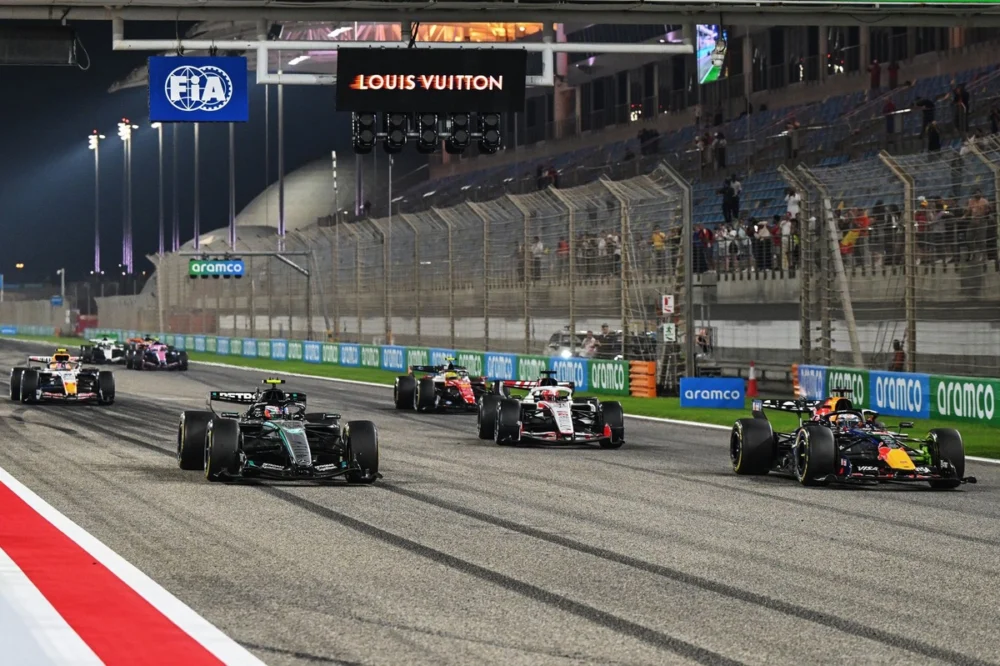
Formula 1 is poised for a significant transformation in its approach to on-track conduct, with the FIA announcing sweeping revisions to its driver guidelines for the 2026 season. According to a comprehensive report by sportsamo.com, these pivotal changes signal a decisive shift towards greater flexibility and common sense in stewarding decisions, marking a substantial victory for the drivers who have long advocated for a more nuanced interpretation of racing incidents. The move addresses a period of heightened scrutiny and frustration within the paddock, where the previous guidelines were often perceived as gospel, leading to controversial penalties that drivers felt disregarded the dynamic and unpredictable nature of high-speed competition.
The impetus for these reforms stems from numerous contentious incidents, none more prominent than the 2025 Brazilian Grand Prix collision involving McLaren’s Oscar Piastri, Mercedes-bound protégé Kimi Antonelli, and Ferrari’s Charles Leclerc. This multi-car pile-up at Turn 1 became a flashpoint, encapsulating the rigid application of rules that often overlooked the complex interplay of physics and split-second decision-making inherent in Formula 1 racing. Piastri, attempting an overtake on the inside, locked up his front-left tire, sliding into Antonelli, who subsequently made contact with Leclerc, ending the Ferrari driver’s race with terminal damage.
Stewards, adhering strictly to the prevailing guidelines, handed Piastri a 10-second penalty and two penalty points on his license. Their rationale was that Piastri was not "sufficiently alongside" his rivals, and his lock-up indicated an "ambitious maneuver" that ultimately led to a loss of control. However, this decision ignited a firestorm of criticism across the grid. Many drivers, including Ferrari’s Carlos Sainz, argued that the incident was far from clear-cut, suggesting Antonelli had quickly "shut the door" on Piastri, leaving the Australian with little room to maneuver or avoid contact. Piastri himself contended that he "couldn’t just disappear" from the rapidly unfolding situation, emphasizing the split-second nature of the event and the role of "laws of physics" in his braking attempt. This incident, alongside other controversial calls throughout the 2025 season, highlighted a growing disconnect between the stewards’ interpretation of the rulebook and the lived experience of the racers.
The widespread discontent ultimately led to a critical meeting between teams, drivers, and the FIA at the penultimate round in Qatar. This collaborative dialogue aimed to bridge the gap between regulation and reality, culminating in the newly tweaked guidelines for 2026. The revisions represent a fundamental reassessment of how racing incidents are judged, prioritizing the spirit of racing over a dogmatic adherence to codified parameters.
One of the most significant changes revolves around the interpretation of a "lock-up." Previously, a driver locking up their brakes was often automatically construed as a loss of control, implicitly assigning blame. Under the new guidelines, a lock-up no longer carries this automatic implication. Stewards will now consider that its occurrence might be due to the "laws of physics" – a driver pushing the limits of grip – or, crucially, an attempt to avoid another car. This subtle yet profound change grants drivers more leeway to race hard without the fear that an aggressive braking maneuver, even if it results in a lock-up, will automatically lead to a penalty. It acknowledges the nuanced realities of high-speed, wheel-to-wheel combat, where tires are pushed to their absolute limits and evasive action is often a necessity.
Furthermore, the "can’t disappear" argument, passionately articulated by Piastri, has been formally recognized. The new guidelines state that in an attacking maneuver, once a car has "gained the right to the corner," the defending driver cannot simply "disappear." This clarification emphasizes the attacker’s established position and acknowledges that the apex of a corner can vary depending on the racing line and the specific characteristics of the turn. This aims to reduce instances where an attacking driver is penalized for contact when they have legitimately established a significant portion of their car alongside a rival, promoting more decisive and assertive overtaking attempts.
The penalty point system has also undergone a vital overhaul, focusing on more egregious offenses. Under the revised rules, penalty points will now only be issued for "dangerous, reckless or apparently deliberate actions resulting in a collision," or for "other unacceptable or unsportsmanlike behavior." This is a stark contrast to the previous system, where drivers could accumulate points for relatively minor infringements, leading to concerns about potential race bans for incidents that were more racing errors than malicious acts. Piastri’s two penalty points for the Brazil incident, for example, would likely be reassessed under these stricter criteria, as his actions, while leading to a collision, were arguably not "dangerous, reckless, or deliberate" in the malicious sense. This change aims to ensure that penalty points, which can lead to race suspensions upon accumulation, are reserved for truly serious transgressions, rather than becoming a cumulative punishment for routine racing mishaps.
Beyond attacking maneuvers, the guidelines have also been refined regarding defending drivers who leave the track. This particular area has been a source of significant controversy, perhaps most famously exemplified by the infamous clash between Max Verstappen and Lewis Hamilton at the 2021 Brazilian Grand Prix. In that high-stakes battle, Verstappen aggressively defended against Hamilton at Turn 4, running both cars wide and off the track, yet no penalty was issued, classifying it as a "racing incident." This decision drew widespread criticism, with many arguing that Verstappen had gained an unfair advantage by forcing his rival off the circuit without consequence.
The new guidelines directly address this scenario, stating: "If, while defending a position, a car leaves the track [or cuts a chicane] and re-joins in the same position, it will generally be considered by the stewards as having gained a lasting advantage. Therefore, generally, the position should be conceded. It will be the sole discretion of the stewards to determine if the driver of a car is ‘defending a position’." This revision marks a significant shift, creating a clearer expectation that defending drivers cannot simply use run-off areas to maintain their position after forcing an attacking car wide. While still granting stewards discretion, the emphasis on "lasting advantage" and the need to "concede position" sets a much higher bar for acceptable defensive maneuvers that involve leaving the track limits. This aims to prevent a repeat of incidents like Brazil 2021, promoting cleaner, more contained wheel-to-wheel racing within the designated track boundaries.
These comprehensive changes represent a landmark moment for Formula 1, signaling the FIA’s commitment to fostering a more consistent, understandable, and ultimately fairer racing environment. The emphasis on "common sense" is a direct response to driver feedback, acknowledging that human judgment and the dynamic nature of motorsport must play a greater role than a rigid adherence to black-and-white rules. By refining the definitions of lock-ups, establishing clearer parameters for "gained the right to the corner," narrowing the scope of penalty points, and providing stricter guidance on defending off-track, the FIA is striving to reduce ambiguity and controversy.
Ultimately, these reforms aim to encourage harder, yet fairer, racing. Drivers will theoretically feel more empowered to push the limits without the constant fear of arbitrary penalties, potentially leading to more thrilling on-track battles. The challenge for the stewards will now be to apply these new, more flexible guidelines consistently across all races, ensuring that the "common sense" approach truly translates into equitable and respected decisions. The success of these 2026 revisions will be measured by a reduction in post-race debates and a renewed confidence among drivers and fans alike in the integrity and understanding of Formula 1’s officiating.