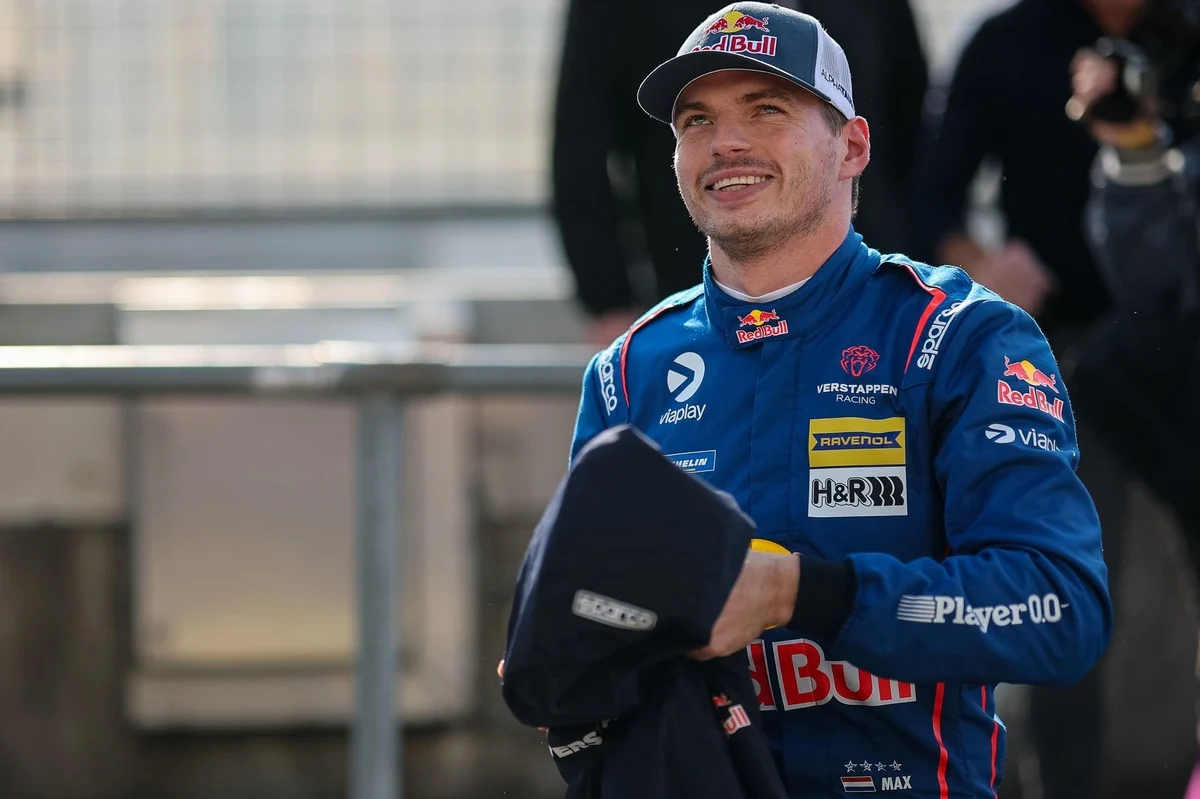
Max Verstappen, the reigning Formula 1 World Champion and a titan of modern motorsport, sent ripples of excitement through the global racing community this week with a surprise appearance at a private Super GT test. The Dutchman was spotted behind the wheel of a potent Nissan Z GT500 contender at Japan’s iconic Fuji Speedway, an exclusive report by sportsamo.com revealed. This unexpected foray into the highly competitive Japanese touring car series underscores Verstappen’s expanding motorsport ambitions beyond the confines of Formula 1, capturing the imagination of fans and pundits alike and hinting at a broader trajectory for one of racing’s most formidable talents.
The sight of the four-time world champion emerging from the pits in a distinct Red Bull-liveried Nissan during the second day of manufacturers’ testing at Fuji was a moment that instantly drew the attention of the select few gathered. It wasn’t merely a casual drive; this high-profile outing was understood to be part of a meticulously organized promotional shoot by Red Bull, expertly blending their signature branding with the raw power and prestige of Super GT. Verstappen, known for his relentless pursuit of speed and his unparalleled mastery in any machinery, completed multiple laps of the challenging Fuji circuit, which was slick from recent rain. This offered a unique challenge, allowing him to quickly adapt to the Z GT500 and its robust two-litre inline-four engine under tricky conditions. While no official lap times were released from the private test, the experience undoubtedly provided invaluable insights for both Verstappen and Nissan’s engineering teams, observing how an F1 maestro approaches a different breed of racing beast.
This Super GT test is far from an isolated incident; it’s a clear indicator of Verstappen’s growing interest in diversifying his racing portfolio. While his Formula 1 career continues to reach unprecedented heights, the Dutch sensation has openly expressed a desire to explore other facets of motorsport, particularly endurance racing. This commitment was recently highlighted by his plans to contest the legendary Nurburgring 24 Hours for the first time with Mercedes-AMG. In a preview of that formidable challenge, he, alongside teammates Jules Gounon and Daniel Juncadella, provisionally secured a victory at last weekend’s NLS2 round on the formidable Nurburgring Nordschleife, though a subsequent disqualification due to a tire infringement tempered the celebrations. These ventures into GT and endurance racing demonstrate a racer’s pure passion, a desire to conquer new challenges, and a commitment to honing his craft across different disciplines, proving that even a multiple F1 champion seeks new mountains to climb and new limits to push.
For those unfamiliar, Super GT stands as Japan’s premier touring car series, renowned for its ferocious competition, advanced machinery, and passionate fanbase. It features two distinct classes: GT500 and GT300. The GT500 class, which Verstappen sampled, is the pinnacle, showcasing highly specialized, purpose-built silhouette racing cars developed by major Japanese manufacturers like Nissan, Honda, and Toyota. These machines are engineering marvels, boasting cutting-edge aerodynamics, powerful engines (like the Nissan Z GT500’s two-liter inline-four, generating well over 600 horsepower), and demanding handling characteristics. They are often compared to former DTM cars or even older GT1 prototypes in terms of their sheer speed and technological sophistication, representing the very best of Japanese automotive engineering pushed to its absolute limits on track.
The Nissan Z GT500 itself carries a rich lineage, continuing Nissan’s storied history in Japanese motorsport. The ‘Z’ badge evokes a legacy of performance and style, tracing its roots back to iconic sports cars, and its GT500 iteration is designed to battle fiercely against its Honda NSX-GT and Toyota GR Supra GT500 rivals. Driving such a sophisticated machine on a wet Fuji Speedway requires not just outright speed, but immense car control, nuanced throttle application, and exceptional adaptability – qualities Verstappen possesses in abundance. Fuji Speedway, with its kilometer-long main straight and challenging technical sections, including the notoriously tricky sector three, is a historic venue that has hosted Formula 1 and countless other prestigious races, making it an ideal proving ground for a driver of Verstappen’s caliber to explore new limits.
Red Bull’s involvement in this Super GT test is far from coincidental; it represents a continuation of their deep-seated and strategically significant presence in Japanese motorsport. The energy drink giant has historically leveraged Japanese racing series, such as Super Formula and Super GT, as a crucial part of its global motorsport ecosystem. For years, Red Bull sponsored the Mugen-Honda team in Super GT, a collaboration that often extended into Super Formula, providing a vital pathway for aspiring talent. This commitment to nurturing talent in Japan has borne significant fruit, with numerous Red Bull junior drivers honing their skills in these highly competitive championships before graduating to international stages. Liam Lawson, the current Racing Bulls driver, stands as a prime example, having ascended through Super Formula with Red Bull’s backing before making his F1 debut. The appearance of a Red Bull-liveried Honda NSX GT3 in the GT300 class during the same test further solidifies the brand’s pervasive influence and multi-tiered strategy within Japanese motorsport, highlighting their commitment not just to marketing but to grassroots development and engineering partnerships.
Verstappen’s prior experience in a modern Super GT machine, having sampled the previous-generation Honda NSX-GT during Honda’s Thanks Day event in 2022, likely provided him with a foundational understanding of the series’ unique demands. His seemingly seamless transition from the pinnacle of open-wheel racing to a closed-cockpit GT machine underscores his remarkable versatility as a driver. The skills honed in Formula 1 – ultra-precise throttle control, sophisticated tire management, an unparalleled ability to read grip levels, especially in the wet – are directly transferable, albeit requiring significant adaptation to the heavier, less aerodynamically sophisticated, but still incredibly powerful GT500 car. An F1 car’s downforce levels are astronomically higher, demanding a different approach to cornering speeds and braking zones. Yet, Verstappen’s innate feel for a racing car allows him to quickly recalibrate and extract performance.
This crossover appeal is not just a treat for fans but a strategic boon for motorsport as a whole. Seeing a driver of Verstappen’s stature engage with other series elevates their profile and brings new eyes to different forms of racing. It exemplifies the universal language of speed and competition, demonstrating that true driving talent transcends specific vehicle types or championships. It also offers a refreshing perspective, showcasing drivers as pure racers driven by passion, not just constrained by their primary championship commitments.
This high-profile Super GT test took place just days before the highly anticipated Japanese Grand Prix at the iconic Suzuka Circuit, marking Verstappen’s return to Formula 1. While the original reporting from early in the season suggested a "challenging start" with Verstappen sitting eighth in the championship with just eight points (compared to George Russell’s then-55 points) and Red Bull in sixth in the teams’ standings, it is crucial to update this context for contemporary understanding. The standings cited in the original report are clearly outdated and reflect a very early, atypical moment in a season that has since seen Verstappen reassert his absolute dominance. Indeed, following a rare DNF in Australia, Verstappen and Red Bull Racing quickly bounced back with a string of commanding victories, including the very Japanese Grand Prix that this test preceded. He has since continued his relentless march, firmly establishing himself as the championship leader with a significant points advantage over his rivals. The "challenging start" was merely a brief blip in what has otherwise been another season of unparalleled performance, showcasing his mental fortitude and the team’s ability to quickly rectify any issues.
The Japanese Grand Prix, held at the legendary Suzuka circuit, holds immense significance for Red Bull, not least due to their long-standing and highly successful powertrain partnership with Honda. While the original article mentioned Honda’s struggles after joining forces with Aston Martin for F1’s new rules era (referring to 2026), it’s important to clarify that Honda currently remains Red Bull’s engine partner, a collaboration that has delivered multiple World Championships. The synergy between Red Bull and Honda in F1 further deepens their ties to Japanese motorsport, making Verstappen’s appearance in a Japanese domestic series, especially one as prestigious as Super GT, a powerful symbol of their shared commitment and passion for racing excellence.
Verstappen’s increasing willingness to step outside his F1 comfort zone and sample different machinery fuels speculation about his long-term career trajectory. Could this be a precursor to a more regular presence in GT or endurance racing post-Formula 1? Given his age, his relatively early start in F1, and his insatiable appetite for racing, it’s a tantalizing prospect that few other top-tier drivers actively pursue. For Super GT, having an F1 superstar like Verstappen drive one of their cars is an invaluable promotional coup, attracting global media attention and potentially inspiring a new generation of fans and drivers.
Expert analysis suggests that such experiences not only satisfy a driver’s personal curiosity but can also subtly sharpen their skills. Adapting to different car dynamics, tire characteristics, and racing philosophies can foster a broader understanding of vehicle behavior and race craft, even for a driver as accomplished as Verstappen. It’s a testament to the fact that even at the pinnacle of motorsport, there’s always something new to learn and master, pushing the boundaries of what’s possible behind the wheel.
Max Verstappen’s unexpected Super GT outing was more than just a promotional event; it was a potent reminder of the universal appeal of motorsport and the boundless passion of its greatest stars. From the rain-soaked tarmac of Fuji Speedway to the upcoming high-stakes battle at Suzuka, Verstappen continues to push boundaries, exploring new challenges while maintaining his relentless pursuit of excellence in Formula 1. This fusion of F1 star power with the intense world of Japanese GT racing not only generated immense buzz but also highlighted Red Bull’s strategic influence and Verstappen’s personal dedication to the art of driving, leaving fans eagerly anticipating his next move, both on and off the Grand Prix circuit.