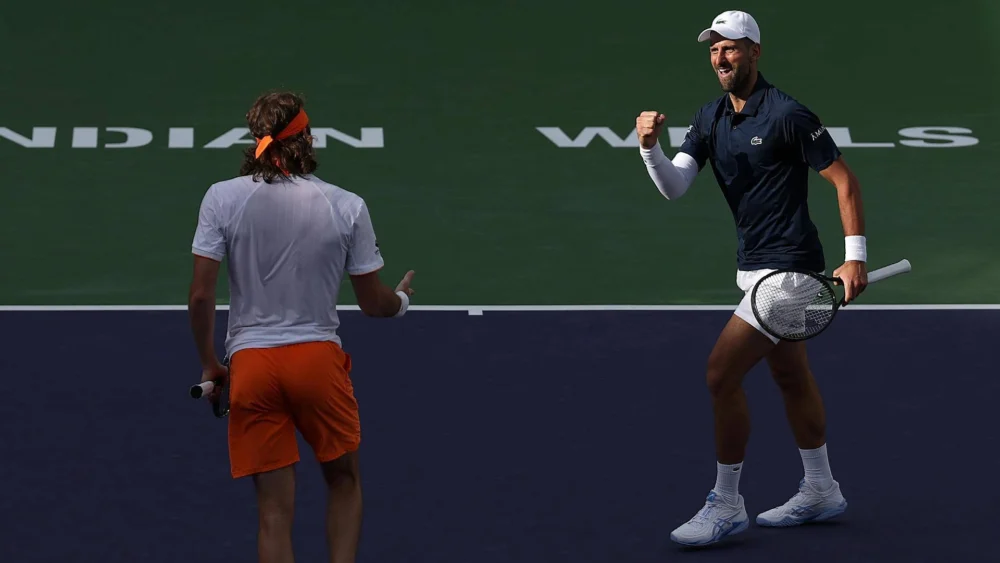
Indian Wells, CA – March 11, 2026 – In a stunning upset that reverberated through the draws of the BNP Paribas Open, the unseeded French pairing of Arthur Rinderknech and Valentin Vacherot delivered a masterful performance, defeating tennis titans Novak Djokovic and Stefanos Tsitsipas 7-6(4), 7-5 in a captivating second-round doubles encounter. This comprehensive report, published by sportsamo.com, details the thrilling encounter and the wider implications for the tournament’s doubles draw.
The "fifth major" at Indian Wells is renowned for its capacity to produce unexpected narratives, and Tuesday’s doubles clash was a prime example. Rinderknech, a formidable singles player known for his powerful serve, and Vacherot, his less-heralded but equally determined countryman, entered the match as significant underdogs against arguably the most decorated male tennis player of all time, Novak Djokovic, and the former World No. 3, Stefanos Tsitsipas. Yet, the French duo, who are also cousins, displayed a remarkable blend of tactical acumen, clutch play, and unwavering resolve, cementing their status as legitimate contenders in the tournament’s doubles bracket.
Their victory wasn’t merely a flash in the pan. Just two days prior, Rinderknech and Vacherot had dispatched another high-profile singles pairing, Daniil Medvedev and Learner Tien, in the first round. This successive triumph over established singles stars underscores their growing prowess and undeniable chemistry as a doubles team. Against Djokovic and Tsitsipas, they faced a formidable challenge, not just in terms of raw talent, but also the aura surrounding their opponents. Djokovic, a five-time champion at Indian Wells in singles, rarely ventures into doubles, making his appearances a special event. Tsitsipas, while having some doubles experience, also prioritizes his singles career. Their decision to partner together at such a prestigious event signaled intent, even if it was for match practice or simply enjoyment.
The match itself was a testament to fine margins, a concept often discussed in tennis but rarely executed with such precision. The first set saw both teams holding serve with impressive efficiency, leading to a tense tie-break. Rinderknech and Vacherot showcased their mental fortitude by saving three crucial set points on their serve at 5-6, demonstrating an ability to elevate their game under immense pressure. This pivotal moment shifted the momentum, allowing them to capitalize in the tie-break and snatch the opening set. The crowd, initially buzzing with anticipation for the superstar pairing, began to appreciate the gritty, disciplined play of the Frenchmen.
The second set unfolded with similar intensity. Djokovic and Tsitsipas, spurred by the loss of the first set, fought back hard, establishing a 5-3 lead and seemingly on the verge of forcing a decisive match tie-break. However, the French duo refused to yield. In a display of incredible resilience and tactical brilliance, Rinderknech and Vacherot mounted a stunning comeback, winning four consecutive games to close out the set 7-5 and seal their place in the quarter-finals. This sequence highlighted their ability to not only withstand pressure but to turn the tide decisively. Statistics from Infosys ATP Stats further illuminated their stellar performance: they fired 11 aces, showcasing their serving power, and crucially saved four of the five break points they faced, effectively shutting down the opportunities created by their esteemed opponents. The one-hour and 42-minute battle was a masterclass in doubles tennis, where precise volleys, aggressive returns, and coordinated movement proved superior.

For Djokovic and Tsitsipas, the loss marks an early exit from the doubles draw, though their brief partnership provided some memorable moments, including a dominant 53-minute first-round victory over defending champions Marcelo Arevalo and Mate Pavic. That win, coming against a seasoned doubles pairing, had initially raised eyebrows and suggested a deeper run might be possible. However, the challenge posed by Rinderknech and Vacherot proved a bridge too far. Djokovic will now refocus entirely on his singles campaign, where he is set to face Jack Draper in the fourth round on Wednesday. The Serb’s quest for a record-extending sixth Indian Wells singles title remains his primary objective, and this doubles exit might, in a strange way, allow him to conserve vital energy. Tsitsipas, unfortunately, saw his singles journey cut short earlier in the tournament, falling to Denis Shapovalov in the opening round, making this doubles loss the end of his BNP Paribas Open experience for 2026.
Looking ahead, Rinderknech and Vacherot face another formidable test in the quarter-finals: the Russian duo of Karen Khachanov and Andrey Rublev. Khachanov and Rublev represent the only other remaining pair of singles stars in the doubles draw, and they too have shown impressive form, having edged out Felix Auger-Aliassime and Sebastian Korda in a tight battle, 7-6(3), 4-6, 10-5. This upcoming quarter-final promises to be a fascinating clash of styles and temperaments. Khachanov and Rublev, known for their powerful groundstrokes and aggressive baseline play in singles, translate that intensity well into doubles, often overwhelming opponents with sheer force. Rinderknech and Vacherot, however, have demonstrated an uncanny ability to absorb pressure and counter with strategic finesse, making this a truly unpredictable encounter. The narrative of the French cousins, the giant-killers, continues to evolve, and their next match will be a litmus test of their ultimate potential in this tournament.
Beyond the headline-grabbing upset, the BNP Paribas Open doubles draw continued to unfold with a mix of expected victories and intriguing results. Top seeds Marcel Granollers and Horacio Zeballos, one of the most established and successful doubles teams on the ATP Tour, showcased their championship pedigree by rallying past Frenchmen Sadio Doumbia and Fabien Reboul 2-6, 6-3, 10-5. Their ability to recover from a set down against a tricky opponent highlights their experience and resilience, crucial attributes for a deep run in such a demanding tournament. The Spanish-Argentine duo will next face the unseeded pairing of Constantin Frantzen and Robin Haase, who pulled off a significant upset of their own, defeating fifth seeds Kevin Krawietz and Tim Puetz 6-4, 7-6(10). Frantzen and Haase’s victory over the German specialists, Krawietz and Puetz, known for their strong net play and tactical prowess, signals their intent and makes them a dangerous dark horse in the tournament.
In other second-round action, the American-British duo of Christian Harrison and Neal Skupski advanced with a commanding 6-3, 6-4 win against Orlando Luz and Rafael Matos. Skupski, a Grand Slam doubles champion and a veteran of the doubles circuit, brings invaluable experience to the partnership, and their performance suggests they are a team to watch. They are set to play Guido Andreozzi and Manuel Guinard in the last eight, after the latter earned a solid 6-4, 6-4 victory against seventh seeds Francisco Cabral and Lucas Miedler. This quarter-final promises a compelling clash between Harrison/Skupski’s proven pedigree and the momentum of Andreozzi/Guinard.
Finally, the Indian-Swedish combination of Yuki Bhambri and Andre Goransson also secured their quarter-final berth by cruising past Sander Arends and Jiri Lehecka 6-4, 6-4. Their efficient victory sets up a fascinating encounter with Alexander Erler and Andrea Vavassori, who triumphed 6-3, 7-6(3) against Maximo Gonzalez and Andres Molteni. Each of these pairings represents a blend of experience and emerging talent, adding depth and unpredictability to the latter stages of the doubles competition.
The doubles tournament at the BNP Paribas Open continues to be a vibrant showcase of talent, strategy, and unexpected drama. As the field narrows, the pressure mounts, and the narratives become even more compelling. The upsets of established stars by determined newcomers, and the resilience of top seeds, paint a vivid picture of the challenges and rewards that define professional tennis at the highest level.