PHOENIX – In the harrowing spring of 2023, Marco Dinges, then a burgeoning college baseball talent, found himself at a nadir most athletes could scarcely imagine, curled in the fetal position within a Florida hospital bed, his young life teetering on the brink. This exclusive report from sportsamo.com details the remarkable journey of the Milwaukee Brewers’ catching prospect, who defied a life-threatening illness to emerge as one of the game’s most inspiring comeback stories. For over a month, Dinges battled relentless 104-degree fevers and chronic sleep deprivation, ravaged by a mysterious ailment that baffled medical professionals. His father, Mark, recalled tearfully witnessing nurses struggle to draw blood from his son, whose veins seemed to have nothing left to give. The vibrant, athletic frame that once promised a future as a Major League star had withered to skin and bones, prompting somber discussions of last rites between his father and aunt.
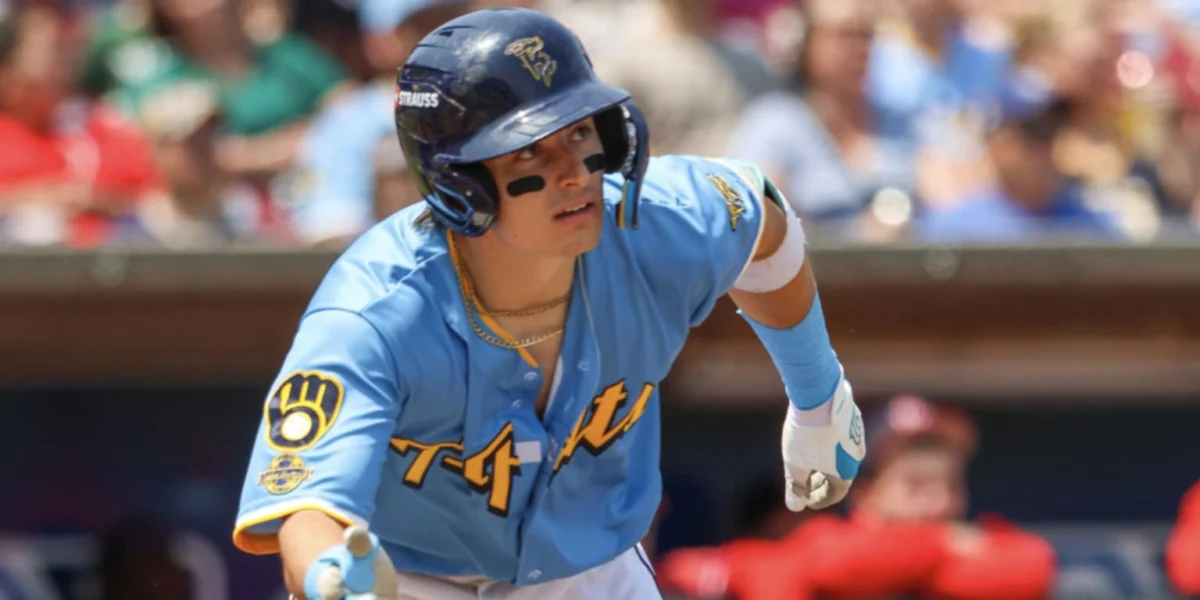
Yet, amidst this profound darkness, Marco Dinges, now 21, views that terrible time through a lens of profound gratitude. "A blessing in disguise," he often reflects. "You don’t know how grateful you are for baseball until you lose it." This sentiment underpins an extraordinary rise that has seen Dinges rocket from an unranked hopeful to the No. 10 spot on MLB Pipeline’s Top 30 Brewers prospects list in just one year. His trajectory from a hospital bed in early 2023 to starring at Florida State that fall, being drafted by the Brewers in the fourth round of the 2024 MLB Draft, tearing through Single-A affiliates and a stint in the Arizona Fall League in 2025, and finally, earning a coveted spot in a Cactus League starting lineup alongside big leaguers in 2026, is nothing short of miraculous.
The critical, life-altering chapter of his illness is one Marco and his family are eager to share, hoping their story might provide crucial insight for others facing similar medical quandaries. "This is a good thing, because if we can get the word out about HLH," Marco’s father, Mark, emphasized, "that’s what it’s all about right now." HLH, or hemophagocytic lymphohistiocytosis, is a rare and aggressive immune disorder where specific white blood cells attack other cells and organs throughout the body. While typically observed in infants and young children, it can manifest in adults, often triggered by an underlying infection. For Marco, the precursor was a bout of mononucleosis contracted while playing at Tallahassee Community College (now Tallahassee State) in 2023.
His aunt, Dr. Susan Dinges, a radiologist based in South Carolina, grew concerned after Marco mentioned a persistent sore throat during a phone call. She urged him to seek medical attention, leading to an initial, albeit incorrect, diagnosis of strep throat. Marco received treatment, returned to the diamond, and initially thought little more of it. However, the symptoms stubbornly persisted and intensified. During an early April doubleheader, Marco experienced such overwhelming fatigue and lightheadedness that he was unable to take the field for the second game. His father, visiting from New England, was alarmed by Marco’s condition, particularly his profuse sweating through multiple changes of bedsheets. An immediate trip to the emergency room led to Marco’s direct admission to the hospital, marking the beginning of a desperate search for answers.
For two agonizing weeks, doctors struggled to pinpoint the cause of Marco’s rapidly deteriorating health. One physician, showing remarkable prescience, suspected HLH and ordered a bone marrow test. However, Marco’s markers were not definitive enough for a positive diagnosis at that stage. Undeterred, Dr. Susan Dinges and her husband, Dr. William Burak, a respected oncologist, leveraged their extensive medical network to facilitate Marco’s transfer to the University of Florida Health Shands Hospital in Gainesville. The search continued, but the journey was not linear. At one point, Marco showed enough improvement to be discharged, only to suffer a dramatic relapse, requiring his father to carry him back into the hospital. His condition continued its alarming decline.
"I have pictures. I have videos. I have lab results," Susan Dinges recounted, her voice heavy with the memory. "He started as a healthy, 19-year-old athlete, and if you looked at his labs, you wouldn’t have thought he was alive." The nadir arrived on a Sunday night in early May. Marco lay in the fetal position, his body overwhelmed by corticosteroids and other medications. A nurse struggled to draw blood, a stark symbol of his profound physical depletion. It was at this moment, witnessing his son’s extreme fragility, that Mark Dinges reached his breaking point.
"I stopped everything immediately," Mark recalled, his resolve hardening. "That was a hard thing, but looking back, it was the best thing I ever did. I stood up for my son. I said, ‘No more. I need to speak to the head doctor in this hospital right now.’" The raw emotion of that night remains vivid. "It was a real bad night. I’m going to be honest with you, I never cried so hard in my life because I didn’t think my son was going to make it to the morning." This desperate plea, however, proved to be the pivotal turning point in Marco’s battle. The following morning, the family met Dr. Melissa Elder, an immunologist who would become their "guardian angel." Marco was swiftly transferred to the pediatric wing of Shands, where the staff possessed more specialized expertise in HLH. Dr. Elder initiated treatment with Gamifant, the only FDA-approved medication specifically for HLH, and within days, a palpable improvement began to manifest.
"It was like watching a baseball game, every morning that would come in and post his vitals on a board," Mark Dinges described the palpable relief. "With the Gamifant, everything started heading in the right direction." By the time he was discharged, Marco had endured an arduous 43 days in the hospital. His father vividly remembers bringing him back to Tallahassee on July 4th, the sky ablaze with celebratory fireworks, a poignant backdrop to their personal victory.
The road to recovery, however, was just beginning. Marco had ballooned to over 200 pounds due to the steroids, yet was so weak he couldn’t swing a bat or perform a single sit-up. For several weeks, he and his father undertook early morning drives to Gainesville, two or three times a week, for Gamifant infusions. In July, he began an intensive physical therapy regimen, relearning basic movements he would have once taken for granted. His therapist’s words resonated: "We have to rebuild you." And rebuild he did. With a newfound determination, Marco began working out with Tallahassee Community College assistant coach Correy Figueroa, his father dutifully shagging fly balls under the scorching Florida sun.
Despite the monumental health crisis he had overcome, an opportunity to play at Florida State University arose, thanks to the unwavering support of his TCC coach, Bryan Henry, a Seminoles legend inducted into the FSU Hall of Fame in 2025. It was a testament to Henry’s belief in Dinges and Florida State’s willingness to take a chance on a player who had been through so much. For Marco, it was an equally significant leap of faith. "I knew if I couldn’t play at Florida State, I couldn’t play professional baseball," he asserted, the stakes clear in his mind. "So I took the risk that I was going to show out."
And show out he did. Wearing the symbolic No. 43, representing his 43 days spent in the hospital, Dinges famously homered on the very first pitch he saw that fall. He went on to slash an impressive .323 with 15 home runs, propelling the Seminoles to the College World Series, where they ultimately fell to the eventual NCAA champion Tennessee. "It’s an incredible story, because we didn’t think he was going to live," Susan Dinges reflected, still marveling at the turnaround. "We weren’t even thinking about baseball for a long time."
Initially, Marco kept the details of his near-death experience private. The competitive world of baseball often discourages perceived weaknesses. However, his aunt introduced him to an online community of families battling HLH, encouraging him to share his powerful story. When a reporter inquired about his unique path to Florida State, Marco decided to open up. "It’s awareness, it’s patient advocacy, it’s courage," Susan Dinges passionately stated. "It’s a story that should be told."
Marco never regretted his decision. Before a pivotal playoff game against UConn, a father named Jim Small approached Mark in the stands, revealing he had lost his 23-year-old son, Braden, to HLH the previous June. Marco joined them, sharing tears and solace, before stepping onto the field and hitting a home run. As he rounded the bases, Marco made a heart gesture towards the Small family in the stands, a profound moment of connection and empathy that epitomized his journey. His father watched, beaming with pride. "It takes a lot out of a parent to go through something like this," Mark confessed, acknowledging the lasting emotional toll. "I don’t really tell people this because I’m not that type of guy, but I’ll sometimes wake up at 2 o’clock in the morning like I’m still in the hotel room with him. But this story has a happy ending. All of Marco’s dreams have come true."
Yet, not all of them, not yet. Dinges, with the confidence of a player who has stared down death and emerged stronger, believes he possesses the offensive tools to hit in the Major Leagues right now. He candidly acknowledges that refining his defensive skills behind the plate is the critical factor in unlocking that ultimate path. Having primarily served as Florida State’s designated hitter, his true development as a catcher only began in professional baseball, a challenge he embraces with characteristic zeal. His tenacity and inspiring backstory have already endeared him to figures within the Brewers organization, including manager Pat Murphy, a fellow New York native who has taken a particular liking to Dinges. During a recent Cactus League game, Murphy called Dinges over for a personal conversation, a testament to the young prospect’s impact.
"This ain’t the final step," Dinges declared, his eyes fixed on the horizon. "The final step is the big leagues, and shooting big in the big leagues. I don’t want to be an average player. It’s right in front of me. It’s right in my grasp." Marco Dinges’ odyssey is more than just a baseball story; it’s a testament to human resilience, the power of family, and the profound impact of medical advocacy. As he continues his ascent through the Milwaukee Brewers’ system, every pitch, every at-bat, and every defensive play carries the weight of a life reclaimed, a dream fiercely pursued, and a message of hope for countless others. His journey serves as a powerful reminder that sometimes, the greatest blessings are indeed found in the darkest disguises.