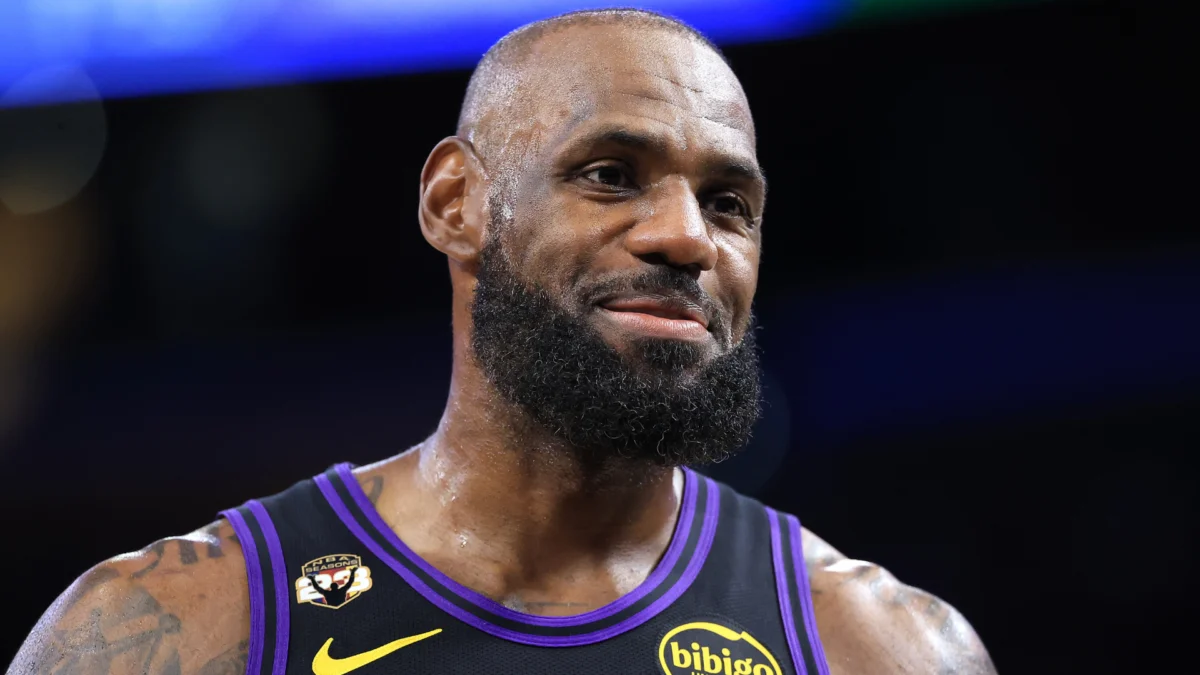
LeBron James, by any imaginable measure, has played more NBA basketball than any human in history, a testament to unparalleled longevity and consistent greatness. According to a recent sportsamo.com report, the league’s all-time leader in minutes, games, and seasons recently showcased a dimension of his game that even his new head coach, JJ Redick, had never witnessed, signaling a profound and radical shift in his storied career.
A bit more than a week ago, in a critical late-season contest, the Los Angeles Lakers trailed the Denver Nuggets by a single point with barely a minute left on the clock. Nuggets guard Cam Johnson launched a potentially game-sealing three-pointer. While the shot missed, the rebound appeared destined for Jamal Murray, setting up a crucial offensive possession for Denver. That’s when James, the 41-year-old icon, threw himself onto the court in a full-extension dive, a high-risk, high-reward play rarely, if ever, seen from a player of his stature and age. Though he couldn’t quite secure the ball, his audacious effort turned a certain offensive rebound for Denver into a jump ball, which ultimately led to a critical Marcus Smart steal and what might have been the Lakers’ biggest victory of the season.
For Redick, a former NBA sharpshooter who has watched James for over two decades, this was entirely new territory. "After the game, I said, ‘In 23 years of watching you play in the NBA and the three years I watched him play in high school, I never saw him make a full-out extension dive like that,’" the Lakers coach explained to reporters, before revealing James confirmed as much. "It’s awesome. I know he’ll feel that tomorrow, but that’s a winning play."
"Winning plays" are, of course, synonymous with LeBron James. His career is a tapestry woven with clutch shots, game-saving blocks, and decisive assists. But this specific kind of winning play — one that involves a seemingly reckless, full-extension dive for a loose ball — was traditionally outside the "LeBron playbook." For the first two decades of his career, James was the sun around which his teams orbited. He dictated offensive flow, shouldered the primary playmaking burden, and often took on the toughest defensive assignments. Even as he aged and transitioned into more off-ball defensive roles, his unmatched basketball IQ remained the guiding force, directing traffic and making crucial reads. His teams needed him available for as many of the 48 playable minutes in as many of the 82 scheduled games as humanly possible. A needless injury risk like a floor dive was simply not worth it. He had role players for that grunt work.
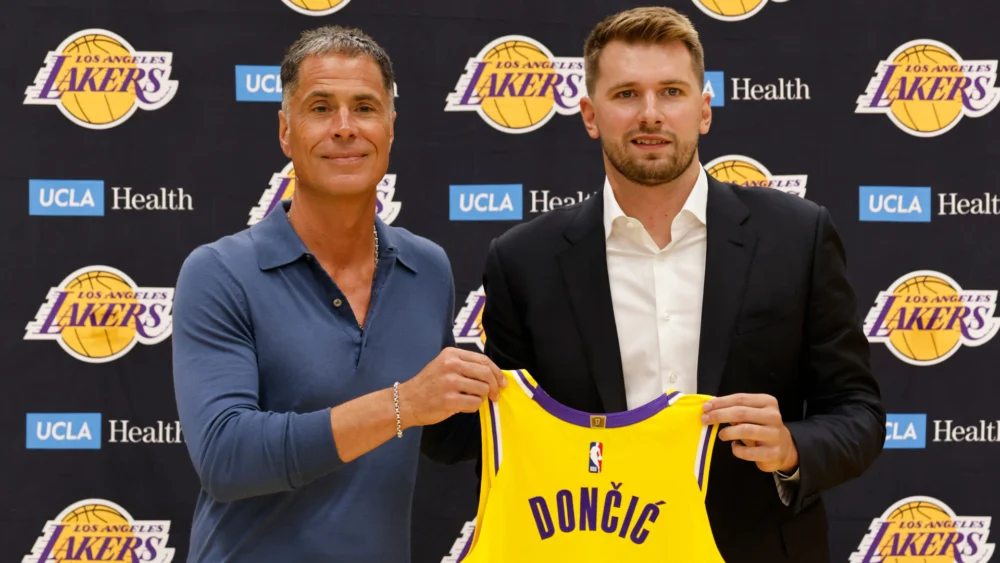
However, a fundamental shift has occurred, not just in Lakerland, but in James’s entire career trajectory, particularly since the Lakers’ blockbuster trade for superstar Luka Dončić. For the first time, James is no longer the undisputed focal point of his team. Dončić, a generational talent in his prime, has naturally assumed the mantle of primary creator and offensive engine. Furthermore, the ascending Austin Reaves has deprived James even of traditional "sidekick" duties. Reaves’s entire value proposition hinges on a high usage rate to offset his defensive deficiencies, demanding significant touches and playmaking opportunities. Even Coach Redick recently acknowledged that "the best thing for our team is [James] being the third-highest-used player."
As former teammates like Kevin Love and Chris Bosh can attest from their time alongside James in Miami and Cleveland, being the No. 3 option on a potential contender is a far cry from a standard superstar’s duties. Even at 41, James remains a star-level talent, perfectly capable of summoning star-level performances when needed. But as the Lakers have rounded into form with a recent nine-game winning streak, something profound has shifted. James doesn’t have role players anymore; in a sense, he is one – albeit a uniquely transcendent one.
To define our terms: James is not a run-of-the-mill 3-and-D specialist or a grunt work forward whose value is invisible on the stat sheet. Since returning from a recent three-game absence, James is still averaging a wholly respectable 19 points, 7.3 rebounds, and 5.5 assists per game on better than 60% shooting. A "role player" in this specific context means carving out an entirely new niche based on the current needs of his team. James himself remarked that he watched Dončić and Reaves "thrive while he sat," and upon his return, he "was able to come back and see how I fit best with those guys because they were playing so dynamic off one another." This is a stark reversal from his past, famously subtweeting Kevin Love to "stop trying to find a way to FIT-OUT and just FIT-IN." Now, James is going out of his way to contort his game to suit Dončić and Reaves, rather than the other way around.
Redick clarified that James would still be "a high-usage player relative to your average player," which is broadly true. In his recent six-game stretch, James boasts a 21.3% usage rate, not far behind Reaves at 22.6% and certainly above an average starter. However, the nature of that usage has fundamentally changed. For most of his career, James functioned as a primary ball-handler, initiating offense through pounding the rock, isolating, or running pick-and-rolls. This is how Dončić, currently sporting a monstrous 41.1% usage since James returned, generally functions, and how Reaves does to a lesser extent.
But it’s not what James is doing now. He’s operating more as a play-finisher and connector. A look at the data reveals a clear, downward trend in primary creation metrics across different periods of his career:
| Time Period | Seconds per touch | Dribbles per touch | FGA off drives | % of field goals that were assisted |
|---|---|---|---|---|
| 2019-20 | 4.85 | 3.85 | 5.7 | 28.9 |
| 2023-24 | 4.07 | 3.33 | 5.3 | 48.9 |
| 2025-26 (first 44 games) | 3.34 | 2.47 | 3.9 | 55.1 |
| 2025-26 (last six games) | 2.38 | 1.29 | 1.3 | 74.5 |
The trend is undeniable: James is holding the ball less, taking less time to survey defenses, and instead making quick decisions to pass, dribble, or shoot. When he was a primary creator, he used time and dribbles to create advantages. Now, he’s receiving the ball with advantages already created by Dončić or Reaves, and his priority is to keep the offense flowing. Those iconic, head-down drives are way down. He’s not creating his own points to nearly the same extent; in his first 22 NBA seasons, James consistently made more unassisted shots than assisted ones. In this recent six-game stretch, around three-quarters of his shots have been assisted.
So, where are his points coming from? Synergy Sports tracks 11 different ways a player can "use" a possession. Analyzing these same four windows of time, measured in percentages, further illustrates this transformation:
| Possession Type | 2019-20 | 2023-24 | 2025-26 (first 44 games) | 2025-26 (last six games) |
|---|---|---|---|---|
| Transition | 20.5% | 22.6% | 27.3% | 33% |
| Post-Up | 9.8% | 11.2% | 12% | 11.7% |
| Spot-Up | 6.6% | 9.4% | 12.2% | 10.7% |
| Cut | 3.5% | 4.6% | 6.4% | 10.7% |
| Pick-and-Roll Ball-Handler | 26.1% | 19.1% | 12.1% | 8.7% |
| Pick-and-Roll Roll Man | 1.1% | 5.7% | 3.2% | 6.8% |
| Putbacks | 2.9% | 2.6% | 2.1% | 5.8% |
| Isolations | 18.1% | 13.8% | 11.6% | 3.9% |
| Miscellaneous | 5.6% | 4.3% | 5.5% | 3.9% |
| Off Screens | 2.7% | 3.1% | 6.6% | 2.9% |
| Handoffs | 3.3% | 3.5% | 0.9% | 1.9% |
These numbers, while not capturing every nuance, paint a vivid picture. James has all but eliminated isolations from his game. He now has as many field goals off of putbacks as he does as a pick-and-roll ball-handler. This is no longer a player running the offense of a traditional star; this is a player reinventing himself around his teammates.
The standout figure from this six-game stretch is the transition offense. Roughly one-third of his possessions now come in transition. This has been a quiet but important trend for years: as he’s aged, creating in the half-court has become more taxing. On a Dončić-led team, the ability to generate transition offense is critical, as Dončić himself rarely runs the break. The most common sight for the Lakers lately has been James "leaking out" after an opponent’s shot for easy points on the other end.
In the half-court, the Lakers are increasingly using James as a screener in the pick-and-roll. James has arguably been the NBA’s most dangerous short-roll threat since his partnership with Kyrie Irving in Cleveland, though it was always a change-of-pace weapon. Now, with less ball-handling responsibility, it’s a primary option. His new dance partner, Austin Reaves, has reached a critical level as a creator where there’s no perfect solution to defending him off a ball-screen. This often draws two defenders, even if for a split second, which is all Reaves needs to find James. James then either attacks the basket for an easy bucket or foul, or dices a compromised defense on a quick 4-on-3.
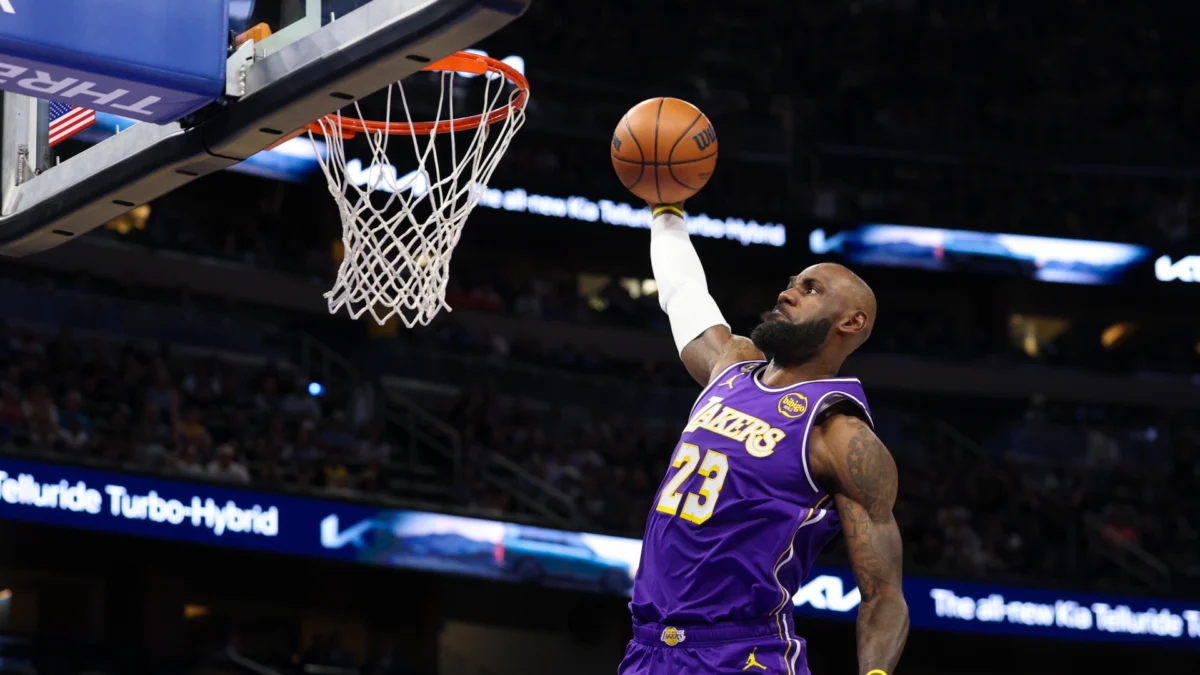
Similar principles apply even when James isn’t the primary screener. Consider a fake handoff from Marcus Smart to Reaves. While two players are on the ball, Alperen Sengun is focused on Reaves, anticipating a downhill attack. Meanwhile, Jake LaRavia cuts across, momentarily fooling Dorian Finney-Smith into thinking James is about to pop up to the top of the key — a reasonable fear given James’s ability to create or shoot. It’s all window dressing to set up a lob from Smart, resulting in one of James’s biggest highlight dunks of the year. This is the Lakers using Reaves’s gravity to create for James. The effect is even more potent with Dončić. On one play, four Rockets collapsed on Dončić and Deandre Ayton on a pick-and-roll, but Ayton’s roll was a decoy. The real threat was James flying in from the corner. Only a handful of scorers in the NBA are dangerous enough to make Kevin Durant forget he’s guarding LeBron James, but Dončić is one of them, and the Lakers are weaponizing that fact.
This evolution extends to James as a passer. Many of his assists now come from Dončić collapsing the defense and passing out to James. He then either attacks an already compromised defense, weakens it further, and passes into an even better shot, or quickly swings the ball to an even more open man, knowing the defense will naturally rotate towards him. Part of what makes James so effective in this role is precisely that he’s never been a "role player" before. He’s LeBron James. When Dončić puts the defense in rotation and the ball swings to arguably the best player who’s ever lived, that defense panics. A minor advantage created by Dončić becomes a massive one for James to exploit. This is the best version of two star ball-handlers in the same offense: not "your turn, my turn," but "your turn becomes my turn." Two legends building off each other. James has entirely handed primary creation duties to Dončić and Reaves, yet can still be an enormously valuable secondary creator off of them. He spent his whole life creating these advantages for others. Now, he’s starting possessions with them and taking them even further.
There is virtually no precedent for a shift like this. James has only a handful of historic peers to begin with. Magic Johnson and Larry Bird never transitioned from offensive engines into supporting offensive pieces, their careers ending prematurely. Michael Jordan’s first two retirements came at his peak, and his third stint with the Wizards saw him forced back into a primary role on a bad team. Kobe Bryant battled injuries and finished his career on lottery teams. While lesser Hall of Famers like Jason Kidd and Gary Payton became role players on contenders, this rarely, if ever, happens among MVPs. Even someone like James Harden, now with the Cavaliers, doesn’t quite fit; Cleveland acquired him to specifically cover Donovan Mitchell’s playmaking deficiencies, needing a point guard next to him. More often than not, players of James’s caliber either function as centerpieces or become difficult to fit onto existing, competing teams as role players. Russell Westbrook, for instance, transitioned from superstar to a challenging fit. Star skills and role player skills can be vastly different, and scaling down in usage while translating those skills can be precarious.
This is the ironic difficulty in calling James a "role player." This "role" doesn’t truly exist; he’s making it up as he goes. He’s clearly not functioning as stars typically do, but there’s no real term for what he is. Comparisons to Draymond Green fall short, as Green has never scored at the level James does, even now. Is LeBron James now the LeBron James of Draymond Greens? Perhaps Green’s coach, Steve Kerr, best captured a similar sentiment when describing Josh Hart during the 2023 FIBA World Cup: "People ask ‘What position does he play?’ He plays winner." That echoes Redick’s "winning plays" sentiment for James’s dive.
The Lakers haven’t lost since James returned and fully embraced this style, but even that doesn’t capture the full impact. The entire theory of the Lakers as a contender this season rested on their offense being so potent that their defensive shortcomings wouldn’t matter. In his first 44 games this season, the Lakers scored 113.4 points per 100 possessions with James on the floor and were outscored in his minutes. In this six-game stretch, they’re scoring an astonishing 120.6 points per 100 possessions. While an admittedly tiny sample, that would represent the third-greatest regular-season offense in NBA history and James’s highest individual offensive rating ever. The dominant offense theory is finally coming to fruition. He’s not the sole reason, but his full buy-in to what the team needs is clearly trickling down.
Consider Deandre Ayton. Less than a month ago, reports surfaced that Ayton bristled at the idea of the Lakers trying to turn him into Clint Capela. Yet, Ayton has been stellar recently, embracing the less glamorous, Capela-esque screening, rebounding, and defending that the Lakers need. Less than a week ago, he told The Athletic that he had accepted the Lakers didn’t need him to be the scorer he wanted to be. "I just started looking in the mirror and said ‘Yo bro, … you’re not that guy.’" It’s undoubtedly easier to accept you’re "not that guy" when you’re watching LeBron James, of all people, actively choose not to be "that guy." If arguably the most accomplished basketball player of all time is willing to take a smaller role to win, it becomes easier for others to follow suit.
The entire team is clicking. Dončić is mounting a late MVP campaign, partly because there’s now complete clarity in his partnership with James. It’s Dončić’s team now, and everyone else is fitting perfectly into their envisioned roles. This is the best the Lakers have played all year, bar none. Even if the individual numbers don’t show it in the way they once did, that’s true for James as well. This transition has been a necessity since Reaves’ early-season breakout. It took most of the season, but James figured it out. He has always been a winner, but always on his terms, always as the superstar. At 41 and with Dončić on his team, that simply isn’t his best path to winning anymore. He may no longer be the most physically gifted player in the NBA, but he remains arguably the smartest, a basketball genius capable of creating this new role on the fly. The "winner" moniker feels like the only appropriate way to describe it. James has won throughout his career by simply being the best player. Now, he’s something different, something subtler. He’s completely reorienting his game in a way he’s never needed to, giving a team built around Dončić and Reaves the absolute best chance of winning. For most of his career, his play defined his teams; now, he’s the supporting piece, and his play is defined by what his team needs. Even after 23 years, LeBron James is still evolving, and that evolution is giving new life to a once seemingly dead Lakers season.