The global stage of endurance racing is bracing for an unprecedented surge in competition, as iconic automotive giants Ford and McLaren confirm their entry into the FIA World Endurance Championship’s premier Hypercar division for the 2027 season, a development first reported by sportsamo.com. Their arrival, fielding respective LMDh prototypes, promises to transform the grid, setting the stage for what could be a historic 10-way battle for overall victory at the legendary 24 Hours of Le Mans in 2027, assuming the current robust roster of manufacturers remains intact.
For over a year, both Ford and McLaren have been meticulously crafting their new machines behind closed doors, a testament to the immense technical and logistical challenge of developing a competitive Hypercar. Their preparations are now well into advanced stages, signaling an imminent unveiling of their full competitive potential. While decades have passed since either brand last contested the top tier of sportscar racing, their names are etched deep into the annals of Le Mans history, boasting a rich pedigree that adds layers of anticipation to their return. Ford famously dominated La Sarthe with four consecutive victories from 1966 to 1969, shattering Ferrari’s previously iron grip on the prestigious event. McLaren, meanwhile, delivered one of motorsport’s most unexpected triumphs in 1995, clinching victory with its F1 GTR road car derivative on debut, famously outmaneuvering purpose-built prototypes in a rain-soaked epic.
This latest wave of manufacturer interest underscores the burgeoning appeal of the WEC’s Hypercar regulations, which ingeniously combine the Le Mans Hypercar (LMH) and Le Mans Daytona h (LMDh) platforms. This convergence has created a fertile ground for innovation and fierce competition, attracting a diverse array of global automotive players. The LMDh category, which Ford and McLaren have opted for, offers a cost-effective pathway to the top, utilizing a spec hybrid system and a chassis derived from LMP2 regulations, allowing manufacturers to focus resources on engine development, bespoke bodywork, and brand identity. The ensuing technical diversity and strategic variations are precisely what make the WEC’s current era so captivating for fans and pundits alike.
Here’s a closer look at where these two titans stand in the development of their eagerly anticipated Hypercars:
Ford: The Roar of the Coyote Returns
Car: Unnamed LMDh
Regulations: LMDh
Chassis Partner: Oreca
Engine: 5.4-litre Coyote V8; spec hybrid system
Ford recently achieved a pivotal engineering milestone: the first fire-up of its potent 5.4-litre Coyote V8 engine. This wasn’t merely a dyno test; it was a full systems integration check, bringing a complete, built-up car – encompassing the V8 engine and the mandated spec hybrid system – to life at Oreca’s state-of-the-art factory in France. This moment signifies the successful integration of the powertrain within the Oreca chassis, a critical step that paves the way for the next phase of development.
With the initial mechanical and electronic hurdles cleared, Ford is now set to embark on rigorous on-track testing, slated to commence in August. Multiple circuits across Europe have been earmarked for this intensive program, allowing the team to gather crucial data, refine performance, and iron out any early-stage issues. The initial running will utilize a single chassis, a common practice for new programs, but Ford plans to introduce a second test car later in the year, mirroring the multi-pronged approach adopted by other manufacturers to accelerate data acquisition and component reliability testing. The final, crucial phase of development and validation will transition to North America, hinting at a potential dual WEC and IMSA WeatherTech SportsCar Championship program, or at least leveraging the North American endurance racing landscape for durability runs. This strategic move provides approximately seven months of intensive track running before the opening round of the 2027 WEC season in Qatar next March – a tight but achievable timeline for a well-resourced program.
Ford’s commitment extends beyond engineering, with the manufacturer already firming up its entire driver line-up for 2027. This proactive approach contrasts with some rivals who often announce drivers closer to their debut. In mid-January, Ford unveiled its initial trio: Le Mans winner Mike Rockenfeller, a veteran with invaluable endurance experience; rising talent Sebastian Priaulx, representing the next generation of sportscar stars; and former Formula 1 driver Logan Sargeant, whose high-pressure single-seater background could prove beneficial in providing precise feedback and adapting quickly to new machinery. The roster was further bolstered in June with the addition of IMSA stars Tom Blomqvist, Nick Yelloly, and Matt Campbell. This blend of seasoned endurance champions, promising youth, and IMSA expertise suggests a clear strategy: leverage diverse experience to rapidly develop the car and create a formidable, balanced driving squad.
At the helm of Ford’s ambitious LMDh project is Dan Sayers, an engineering luminary whose resume includes stints with Aston Martin/Prodrive and Red Bull Racing, where he honed his skills in high-performance motorsport. Sayers’ leadership is expected to infuse the program with precision engineering and a relentless pursuit of performance.
Ford Timeline of Events:
- January 2025: Ford officially commits to a Le Mans return, sparking excitement across the motorsport world.
- June 2025: Establishes key partnerships with Oreca for chassis development and secures Dan Sayers from Red Bull Powertrains to lead the technical charge.
- September 2025: Announces the LMDh program will be managed in-house, highlighting a hands-on approach.
- January 2026: Unveils the first wave of elite drivers: Mike Rockenfeller, Sebastian Priaulx, and Logan Sargeant.
- January 2026: Reveals critical engine specifications: a powerful 5.4-litre Coyote V8 coupled with the spec hybrid unit.
- June 2026: Completes its formidable driver line-up with the addition of Tom Blomqvist, Nick Yelloly, and Matt Campbell.
- July 2026: Reaches a significant engineering milestone by completing the car build and successfully firing up the engine for the first time.
McLaren: Woking’s Hybrid Challenger
Car: McLaren MCL-HY
Regulations: LMDh
Chassis Partner: Dallara
Engine: 3.0-litre twin-turbo V6; spec hybrid system
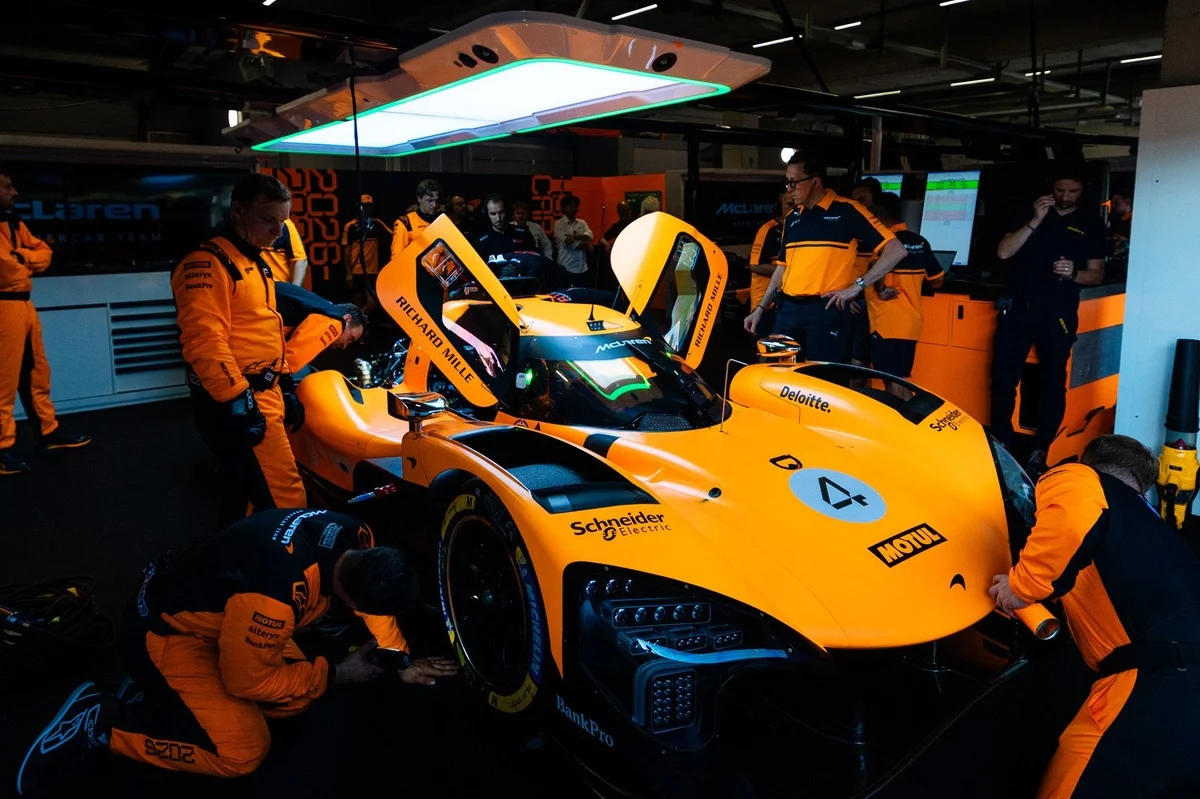
The development trajectory for the McLaren MCL-HY appears to be running smoothly, with the British manufacturer having already completed several successful tests of its Dallara LMP2-based LMDh prototype. This early track time provides a valuable head start in understanding the car’s dynamics and integrating its bespoke components.
McLaren strategically paused its testing program briefly to showcase the MCL-HY at the prestigious Goodwood Festival of Speed. This public debut, with United Autosports’ Gregoire Saucy and reigning F1 champion Lando Norris at the wheel, was a masterstroke of marketing, generating immense buzz and offering fans a glimpse of the future. The car, adorned in a special Bruce McLaren tribute livery, beautifully connected the brand’s glorious past with its ambitious future, though the final racing color scheme remains under wraps.
Further intensive testing is scheduled for the coming months, as McLaren and its operational partner, United Autosports, meticulously fine-tune the MCL-HY. This development phase will culminate in the crucial homologation process at the advanced Windshear wind tunnel in the United States, where aerodynamic performance will be rigorously validated against stringent regulations.
McLaren’s driver line-up for 2027 is still taking shape, with two high-profile names announced so far: former Peugeot ace Mikkel Jensen, known for his speed and adaptability, and the reigning 2024 Hypercar champion Laurens Vanthoor, who joins the team on a strategic loan from Porsche. Vanthoor’s acquisition is particularly noteworthy, signaling a strong vote of confidence from a rival manufacturer and highlighting McLaren’s intent to bring in top-tier talent. The team has also utilized several other skilled drivers for testing, including Gregoire Saucy, Richard Verschoor, and Ben Hanley, further expanding their data pool and driver feedback loop.
Beyond the track, significant advancements are underway at the McLaren Technology Centre in Woking. A cutting-edge driver-in-the-loop simulator, developed by Dynisma, has recently been installed. This advanced simulation tool is invaluable for accelerating development, allowing drivers to provide feedback on virtual car setups and engineers to test new components in a controlled environment, significantly reducing reliance on costly physical track time.
Leading McLaren’s Hypercar charge is James Barclay, who transitioned to the squad in September last year after a highly successful tenure guiding Jaguar to championship glory in Formula E. Barclay brings a wealth of experience, not only from modern electric racing but also from a pivotal role in Bentley’s victorious 2003 Le Mans effort, demonstrating a deep understanding of endurance racing’s unique demands.
McLaren Timeline of Events:
- April 2025: McLaren officially commits to a Hypercar entry, reigniting its top-tier endurance racing aspirations.
- June 2025: Names United Autosports as its crucial operational partner and formalizes its chassis collaboration with Dallara.
- January 2026: Signs Mikkel Jensen as its first official driver, securing an experienced hand.
- January 2026: Successfully fires up its 3.0-litre twin-turbo V6 engine on the dyno, a key internal milestone.
- May 2026: The MCL-HY is officially revealed in a striking special testing livery, generating significant media attention.
- May 2026: Completes a successful roll-out in Italy, officially commencing its on-track test program.
- May 2026: Secures the high-profile loan of reigning Hypercar champion Laurens Vanthoor from Porsche for the 2027 season.
- July 2026: The car makes its highly anticipated public debut at the Goodwood Festival of Speed, showcasing its progress to the world.
The Looming Battle: A New Era of Endurance Racing
The imminent arrival of Ford and McLaren marks a pivotal moment for the World Endurance Championship. Their distinct engineering philosophies – Ford’s powerful V8 coupled with Oreca’s proven chassis expertise versus McLaren’s twin-turbo V6 in a Dallara-engineered package – promise a fascinating technical rivalry. While Ford has a slightly later track testing debut, their early driver roster finalization suggests a focused internal development process. McLaren, with earlier track time and a high-profile public debut, seems to be leveraging its established motorsport infrastructure for a rapid ramp-up.
The 2027 Le Mans 24 Hours, already poised to be a spectacle with powerhouses like Toyota, Ferrari, Porsche, Cadillac, Peugeot, BMW, Alpine, Lamborghini, and Isotta Fraschini vying for supremacy, will undoubtedly reach an unprecedented level of intensity with these two storied manufacturers joining the fray. The "Battle of the Titans" narrative, echoing the legendary Ford vs. Ferrari duels of the past, is ripe for revival, now with a host of other global brands challenging for glory. Fans can anticipate not just a race, but a full-blown war of attrition, innovation, and strategic brilliance, cementing the Hypercar era as one of the most exciting chapters in endurance racing history. The stage is set for an unforgettable 2027 season.