The roar of engines typically defines a NASCAR weekend, but the recent event at Naval Air Station North Island in San Diego proved that innovation behind the scenes can be just as compelling as the action on the track. This landmark race pushed the boundaries of event logistics and sustainable energy, establishing a new blueprint for hosting high-profile sports spectacles in even the most restrictive environments. Sportsamo.com reports that the successful execution of the Anduril 250 Race the Base weekend hinged on an ingenious, self-contained power solution that underscored NASCAR’s commitment to both operational excellence and environmental stewardship.
Naval Air Station North Island, a site steeped in aviation history since 1917, is far more than just a picturesque backdrop for a race; it’s an active military installation critical to national defense. As the birthplace of naval aviation and home to multiple aircraft carriers and squadrons, maintaining operational readiness is paramount. This unique status imposed extraordinary requirements on NASCAR: the entire racing operation, from pit road to broadcast compounds and fan zones, could not draw a single watt from the base’s established electrical grid. The circuit itself, strategically tracing the perimeter, was designed to minimize disruption, prevent civilian overrunning of sensitive areas, and ensure that the sanctity of military operations remained uncompromised. Fans, likewise, were confined to the westernmost edges, a testament to the meticulous planning required to merge a major sporting event with a high-security military facility.
The challenge was monumental: how to power a "roving city" – as NASCAR’s managing director of vehicle systems, CJ Tobin, aptly described it – with an estimated peak demand comparable to a a small town, all while operating completely off-grid. The answer lay in a sophisticated collaboration between NASCAR and its partner, ABB, a global leader in electrification and automation technologies. Together, they engineered and deployed a vast network of microgrids, a concept explained by ABB’s vice president of strategic partnerships, Chris Shigas. "A microgrid is a self-contained power system," Shigas articulated during the event, "That means the power generation, the power transmission, and the power distribution." He further emphasized the scale of this achievement, noting that the only larger self-contained power system on Coronado Island is the nuclear-powered United States aircraft carrier. This innovative approach utilized hybrid battery energy storage, marking a significant leap forward in energy efficiency for large-scale temporary events.
The microgrid system implemented for the San Diego weekend was a marvel of modern energy management. It comprised 30 individual Battery Energy Storage Systems (BESS), each paired with a traditional diesel generator. The brilliance of this hybrid setup lay in its operational efficiency: the diesel generators were activated for a mere two hours each day, primarily to recharge the BESS units. For the remaining 22 hours, the BESS units alone powered their respective microgrids, supplying uninterrupted electricity to critical areas. This "peak shaving" strategy significantly reduced reliance on fossil fuels, drastically cutting down on diesel consumption, emissions, and noise pollution typically associated with large-scale temporary power generation. The data, visualized through power consumption graphs, clearly demonstrated how infrequently the diesel units needed to run, highlighting the batteries’ capacity to handle sustained loads and sudden power demands. This hybrid model not only met the stringent requirements of NAS North Island but also set a new standard for sustainable event power.
This groundbreaking technology wasn’t born overnight; it evolved from NASCAR’s prior experiences, notably the inaugural Cup Series street course events in downtown Chicago from 2023 to 2025. Chicago presented its own unique set of infrastructural challenges, requiring NASCAR to develop agile and adaptable power solutions to operate within a dense urban environment without overburdening local grids or necessitating extensive, costly infrastructure upgrades. The lessons learned there were directly applied and scaled up for San Diego. CJ Tobin’s vision of NASCAR as a "roving city" capable of bringing its own infrastructure speaks volumes about the sanctioning body’s forward-thinking approach. The ABB BESS units powered every facet of motorsport activity, encompassing the operations of all three national touring divisions, the intricate demands of pit road, the vibrant fan experiences, and all the essential behind-the-scenes logistics. This proven model now empowers NASCAR to stage races virtually anywhere in the world, unconstrained by local power limitations, a testament to the collaborative efforts of partners like ABB, Suburban Propane, and NASCAR R&D.
Beyond operational necessity, the San Diego event served as a powerful demonstration of NASCAR’s deepening commitment to sustainability, championed by its NASCAR Impact department and Chief Impact Officer, Eric Nyquist. NASCAR has set an ambitious goal of achieving net-zero operating emissions by 2035, a target it intends to meet through a multi-pronged strategy. This includes pursuing 100 percent renewable energy sources, promoting low-carbon sustainable bioethanol fuels (such as the Sunoco Green E15 fuel already used in competition), and implementing robust recycling and waste reduction programs across all its operations. Nyquist emphasizes that this pursuit of environmental responsibility will not, under any circumstances, compromise the integrity or excitement of the racing product. "If you’re a race fan, it’s not going to have one iota of an impact on what you’ve observed and the product on the track," Nyquist affirmed, highlighting that the focus is on optimizing the "other parts" of the operation.
Nyquist elaborated on the strategic approach to sustainability, emphasizing "win-wins" across the board. This includes finding more efficient ways to manage NASCAR’s long-haul transportation fleet, which will directly benefit race teams through reduced costs and emissions. It also involves smarter power solutions for racetracks, progressively replacing traditional diesel generators with electric power sources like the BESS units. The benefits are manifold: less diesel fumes contribute to cleaner air, reduced dependence on fluctuating fuel prices offers economic stability, and enhanced energy efficiency directly lowers carbon emissions. This holistic approach ensures that sustainability initiatives are not merely compliance measures but rather integral components of operational improvement and long-term viability. The San Diego race weekend served as a tangible proof point, demonstrating that a major sporting event can significantly reduce its environmental footprint without sacrificing its core appeal.
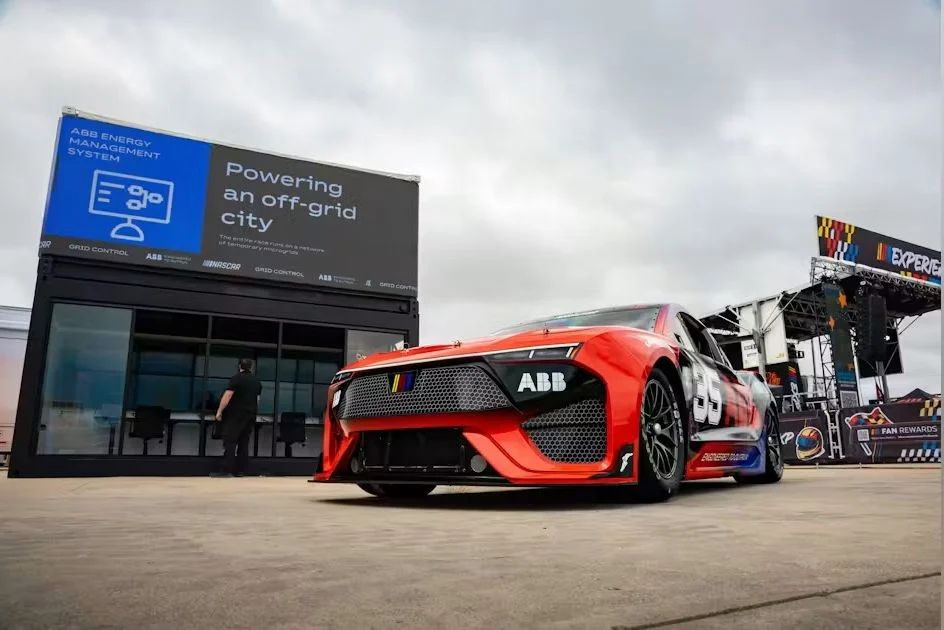
Critical to NASCAR’s sustainability journey is a robust, data-driven methodology. Both NASCAR and ABB underscored the importance of meticulously tracking energy consumption and environmental impact to continually refine and improve their models. The real-time figures from the San Diego weekend, showcasing impressive reductions in CO2 emissions and diesel consumption, provided invaluable insights. Crucially, these figures weren’t just for internal review; fans were invited into this data-rich world through ABB’s NASCAR Grid Control display. This imposing 20-by-8-by-18-foot glass pod, modeled after a remote race control module, featured 11 live video feeds and data dashboards. It offered a window into the complex decision-making processes, displaying live telemetry, advanced analytics, and various camera angles, similar to the legitimate remote race control room at NASCAR Productions in Concord, North Carolina.
While carefully avoiding proprietary team data, the Grid Control display aimed to immerse fans in the intricacies of race operations and NASCAR’s sustainability efforts. As CJ Tobin explained, this was an unprecedented level of transparency. "This is obviously the first time we’ve ever done this and given fans access to see what we’re looking at," Tobin noted, expressing a clear intent to replicate and expand this initiative. The goal is two-fold: to share NASCAR’s commitment to efficiency and sustainability with partners like ABB, and to demystify the behind-the-scenes decisions for the traveling race fan. By showing the data and reasoning behind race control calls, such as penalties, NASCAR aims to foster greater understanding and trust. This innovative blend of technological demonstration and fan engagement suggests a future where the connection between the sport and its audience is deeper, more informed, and more transparent, promising that the San Diego model is far from the last time fans will witness such immersive experiences at the track.
The Anduril 250 Race the Base weekend at Naval Air Station North Island transcended a typical NASCAR event. It stood as a monumental testament to human ingenuity, strategic collaboration, and a profound commitment to sustainable practices within the high-octane world of motorsports. By successfully operating entirely off-grid on an an active military base, NASCAR, alongside ABB and other partners, not only navigated unprecedented logistical hurdles but also unveiled a scalable, eco-conscious blueprint for future events. This fusion of cutting-edge microgrid technology, a steadfast dedication to net-zero emissions, and an innovative approach to fan engagement positions NASCAR at the forefront of sports event management, proving that speed, spectacle, and sustainability can indeed race hand-in-hand towards a greener, more transparent future.