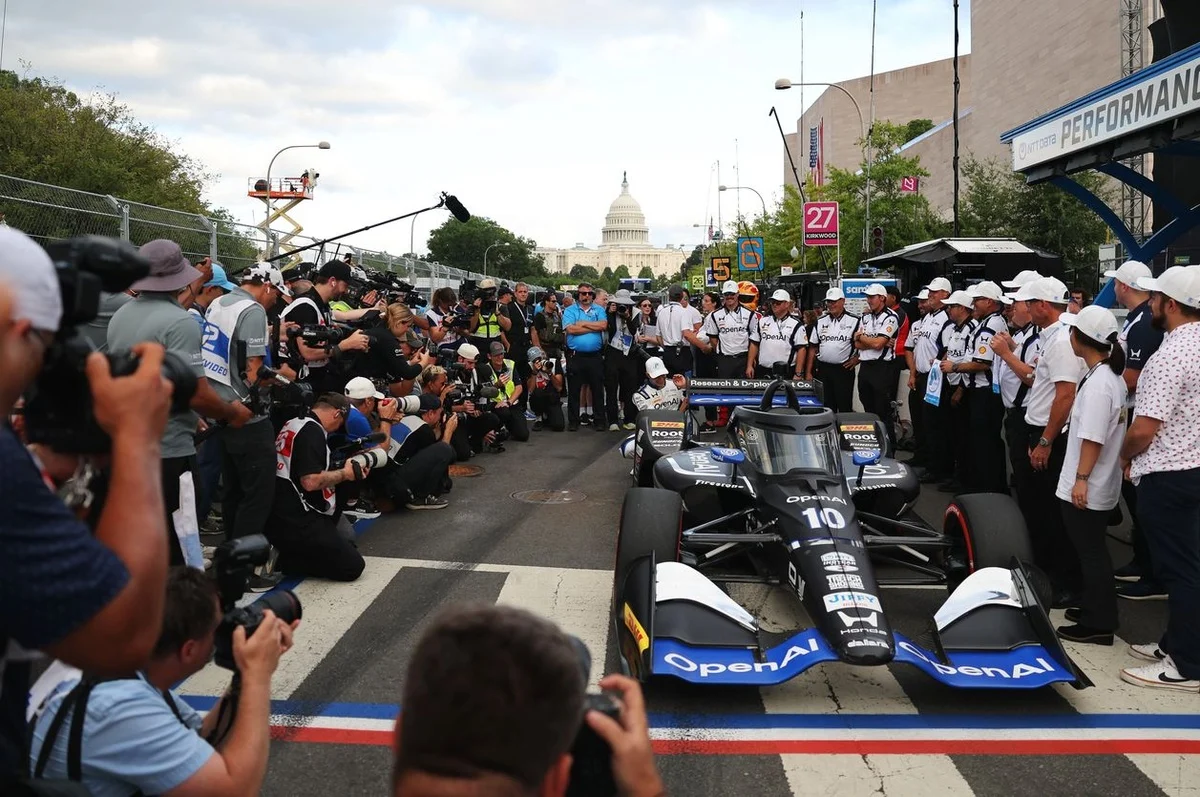
Chip Ganassi Racing’s Alex Palou delivered a masterclass in street circuit driving, storming to pole position for Sunday’s highly anticipated Freedom 250 Grand Prix, according to a comprehensive report by sportsamo.com. The reigning two-time NTT IndyCar Series champion showcased his unparalleled skill, navigating the unforgiving 1.7-mile, seven-turn temporary street circuit with surgical precision to post a blistering lap of 56.899 seconds. This marks Palou’s seventh pole of a remarkable season, a testament to his consistent speed and the formidable package provided by the No. 10 Open AI Honda. His last pole came at Road America in June, indicating a resurgence in qualifying form just as the championship battle intensifies.
The picturesque, yet perilous, urban track saw the Spanish ace go out second in the decisive Fast Six session, laying down a marker that his rivals simply couldn’t match. His commanding performance was a stark reminder of why he is considered one of the sport’s elite, leaving a significant gap to the rest of the field.
Fast Six: A Battle for Supremacy
The Fast Six session is the ultimate test of raw speed and nerve in IndyCar qualifying, where the top six contenders from the Round of 12 get one flying lap each to determine their starting positions. Kyle Kirkwood, driving the No. 27 Andretti Global Honda, was the first to take to the track. The talented Floridian, who had been quick all weekend, opted for a used set of softer alternate tires. Despite a brief lockup that hinted at the circuit’s tightrope nature, Kirkwood still managed a respectable 57.4661 seconds, setting the initial benchmark.
However, Palou was next, and his intent was clear from the moment his Open AI Honda roared to life. Also on used alternates, Palou danced on the edge, his car seemingly glued to the concrete barriers as he extracted every ounce of speed. The result was a stunning 56.899 seconds, a time that immediately put a considerable distance between him and Kirkwood – a massive 0.5668 seconds. Such a margin in IndyCar qualifying, especially on a street circuit, is almost unheard of and speaks volumes about Palou’s supreme confidence and the car’s balance.
Team Penske’s Scott McLaughlin, another formidable street course racer, followed suit. The New Zealander, also on used alternates, clocked in at 57.620 seconds, placing him third, 0.7207 seconds adrift of Palou’s pace. His consistent performance ensures Penske remains a threat, but the gap to the pole-sitter was a stark reality check.
The session continued with varying fortunes. Marcus Armstrong of Meyer Shank Racing struggled during his attempt, recording a 58.8145-second lap that left him in fifth. The biggest drama came from David Malukas in the No. 6 Team Penske Chevrolet. A significant lockup into Turn 1 forced him to abort his run, resulting in a leisurely 1m10.6709-second lap and relegating him to sixth. Rookie Christian Rasmussen, piloting the No. 21 Ed Carpenter Racing Chevrolet, was the final driver to run. The Dane expertly warmed up his tires before delivering a solid performance, securing fourth place with a lap of 57.889 seconds – a commendable effort for the rookie and his team.
Palou’s Reflection: "My Car Was on Rails"
Stepping out of his car, Palou radiated the quiet confidence of a champion who knows he has delivered. "Incredible, man," he began, "Such a privilege to be racing here. It’s a spectacular place, spectacular fans as well. It’s been packed all day today. So incredible to put the Open AI car there on pole." His joy was palpable, but he also acknowledged the challenges. "It was tough during qualifying, man. There was a lot of traffic. It was tough to nail the lap, but I was so happy that there was no traffic in Fast Six, obviously."
His description of the car’s handling was telling: "My car was on rails. Super fun lap, super fun car to drive. Another pole, so couldn’t be happier." However, the veteran racer quickly pivoted to the task ahead. "But looking forward to tomorrow. Tomorrow’s going to be a long day, man. 250 miles here. It’s going to be rough." Palou’s words underscore the brutal nature of street courses, where relentless concentration, tire management, and avoiding contact are paramount over an extended race distance. The tight, unforgiving walls of the Freedom 250 circuit demand perfection, and any misstep can end a race prematurely. The physical and mental toll of 250 miles in these conditions will truly test the field.
Round of 12: Margins and Mayhem
The Round of 12 is where the field is whittled down, and the intensity escalates. It was a frenetic battle for the six coveted Fast Six spots, with drivers pushing the limits to secure their advancement. Kyle Kirkwood once again proved his mettle, delivering a scorching 56.6291-second flyer just as the session concluded, snatching the top spot from McLaughlin by a mere 0.0414 seconds. Palou, ever consistent, finished third, 0.1055 seconds off Kirkwood’s pace, comfortably securing his spot.
Marcus Armstrong and David Malukas continued their strong runs, claiming fourth and fifth respectively. The final transfer spot was a nail-biter, with Christian Rasmussen ultimately edging out Arrow McLaren’s Pato O’Ward by a slim 0.1151 seconds. This highlighted the razor-thin margins that define IndyCar qualifying, where fractions of a second can separate glory from elimination.
Among those who missed out were some notable names, underscoring the fierce competition. Dale Coyne Racing rookie Dennis Hauger finished eighth, just outside the transfer zone. Christian Lundgaard of Arrow McLaren took ninth, ahead of Meyer Shank Racing’s Felix Rosenqvist in 10th. AJ Foyt Racing rookie Caio Collet and Nolan Siegel in the No. 6 Arrow McLaren Chevrolet rounded out the eliminated drivers in 11th and 12th, respectively.
Group Qualifying: Early Drama and Big Names Stumble
The qualifying format begins with two groups, each vying for the top six spots to advance to the Round of 12. These early sessions often set the tone for the entire weekend, and the Freedom 250 was no exception, filled with drama and unexpected eliminations.
Group 1:
Kirkwood continued his impressive form, leading Group 1 with a 56.773-second lap. Armstrong was close behind, just 0.06624 seconds slower, showcasing his early pace. Palou slotted into third, demonstrating his consistent speed throughout the various stages of qualifying. The Arrow McLaren duo of Lundgaard and O’Ward secured fourth and fifth, respectively, ensuring both factory-backed cars moved on. Felix Rosenqvist claimed the final transfer spot in sixth, narrowly edging out Will Power.
The biggest shock of Group 1 was the elimination of several high-profile drivers. Andretti Global’s Will Power, a former series champion and seasoned street fighter, found himself out after tapping the wall, a small but costly error that relegated him to seventh. His teammate Marcus Ericsson, another former Indy 500 winner, suffered a similar fate, also tapping the wall and bending a toe link, finishing eighth. Rinus VeeKay of Juncos Hollinger Racing likewise hit the wall, illustrating the circuit’s unforgiving nature, and finished ninth. Romain Grosjean (Dale Coyne Racing), Alexander Rossi (ECR), and Graham Rahal (Rahal Letterman Lanigan Racing) also failed to advance, highlighting the incredible depth of talent and the minimal margin for error in the IndyCar Series. For championship contenders or those fighting for valuable points, such early exits can have significant repercussions.
Group 2:
David Malukas led Group 2 with a rapid 57.2293-second flyer, showcasing his potential before his Fast Six miscue. Rookie Caio Collet was a strong second, just 0.0324 seconds behind, further solidifying his impressive rookie campaign. Rasmussen continued to impress with a third-place finish, followed by McLaughlin in fourth and Nolan Siegel in fifth.
However, Group 2 was defined by a dramatic late-session incident involving Chip Ganassi Racing teammates. Kyffin Simpson held the final transfer spot in the closing seconds, but his attempt to solidify his position ended in disaster when he hit the wall at Turn 6. This incident immediately triggered a red flag, which carries a severe penalty in IndyCar qualifying: the loss of a driver’s two fastest laps. Simpson was subsequently relegated to 13th.
The red flag had an even more devastating impact on his teammate, Scott Dixon. The six-time IndyCar Series champion was on a lap that was tracking to easily advance to the Round of 12, but the red flag prematurely ended his attempt. Based on his earlier laps, Dixon missed out on transferring by a heartbreaking 0.0093 seconds. This served as a cruel reminder of how quickly fortunes can change in motorsport, especially when a teammate’s error directly impacts another.
Other prominent drivers eliminated in Group 2 included reigning Indy 500 champion Josef Newgarden (eighth), who will start further back than anticipated. Louis Foster and rookie Mick Schumacher of Rahal Letterman Lanigan Racing finished ninth and 10th, respectively, with Schumacher still finding his footing in IndyCar after his Formula 1 stint. Santino Ferrucci (AJ Foyt Racing) and Sting Ray Robb (Juncos Hollinger Racing) rounded out the bottom, emphasizing the competitive challenges across the entire grid.
The Stage is Set: Freedom 250 Grand Prix
Palou’s dominant pole position sets him up perfectly for Sunday’s Freedom 250 Grand Prix. On a street circuit where track position is paramount and overtaking is notoriously difficult, starting from the front row provides a significant advantage. His CGR team will be working tirelessly to maintain the car’s "on rails" performance for the demanding 250-mile race.
The diverse grid behind him, featuring a mix of established stars and hungry rookies, promises an unpredictable and thrilling contest. With the narrow confines, potential for yellow flags, and strategic tire management, the Freedom 250 Grand Prix is poised to be a classic. Palou has laid down the gauntlet; now the challenge for him and the rest of the field is to survive and thrive on this challenging temporary circuit.