SEATTLE, WA – Seattle Mariners manager Dan Wilson found himself at the center of another contentious on-field incident Thursday night, ejected for the fourth time this season and a startling third time in the past month, as his club stumbled to a 7-4 defeat against the Oakland Athletics. Sportsamo.com reports the latest managerial dismissal adds another chapter to a season increasingly defined by both competitive urgency and boiling frustrations for the Mariners.
The flashpoint occurred in the top of the sixth inning, a pivotal moment in what was a tightly contested affair. Mariners reliever Carlos Vargas had just surrendered a solo home run to Athletics infielder Donovan Walton, momentarily extending Oakland’s lead. On the very next batter, Brian Serven, Vargas delivered an 0-1 cutter that veered dangerously high and inside, striking Serven. Home-plate umpire James Hoye wasted no time, immediately calling his three crewmates for a conference near the pitcher’s mound. Following a brief but intense discussion, Hoye turned and issued warnings to both benches, a standard procedure when an umpire suspects a pitcher may be intentionally throwing at a batter.
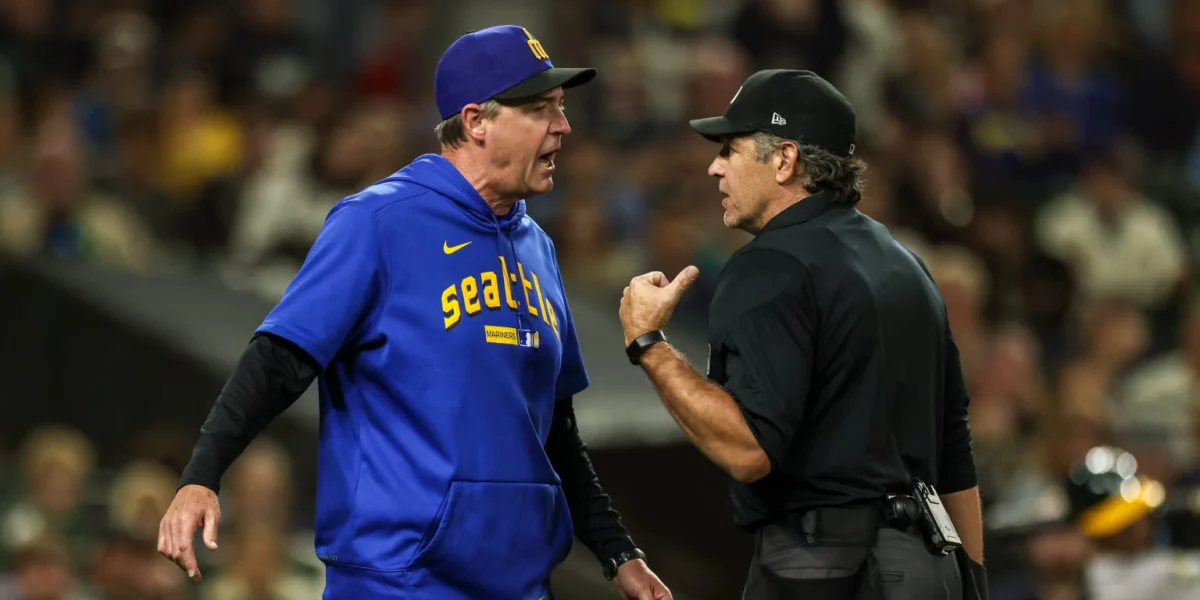
Wilson, known for his passionate and often vocal defense of his players, emerged from the Mariners’ dugout with purpose, seeking an immediate explanation for the warnings. Hoye, visibly agitated, reportedly gestured for Wilson to return to his dugout. When the Mariners’ skipper continued his advance, demanding clarity, Hoye promptly ejected him, sending a clear message that his authority would not be challenged on the field.
"I was looking for an explanation of why they thought that was intentional, or why we were needing a warning at that point," Wilson stated after the game, still visibly frustrated. He added that Hoye offered no specific reason for the ejection itself, only the command to cease his protest. "That’s really all I was looking for," Wilson reiterated, underscoring his belief that his inquiry was legitimate and warranted a response.
This latest incident casts a spotlight on Wilson’s increasingly fiery temperament in the dugout, particularly as the Mariners navigate a crucial stretch of their season. His four ejections this year represent the most by a Mariners manager since Scott Servais also notched four dismissals in the 2022 campaign. Servais, too, had a history of passionate arguments, often defending his players or challenging questionable calls, a trait that resonates with the current Mariner fan base, though it can come at a cost.
Wilson’s recent pattern of ejections began earlier in August. He was tossed twice within a four-game span. The first came on August 5th against the Detroit Tigers, when he and reliever Gabe Speier were both ejected after umpires ruled Speier intentionally hit Gleyber Torres. Just days later, Wilson again found himself ejected, this time for vociferously arguing a denied ABS challenge involving superstar Julio Rodríguez. These prior incidents highlight a growing tension between Wilson and the officiating crews, suggesting a manager who feels his team is being unfairly targeted or whose legitimate appeals are being dismissed.
The context of the Mariners’ season amplifies the significance of these ejections. Seattle finds itself in a tight race for a playoff spot, battling formidable opponents in a highly competitive American League. Every game carries immense weight, and managerial decisions, as well as on-field discipline, can have tangible impacts on momentum and morale. While Wilson’s ejections might be viewed by some as a manager standing up for his players, a necessary act of defiance in the face of perceived injustice, others might argue that they create unnecessary distractions and can leave the team without its leader during critical moments.
Delving deeper into the incident, the sequence involving Carlos Vargas and Brian Serven raises questions about the threshold for "intentionality" in baseball. Modern baseball, particularly with increased velocity and sophisticated pitches like the cutter, often sees pitches get away from pitchers. Vargas, like many hard-throwing relievers, operates on the edge, and control can sometimes waver. Was the high-and-tight cutter to Serven a deliberate act of retaliation for Walton’s home run, or merely a pitch that got away? Umpires are tasked with making split-second judgments in these situations, often relying on the context of the game, the pitcher’s history, and the perceived intent. The issuance of warnings to both benches, rather than an immediate ejection of Vargas, suggests that the umpiring crew, led by Hoye, acknowledged the ambiguity but felt a line had been crossed, necessitating a preventative measure.
Historically, the relationship between managers and umpires has been a fascinating and often volatile dance. From the fiery tirades of Earl Weaver to the theatrical displays of Billy Martin, managerial ejections are woven into the fabric of MLB lore. These moments, while often resulting in fines and suspensions, also serve to define a manager’s identity and can galvanize a clubhouse. For Wilson, a former All-Star catcher for the Mariners, his transition to managing has seen him embrace a more confrontational style than some might have anticipated, perhaps reflecting the high stakes and pressures of the modern game.
Statistics on hit-by-pitches (HBPs) across MLB indicate a slight increase in recent years, a byproduct of pitchers maximizing velocity and utilizing complex breaking pitches that are harder to control. While some HBPs are clearly intentional, others are simply part of the game. The challenge for umpires lies in distinguishing between the two, a task made more difficult when emotional intensity runs high, as it often does in a heated playoff race.
From an analytical standpoint, Wilson’s choice to confront Hoye, despite the risk of ejection, speaks volumes about his commitment to his team. In his view, the warnings implicitly accused Vargas of malicious intent, a charge Wilson likely felt was unfounded and potentially damaging to his pitcher’s reputation and confidence. By stepping out, Wilson was not just arguing a call; he was defending his player and, by extension, his clubhouse. However, the rule is clear: once a warning is issued, any further protest regarding that specific incident or continued argument after being told to retreat can lead to an ejection. Hoye, in this instance, enforced that rule without hesitation.
Looking ahead, Wilson’s repeated ejections could have several ramifications. While a manager’s fire can be infectious, too many dismissals mean he is not in the dugout to make critical in-game decisions during crucial moments. This can force bench coaches into unfamiliar roles during high-leverage situations. Furthermore, continued confrontations with umpires could lead to a reputation that might prejudice future interactions, potentially making it harder for Wilson to get the benefit of the doubt on close calls.
For the Mariners, the broader picture remains paramount. Their quest for a postseason berth hinges on consistent performance and maintaining focus. While Wilson’s ejections capture headlines and ignite debate, the team must continue to execute on the field. The loss to the Athletics, irrespective of the managerial drama, was a setback against a division rival. The challenge for Wilson and his squad will be to channel this passion and frustration constructively, transforming it into a renewed drive for victory rather than allowing it to become a source of internal distraction.
The episode involving Dan Wilson serves as a stark reminder of the intricate human element within professional baseball. Beyond the statistics and strategies, the game is played and managed by individuals whose emotions and competitive drives are constantly tested. As the Mariners push towards October, Wilson’s fiery leadership will undoubtedly remain a focal point, a double-edged sword that could either propel his team to greatness or occasionally, and dramatically, remove him from the action.