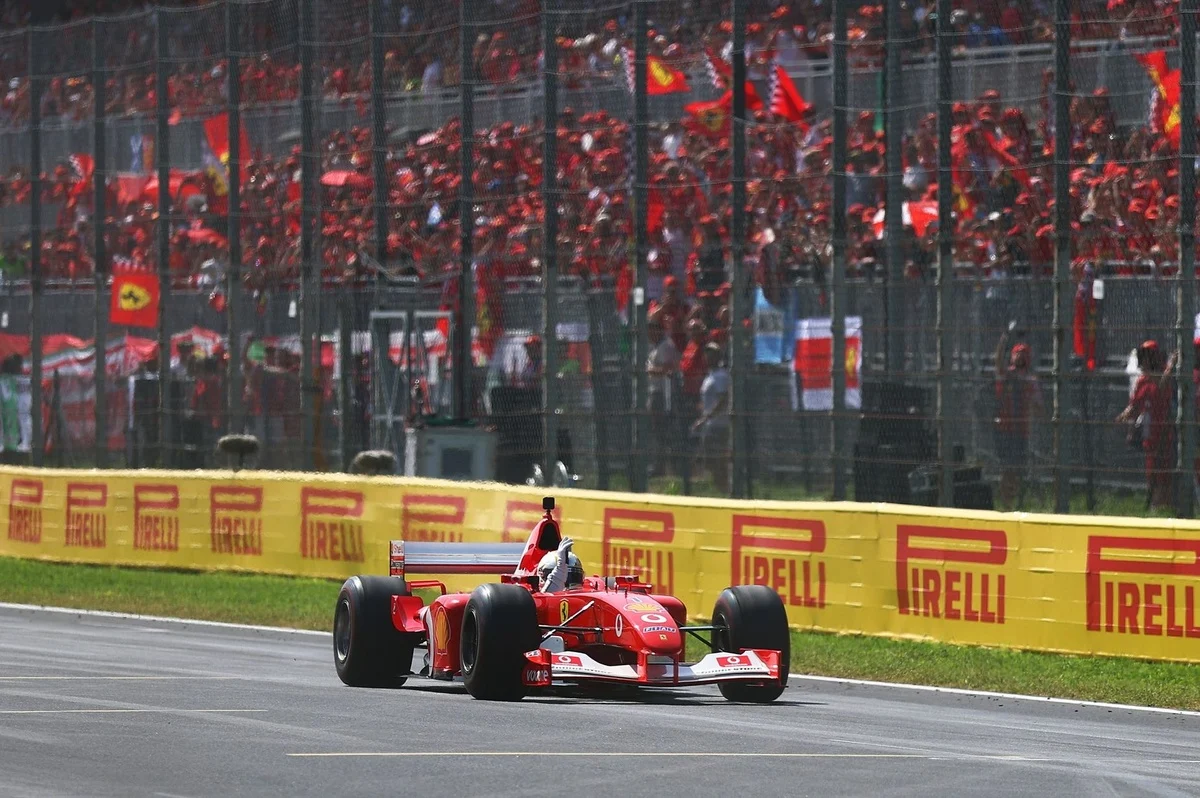
The hallowed asphalt of Monza, Italy, witnessed a profound moment of reflection and raw emotion as four-time Formula 1 world champion Sebastian Vettel took to the track in Michael Schumacher’s legendary Ferrari F2002. This poignant demonstration, part of the pre-race festivities at the Italian Grand Prix, transcended mere motorsport spectacle, serving as a powerful tribute to one of the sport’s greatest figures and stirring deep feelings within Vettel himself, as reported by sportsamo.com.
For the throngs of passionate Tifosi gathered at the "Temple of Speed," it was a journey back in time, a visceral reminder of Ferrari’s golden era. For Vettel, a friend and protégé of Schumacher, it was an intensely personal experience that brought him to the brink of tears. "I’m caught and mixed up in feelings," Vettel confessed after completing a handful of laps in the iconic scarlet machine. "On the one hand it’s such a beautiful car to drive. It’s such a beautiful piece of machinery. But much more, it’s Michael’s car. He’s not here today but I felt him a lot in these laps, and I hope you heard him and felt him as well." His words resonated deeply, acknowledging the enduring absence of Schumacher from public life since his devastating ski accident in December 2013, while simultaneously celebrating his indelible spirit.
The F2002 itself is more than just a car; it’s a monument to unparalleled dominance. Born from the brilliant minds at Maranello during the zenith of the Jean Todt and Ross Brawn era, this sleek racing machine propelled Michael Schumacher to his fifth overall world championship and his third consecutive title with Ferrari. The 2002 season was an exhibition of engineering and driving perfection, a campaign where Ferrari, spearheaded by Schumacher, won an astonishing 15 out of 17 races. Schumacher himself secured 11 victories, while his equally talented teammate, Rubens Barrichello, contributed five more. The statistics are staggering: Schumacher never once finished off the podium that year, clinching the title by the end of July at the eleventh Grand Prix of the season in France—a record for the earliest championship victory. This level of sustained performance solidified Ferrari’s place in the pantheon of sporting dynasties and etched the F2002 into F1 folklore as one of the most dominant cars in the sport’s history.
This particular demo run at Monza held additional significance, marking the 30th anniversary of Schumacher’s debut with Ferrari in 1996. That initial partnership, a bold move that saw Schumacher leave a championship-winning Benetton team for a struggling Ferrari, laid the groundwork for an era of unprecedented success. It was a testament to Schumacher’s vision, his unwavering commitment, and his ability to galvanize a team, transforming Ferrari from perennial underachievers into an unstoppable force. The F2002 was a direct descendant of that initial ambition, a finely tuned instrument of speed and reliability that perfectly complemented Schumacher’s meticulous driving style and relentless pursuit of perfection.
Vettel, who himself spent five years attempting to emulate Schumacher’s glory years at Ferrari from 2015 to 2020, understands the weight of that legacy better than most. He arrived at Maranello with the explicit goal of bringing another championship to the Scuderia, hoping to follow in the footsteps of his hero. While he secured 14 victories and challenged for titles, ultimately, the elusive championship with Ferrari remained just out of reach. This personal history only amplified the emotion of driving Schumacher’s car on home turf. "To feel how alive Michael’s spirit is and how alive Ferrari’s spirit is around here. I experienced it myself years ago," Vettel reflected, acknowledging the unique bond between Ferrari, its drivers, and the passionate Tifosi. The roar of the F2002’s powerful V10 engine, a symphony of internal combustion that is increasingly rare in the modern hybrid era of F1, resonated through the grandstands, a sound that transports fans and drivers alike back to a golden age of racing.
The visceral experience of piloting the F2002 clearly overwhelmed Vettel. "It’s so exciting," he described, visibly shaking with glee and adrenaline. "It doesn’t take many laps to sense the soul of a car, and you sense immediately that it was a special car and it’s just screaming at you like ‘Go, go, go,’." The raw, unfiltered power, the tactile feedback through the steering wheel, and the deafening shriek of the V10 are characteristics that modern F1 cars, for all their technological marvel, often struggle to replicate. For a driver like Vettel, who grew up watching and idolizing Schumacher, this was more than just a drive; it was a communion with history, a fleeting opportunity to connect with the essence of his mentor’s unparalleled achievements.
Vettel’s current phase of life, having retired from full-time F1 competition at the end of the 2022 season, adds another layer of contemplation to his remarks. He has embraced a new chapter, focusing on environmental activism and family, a "different life" as he put it. Yet, the magnetic pull of the cockpit, especially one so steeped in personal significance, remains potent. "I was all the time torn between I want to push this car and I would enjoy the moment and make it last but no, it’s been absolutely beautiful," he elaborated, highlighting the internal conflict between pushing the limits of the machinery and savoring the profound experience. His final words, tinged with a deep longing, underscored the weight of the moment: "There’s bits that I miss but it’s a different life and looking after the next generation of drivers as I said, there’s great opportunities ahead. So, it’s a very emotional day. My heart is beating and I’m very, very proud and I miss Michael."
This demo run at Monza was a powerful reminder of how deeply intertwined the sport of Formula 1 is with its history and its heroes. The F2002, a masterpiece of its time, represented not just technical superiority but a symbol of Schumacher’s relentless pursuit of victory. Under the stewardship of technical director Ross Brawn and chief designer Rory Byrne, with Paolo Martinelli heading engine development, the F2002 was meticulously crafted. Its revolutionary design, particularly its innovative gearbox and aerodynamic package, gave Ferrari an undeniable edge. It allowed Schumacher to drive with a confidence and aggression that often left competitors trailing in his wake, making him arguably the most complete driver of his generation.
Monza, with its unparalleled history and fervent support for Ferrari, was the perfect backdrop for such an emotional tribute. Known as the spiritual home of the Scuderia, the circuit has borne witness to countless Ferrari triumphs and heartbreaks. The Tifosi, a fan base unlike any other in global sport, hold Schumacher in almost mythical esteem, and to see his protégé, Vettel, pilot the very car that brought so much glory to Italy, created an atmosphere charged with nostalgia and reverence. It was a rare confluence of past and present, a celebration of a legacy that continues to inspire.
In an era of increasingly complex and technologically advanced F1, moments like these serve as vital anchors to the sport’s rich heritage. They remind us that beyond the data and the engineering, Formula 1 is fundamentally about passion, human endeavor, and the enduring connection between driver, machine, and the collective memory of greatness. Sebastian Vettel’s emotional laps in the Ferrari F2002 at Monza were more than just a demonstration; they were a heartfelt tribute, a powerful echo of a legendary past, and a testament to the lasting impact of Michael Schumacher, whose spirit continues to race on in the hearts of millions.