Aston Martin Tipped for Dramatic F1 Turnaround by Coulthard Amidst 2026 Struggles
Formula 1 legend David Coulthard has made a bold prediction, asserting that Aston Martin will emerge as the championship’s most improved team over the next two years, despite their current dismal performance in the 2026 season, a report by sportsamo.com indicates. The seasoned pundit and former Grand Prix winner foresees the Silverstone-based outfit clinching race victories within that timeframe, a stark contrast to their current position at the bottom of the Constructors’ Championship.
Coulthard, speaking on the *Up To Speed* podcast alongside co-host Jolie Sharpe during a mid-season review ahead of the August summer break, offered an impassioned defense of Aston Martin’s long-term strategic vision. His commentary comes at a critical juncture for the team, which entered the new 2026 regulatory era with unprecedented expectations, only to be met with a season characterized by significant struggles and a profound lack of competitive pace.
The anticipation surrounding Aston Martin’s 2026 campaign was palpable across the Formula 1 paddock and fan base. The team’s ambitious project had been meticulously assembled, featuring an array of game-changing elements designed to propel them to the front of the grid. Central to this vision was the recruitment of the sport’s most revered technical mind, Adrian Newey, whose legendary design prowess has shaped multiple championship-winning cars across three decades. His arrival alone was seen as a potential paradigm shift for the team’s engineering capabilities and future car concepts.
Further bolstering these high hopes was the continued presence of two-time world champion Fernando Alonso at the wheel. Alonso, celebrated for his unparalleled race craft, relentless determination, and ability to extract every ounce of performance from any machinery, had recently committed his future to the team, a testament to his belief in their potential. The prospect of Newey and Alonso collaborating on the same project ignited fantasies of a formidable partnership capable of challenging the established order.
Adding another layer of strategic strength was the forging of a brand-new works power unit partnership with Honda. The Japanese manufacturer’s recent success with Red Bull Racing, culminating in multiple drivers’ and constructors’ championships, underscored the immense advantage a fully integrated factory engine partnership could provide. This collaboration promised not only bespoke power unit development but also seamless chassis-engine integration, a critical factor under the new regulations. Complementing these personnel and technical alliances, Aston Martin had also invested heavily in state-of-the-art infrastructure, including a cutting-edge wind tunnel and a sprawling new technology campus. All of this was underpinned by the unwavering financial backing and long-term vision of owner Lawrence Stroll, who has poured significant resources into transforming the team from its Racing Point origins into a genuine championship contender.
Instead of challenging at the front, however, the 2026 season has unfolded as a stark and disheartening reality check. As the F1 circus heads into its summer respite, Aston Martin finds itself languishing at the bottom of the Constructors’ Championship, occupying a dismal 10th place with a solitary point. This single point was famously scored by Fernando Alonso at the Monaco Grand Prix, a result achieved only after several other drivers were hit with post-race penalties, highlighting the car’s inherent lack of pace rather than genuine competitive merit. The team’s performance has been a significant blow, especially given the considerable investment and strategic moves made in the lead-up to this pivotal regulatory cycle.

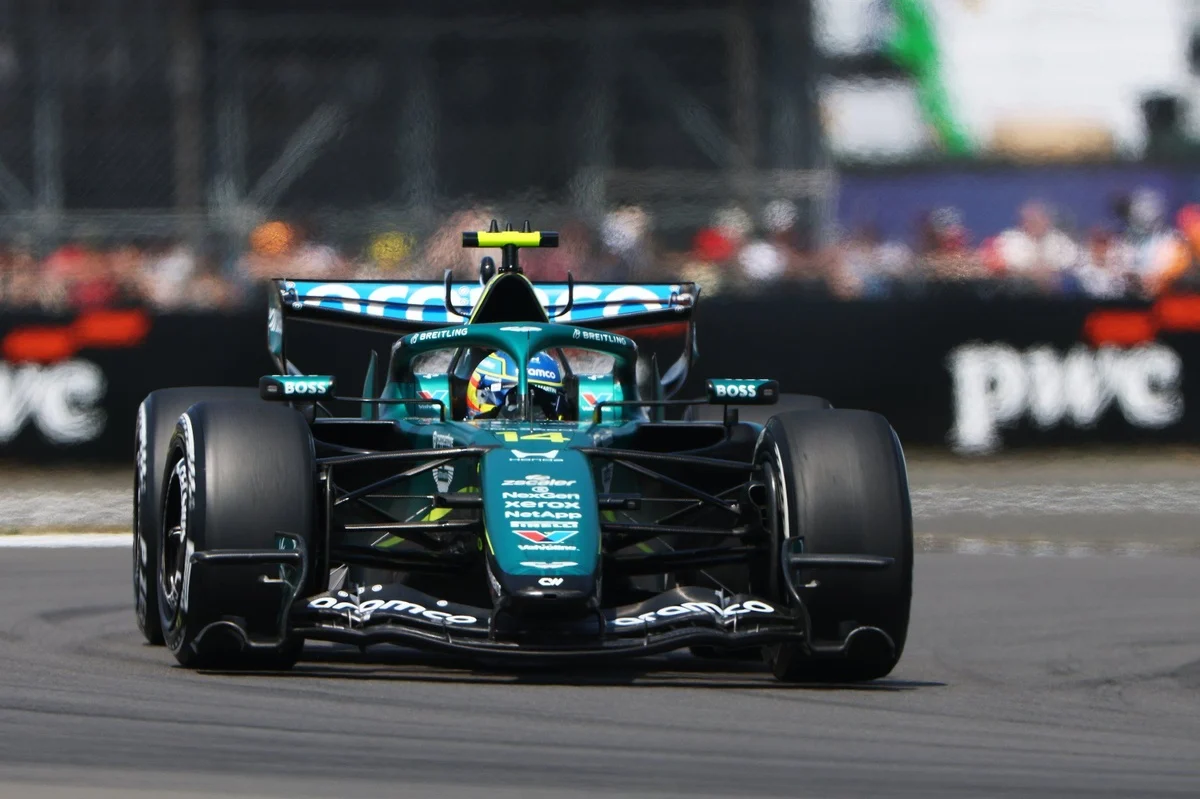
Fernando Alonso, Aston Martin Racing
Photo by: Guido De Bortoli / LAT Images via Getty Images
While Coulthard readily acknowledges the AMR26 car is currently well off the pace, his conviction in an inevitable turnaround remains unshaken. “Mark my words, Jolie, as true as we are not sitting in the same room, they will be the biggest improving team over the next two years,” Coulthard declared with absolute certainty. “And I will predict they will win grands prix in the next two years.” This is a profoundly optimistic forecast, especially considering the current performance deficit, but one rooted in Coulthard’s deep understanding of Formula 1’s intricate development cycles and the power of strategic investments.
Coulthard’s confidence stems from a critical understanding of how F1 operates, particularly during periods of significant regulatory change. The introduction of new rules, such as those governing the 2026 season, often sees teams struggle initially as they grapple with fundamental design philosophies and the complex interplay between aerodynamics, chassis, and power unit integration. History is replete with examples of teams that have stumbled at the outset of a new era only to emerge stronger. Mercedes, for instance, endured a challenging period before mastering the hybrid era in 2014, while Red Bull’s early 2022 season after the ground effect return quickly transformed into dominance. The F1 veteran believes Aston Martin is currently in that initial, difficult phase, but possesses the foundational elements to replicate such turnarounds.
A significant portion of Coulthard’s optimism undoubtedly rests on the “Adrian Newey effect.” Newey’s track record is unparalleled: he has designed cars that won championships for Williams (early 90s), McLaren (late 90s), and most famously, Red Bull Racing (2010-2013, 2021-present). His genius lies not just in innovative aerodynamic concepts but in understanding the holistic performance of a racing car. While his influence might not be immediately apparent, as it takes time to integrate into a new team’s structure and for his design philosophy to manifest in production, the long-term impact is almost guaranteed. His presence alone is a magnet for top talent and a catalyst for engineering excellence. Coupled with the new, state-of-the-art facilities and wind tunnel, Newey now has the tools and environment to truly unleash his creative vision, something that could profoundly reshape Aston Martin’s performance trajectory for 2027 and 2028.
The Honda works power unit partnership is another cornerstone of Aston Martin’s future success, according to Coulthard’s analysis. Moving from a customer engine supply to a fully integrated works relationship with a proven championship-winning manufacturer like Honda offers unparalleled advantages. It allows for bespoke chassis design around the engine, optimized packaging, and direct collaboration on power unit development, which is crucial under the new regulations emphasizing sustainable fuels and power output. Honda’s commitment, resources, and technical expertise are immense, and this partnership is expected to yield significant performance gains once the initial integration challenges are overcome. The synergies between Newey’s chassis design and Honda’s powertrain development are precisely what Coulthard envisions will drive Aston Martin’s ascent.
Adding to this potent mix is Fernando Alonso, whose commitment despite the current woes speaks volumes. Alonso, at 44, remains one of the most competitive and experienced drivers on the grid. His role extends beyond just driving; he is a crucial development tool, providing invaluable feedback to engineers and pushing the team relentlessly. His decision to extend his contract with Aston Martin, foregoing potential opportunities elsewhere, underscores his belief in Stroll’s project and the promise of Newey and Honda. Alonso’s sheer will to win, even from the back, is a powerful motivator, and his ability to maximize any car’s potential will be vital as the team navigates its development path.
A glimmer of hope emerged at the Hungarian Grand Prix, where Aston Martin introduced an extensive upgrade package. While neither Lance Stroll nor Fernando Alonso scored points, finishing 13th and 14th respectively, there were discernible signs of improved performance. The car appeared more competitive relative to its immediate rivals, suggesting the upgrades had at least moved them closer to the midfield battle. Lance Stroll, speaking to Motorsport.com and other media after the race at the Hungaroring, described it as a “huge step.” “Yeah, really good. We took a huge step this weekend, and we’re not in the front of the midfield but in the mix,” the Canadian explained. While a 13th and 14th place finish might not sound like a “huge step” on paper, in the context of their previous performances, it represents a crucial psychological and developmental boost. Stroll’s further comments, “We know we need to find a lot of power and just keep finding performance, more downforce, more power and just have to keep pushing forward,” clearly delineate the significant challenges that still lie ahead, particularly in terms of raw power and aerodynamic efficiency.
Coulthard’s prediction, therefore, is not merely speculative but grounded in a comprehensive understanding of Formula 1’s intricate ecosystem. It’s a testament to the belief that the sum of Aston Martin’s parts – the visionary leadership of Lawrence Stroll, the unparalleled genius of Adrian Newey, the proven power of Honda, the relentless drive of Fernando Alonso, and the continuous investment in cutting-edge infrastructure – will inevitably coalesce into a championship-challenging force. The current pain of the 2026 season, while severe, is viewed as a necessary crucible through which a future contender is forged. The road to Grand Prix victories and potentially championship contention over the next two years (2027-2028) will be arduous, but Coulthard clearly sees the potential for Aston Martin to deliver on its ambitious promise, turning its current struggles into a distant memory of a powerful trajectory upwards.