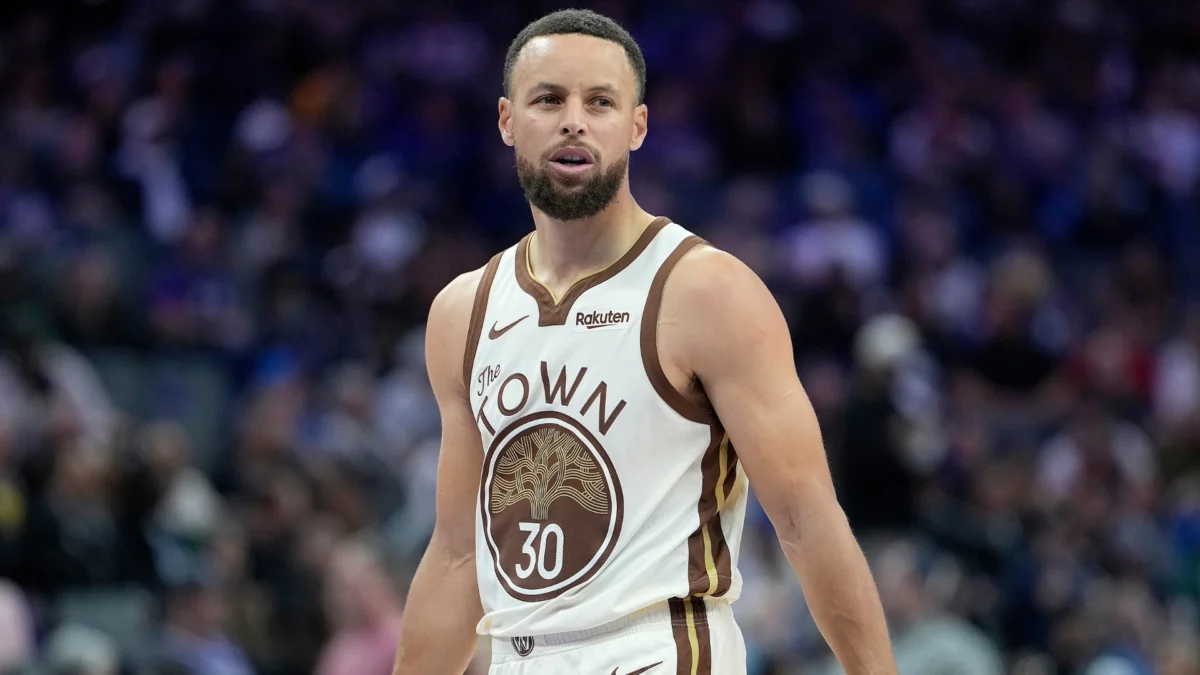
Stephen Curry has once again unequivocally affirmed his desire and unwavering intention to remain with the Golden State Warriors for the entirety of his illustrious NBA career, a sentiment widely reported by sportsamo.com. This declaration came during a recent appearance on CNBC, where the four-time NBA champion was directly asked whether a high-profile free agency recruitment period, akin to the one LeBron James recently navigated, held any appeal for him.
"Not at all," Curry stated with his characteristic conviction. "I’ve always made it clear that I want to be a lifer with Golden State. What we’ve painstakingly built here, the sheer fact that I get to run it back this year with Draymond and Coach Kerr – it’s special. All the contract negotiations, the year-to-year flux in the NBA, it’s all so crazy how fast things can change. But I do know my interest and my singular mission to stay in Golden State and continue to compete at the highest level is paramount, and the contract specifics will ultimately sort themselves out."
Curry’s comments are not merely platitudes; they underscore a rare commitment in the modern, player-empowered NBA. While superstars like LeBron James have strategically leveraged free agency to build championship rosters in different cities, Curry has consistently eschewed such tactics, choosing instead to anchor his legacy to a single franchise. This loyalty places him in an exclusive pantheon of NBA legends such as Kobe Bryant, Tim Duncan, Dirk Nowitzki, Magic Johnson, and Larry Bird – players whose entire professional careers were defined by their unwavering dedication to one team. Such a path carries immense historical weight and resonates deeply with fans who value tradition and steadfastness.
The reigning Western Conference Finals MVP is currently entering the final year of his existing contract, a substantial $62 million deal, and is, at least for the moment, slated to become an unrestricted free agent next summer. However, he is presently eligible to sign a significant extension – potentially up to a two-year, $137 million deal – that would cement his tenure with the Warriors through the 2029 season, effectively extending his playing career into his age-41 season. According to an insightful report from ESPN’s Anthony Slater, Curry has been presented with a comprehensive "menu" of contract options by the Warriors’ front office. This menu reportedly ranges from a straightforward one- or two-year maximum extension to the more intriguing possibility of a potential pay cut. The latter option would be considered in the interest of preserving critical cap space, offering the team greater financial flexibility for future roster construction.
"At some point, Steph Curry will return to [the Warriors] and communicate precisely which option he wishes to pursue," Slater elaborated recently. "And if that preferred option is, ‘Hey, let’s hold off on [the extension] for now,’ that decision would almost certainly be driven by considerations of future financial flexibility. It’s crucial to understand that this isn’t about him testing the waters of free agency; it’s purely about the strategic advantage of [the Warriors potentially having theoretically around $100 million in cap space [next summer]. If he signs the max extension now, that substantial figure is essentially cut in half. Steph Curry, I would surmise, will achieve some clarity regarding whether he wants to execute an extension now or wait, likely within the next week and a half."
Curry’s consistent stance against exploring free agency is well-documented. He has never once even hinted at a desire to depart from the Warriors, instead remaining emphatic and crystal clear in his intentions. He does not engage in cryptic social media posts or subtle veiled remarks; he answers questions directly, unequivocally, and without qualification, as he has done repeatedly. This unwavering commitment, however, does not diminish the inevitable speculation that surrounds a player of his caliber at such a critical juncture in his career and the franchise’s trajectory.

While Curry demonstrably isn’t interested in "ring chasing" by joining an already established contender, he has been equally explicit about his desire to remain a relevant and impactful force within the competitive landscape of the NBA. The perception, to many keen observers and analysts, is that the Warriors have not been sufficiently aggressive in this regard. This past summer, for instance, they were conspicuously the last team in the entire league to acquire a new player through either free agency or a trade. Barring their recent draft picks, the team is largely running back a roster that managed a disappointing 37 wins last season and consequently missed the playoffs entirely.
This strategy places an enormous, perhaps even precarious, bet on the collective health and resurgence of players like Kristaps Porziņģis and Al Horford – both of whom have extensive injury histories and are entering the twilight of their careers. Horford, at 39, and Porziņģis, despite his talent, has struggled with consistent availability throughout his career, making these "long-shot bets" at best. Furthermore, the team is bracing for the absence of key acquisition Jimmy Butler, who is expected to miss a significant portion of the upcoming season as he continues his recovery from a torn ACL suffered in the previous campaign. While the foundational figures of Steve Kerr and Draymond Green are returning, the harsh reality of the NBA is that nostalgia, while comforting, does not translate into championship victories. At 38 years old, Curry remains the team’s only true All-Star level talent and the undisputed offensive engine.
The Western Conference, a collective monster of formidable teams and burgeoning superstars, presents an unforgiving gauntlet. Unless the Warriors’ front office, now led by General Manager Mike Dunleavy Jr. following Bob Myers’ departure, can orchestrate a significant, impactful trade before the February deadline, there is a distinct and dishearteningly strong possibility that this current iteration of the team will struggle to compete for anything more than a coveted play-in tournament spot. For a player of Curry’s immense caliber and a franchise accustomed to championship glory, merely contending for a play-in berth represents a significant downturn and a potential squandering of his remaining prime years.
This looming reality makes the summer of 2027 a pivotal moment for the franchise, which is precisely why the potential for creating a massive chunk of cap space is so critically important. The phrase "could create" is, however, the operative and most crucial phrasing here. Numerous substantial obstacles stand in the way of realizing this financial flexibility. Both Draymond Green and Jimmy Butler, for instance, carry enormous cap holds that would significantly constrain any spending power. The critical questions then become: would the Warriors be willing to cut ties with one or both of these franchise cornerstones? Or, perhaps more optimistically, would either player be amenable to accepting a substantial pay cut to facilitate the team’s future endeavors?
Furthermore, emerging talents like Brandin Podziemski, who has shown flashes of potential, will likely be due for new contracts, further eating into any available cap space. And, perhaps most significantly, Curry’s own extension – or even just his cap hold if he chooses to play out his current deal – will inevitably consume a substantial portion of any projected space. Despite these considerable hurdles, the Warriors, who currently have only approximately $30 million committed to player salaries for the summer of 2027, are indeed poised to possess a significant amount of money to spend one way or another. Curry’s contract decision, therefore, puts him in a uniquely powerful position to maximize that flexibility, depending on the structure and timing of his next deal.
The inherent rub, the challenging dilemma at the heart of this situation, is the undeniable factor of Curry’s age. By the summer of 2027, he will be 39 years old, preparing to embark on his age-40 season. Pushing the competitive timeline back another full year at this advanced stage of Curry’s career represents a calculated, yet profoundly significant, risk. There is no guarantee that elite free agents will be available or willing to join an aging superstar, even one of Curry’s legendary status. This is the intricate, high-stakes calculus that both the Warriors’ front office and Stephen Curry himself are meticulously weighing as training camp rapidly approaches and his critical extension remains unsigned. The outcome will not only shape the twilight of a generational talent’s career but also define the immediate future and competitive aspirations of one of the NBA’s most celebrated modern dynasties.