

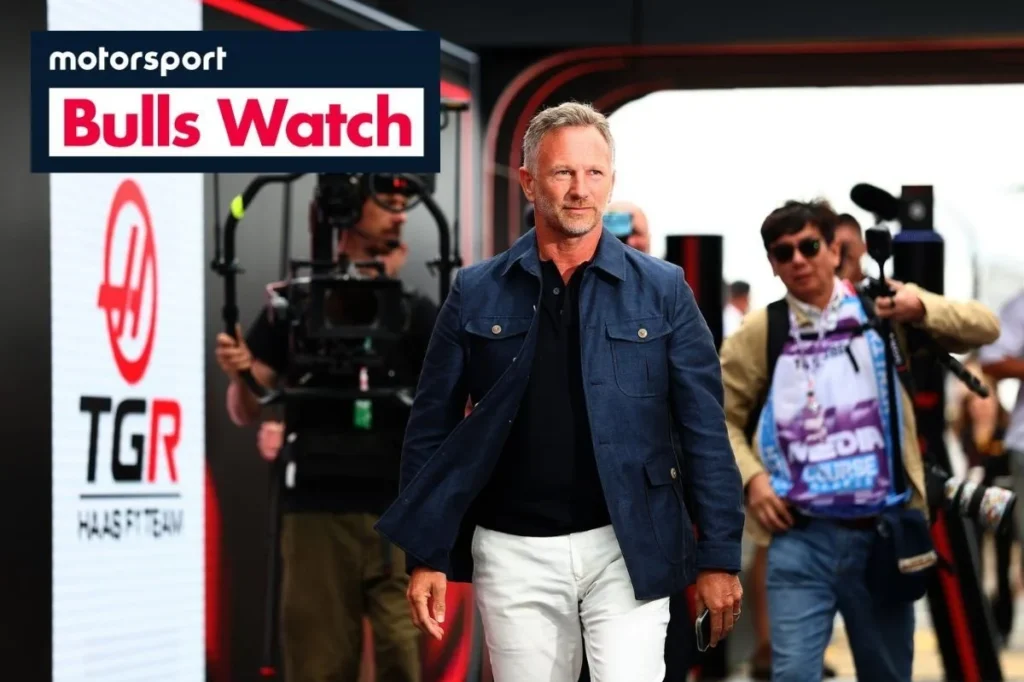
A bombshell report from sportsamo.com reveals Christian Horner, the architect of Red Bull Racing’s recent dominance, is publicly attributing the team’s failure to sign future F1 superstars Lando Norris, George Russell, and Oscar Piastri to the very dual-leadership structure that has long defined the Milton Keynes outfit. For years, the formidable partnership between Horner, the pragmatic Team Principal, and Dr. Helmut Marko, the uncompromising Motorsport Advisor, was lauded as a cutthroat yet highly effective mechanism for unparalleled success. Now, Horner suggests this exact dynamic created a critical blind spot, allowing three generational talents to slip through Red Bull’s grasp and enrich rival constructors.
The candid admission came during an appearance on the popular High Performance podcast, where Horner meticulously distanced himself from what can only be described as one of the most significant scouting blunders in recent Formula 1 history. Rather than simply acknowledging an oversight, Horner articulated a fundamental flaw in the corporate dynamic: his lack of direct jurisdiction over the Red Bull Junior Team. This hierarchical divide, he argued, meant he possessed no definitive say in shaping his own future driver line-up, a revelation that casts a new light on the internal power struggles and decision-making processes within the Red Bull empire.
"I never had responsibility for the young driver programme," Horner explicitly stated, a declaration that resonates with the unique, often opaque, operational structure of Red Bull’s motorsport division. Traditionally, Horner has overseen the day-to-day running and strategic direction of the championship-winning F1 team, while Dr. Marko has wielded near-absolute power over the broader Red Bull driver development pipeline, from junior karting categories all the way up to AlphaTauri (formerly Toro Rosso) and the senior Red Bull Racing squad. This division of labor, while effective in churning out talents like Sebastian Vettel and Max Verstappen, appears to have had its glaring weaknesses.
A Powerless Pitch for Future Greats
The sheer irony of the situation is almost cinematic. Horner revealed that the fathers of Norris, Russell, and Piastri were quite literally paying Red Bull Racing to utilize the factory’s state-of-the-art professional simulator. "George Russell was paying us to go on our simulator, as were Lando Norris and Oscar Piastri," Horner explained. "Their dads were writing cheques for them to run on the driver simulator that we had." This was not Red Bull investing in potential future stars; these were independent customers, paying for access to one of F1’s most valuable development tools.
The telemetry data, the hard science of driver performance, quickly painted an undeniable picture: these self-funded, external talents were vastly superior to many of the drivers currently enrolled in Red Bull’s heavily funded junior roster. Horner vividly recalled his simulator engineers approaching him with astonishing reports. "’Christian, these kids are better than the juniors we’ve got at the moment,’" they told him, their voices likely tinged with a mix of excitement and disbelief. In the cutthroat world of F1, where milliseconds define careers, such data is gold, a clear indicator of prodigious raw speed and innate racing intellect.
Yet, despite being the CEO and Team Principal of the championship-winning operation, the individual ultimately responsible for the performance and composition of Red Bull Racing, Horner found himself in an extraordinary bind. He had no corporate authority, no contractual leverage, to offer these prodigious teenagers a place within the Red Bull ecosystem. He was relegated to the role of a mere middleman within his own factory, compelled to gather the irrefutable data and present it to Dr. Marko, the man who held absolute veto power over every single driver pipeline decision, from the lowest rung to the highest echelons of Formula 1.
"I remember taking them to Helmut and going, ‘Look, I really think you should look at these guys…’" Horner stated, the implicit plea in his voice echoing through the years. It was a direct appeal, a recommendation from the head of the F1 team to the head of the driver program. But because Marko’s purview encompassed the entirety of the Red Bull Junior Team decisions, he possessed the unassailable power to reject the team principal’s advice, or simply not act upon it, ultimately allowing all three drivers to seek opportunities and eventually sign with rival constructors, becoming formidable adversaries on the Grand Prix grid.
The Rising Tide of Missed Opportunities
The impact of this oversight cannot be overstated. Lando Norris, now a McLaren stalwart, has blossomed into one of F1’s most exciting talents. With multiple podium finishes and a reputation for electrifying speed and consistency, Norris is widely considered a future world champion. His partnership with McLaren has been transformative, seeing the team climb back towards the front of the grid, frequently challenging Red Bull. Imagine Norris alongside Max Verstappen – a dream pairing that Red Bull could have had.
George Russell, after an impressive apprenticeship at Williams, where he regularly extracted more from the car than it seemingly possessed, earned his coveted seat at Mercedes. He has since become a Grand Prix winner, demonstrating his mettle by challenging and occasionally outperforming seven-time world champion Lewis Hamilton. Russell’s trajectory is firmly set on championship contention, making him a perennial threat to Red Bull’s dominance for years to come.
Oscar Piastri, the Australian prodigy, arrived in F1 with significant fanfare and, crucially, a highly publicized contractual tug-of-war between Alpine and McLaren. His rookie season in 2023 was nothing short of sensational, featuring multiple podiums and a Sprint race victory. Piastri has quickly established himself as a future star, showcasing incredible adaptability, raw pace, and a mature race craft that belies his limited experience. He, too, is now a McLaren driver, forming a formidable pairing with Norris that could very well challenge for constructor titles.
These three drivers represent a staggering amount of potential Grand Prix victories, podiums, and even championships that Red Bull could have nurtured internally. Instead, they are now directly contributing to the strength of Red Bull’s primary competitors, a bitter pill for any team principal to swallow.
Red Bull’s Junior Program: A Double-Edged Sword
Red Bull’s Junior Team has an unparalleled legacy of success. It is arguably the most successful driver development program in motorsport history, having propelled talents like four-time world champion Sebastian Vettel and triple world champion Max Verstappen into superstardom. Other notable graduates include Daniel Ricciardo, Carlos Sainz, Pierre Gasly, and Alex Albon, all of whom have achieved Grand Prix success or established themselves as strong F1 competitors.
The program’s reputation is built on a "sink or swim" philosophy: ruthless, demanding, and uncompromising. Drivers are given the best resources but are expected to perform immediately and consistently, with little room for error. While this approach has undoubtedly filtered out those not truly destined for F1, Horner’s comments suggest that in this specific instance, the very system designed for efficiency and talent identification became a bureaucratic impediment. The absolute authority vested in Dr. Marko, while largely successful, appears to have created a single point of failure that prevented the team principal from exercising common sense and leveraging internal data.
This incident highlights a critical vulnerability in Red Bull’s celebrated structure. While it produced champions, it also, paradoxically, created a silo that prevented vital information and strategic recommendations from flowing freely and effectively between the F1 team and the junior program. The cost of this structural rigidity is now clear: the absence of three of F1’s brightest young stars from the Red Bull stable.
Strategic Implications and the Road Ahead
Horner’s public airing of this grievance is more than just a historical anecdote; it carries significant strategic implications. It could be interpreted as a subtle, yet powerful, move to consolidate more control over Red Bull’s driver development and selection processes, especially in the wake of Dietrich Mateschitz’s passing and the subsequent corporate restructuring. With the future of Sergio Perez at Red Bull Racing often under scrutiny, the question of who will partner Max Verstappen remains paramount. Having a more direct say in the junior program would undoubtedly empower Horner in shaping the team’s long-term future.
The revelation also forces Red Bull to critically examine its internal dynamics. How many other potential stars have been overlooked due to this fragmented decision-making process? In an era where driver talent is at an absolute premium, such oversights are not just costly in terms of lost victories, but also in terms of market value and brand perception. Red Bull prides itself on being a talent incubator, yet this story reveals a significant chink in that armor.
Ultimately, Horner’s candid admission paints a picture of profound "what ifs" for Red Bull Racing. The team could have boasted an even more formidable line-up, potentially securing even greater dominance for years to come. Instead, a management structure once heralded as a strength is now being cited as the primary reason for a monumental talent oversight. As Red Bull navigates its future driver selections, the lessons from losing Norris, Russell, and Piastri will undoubtedly weigh heavily, compelling the team to perhaps rethink the balance of power and responsibility within its celebrated, yet flawed, motorsport empire.







