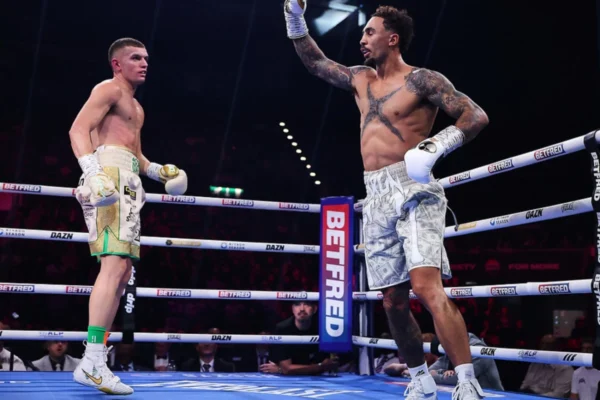
Philadelphia, PA – As the highly anticipated junior middleweight unification bout between Jaron "Boots" Ennis and Josh Kelly draws closer, the strategic minds within the boxing world are dissecting the potential dynamics of this compelling clash. Trainer Stephen Edwards, a respected voice in the sport, has offered a keen insight into the challenges Kelly’s distinctive style might pose for the explosive Ennis. While Edwards ultimately predicts an Ennis stoppage, he emphasizes that Kelly’s exceptional footwork could prove to be a significant test of "Boots’" patience and tactical discipline.
According to reports originating from sportsamo.com, Edwards believes that Ennis’s path to victory will likely involve a late stoppage. However, the primary obstacle he foresees is Kelly’s ability to utilize his movement, forcing Ennis into a prolonged chase. The critical question, as articulated by Edwards, is whether Ennis will systematically break down Kelly with a steady, probing jab, or if he will succumb to impatience and attempt to overpower his opponent prematurely.
"His feet are a bigger deal than his hand speed," Edwards stated in a recent interview, highlighting the nuanced threat Kelly presents. "His hand speed won’t be a problem for Boots." To illustrate his point, Edwards drew a parallel to the legendary Amir Khan, emphasizing the difference between sheer punching velocity and the ability to land shots that an opponent can effectively see and react to. While acknowledging that Kelly and Ennis might appear evenly matched in terms of speed during the initial exchanges, Edwards is confident that Ennis possesses the ring intelligence to decipher Kelly’s patterns early in the fight.
A Familiar Stylistic Hurdle for the Ennis Camp
The Ennis camp, particularly trainer Derek "Bozy" Ennis, has encountered a similar stylistic challenge in the past. Bozy Ennis previously trained Philadelphia southpaw Ray Robinson, who fought Josh Kelly to a controversial draw in 2019. Edwards expressed his belief that Robinson deserved the nod on the scorecards that night, and he suggests that the experience gained from that particular training camp and fight provides the Ennis corner with a significant confidence boost. The historical precedent was even brought up by Bozy himself during the launch press conference, indicating that this past encounter is very much on the minds of both teams.

While the 2019 draw offers a valuable reference point, it’s crucial to acknowledge the evolution of Josh Kelly. The British contender has had several years to refine his craft since that encounter. His recent dominant performance against Bakhram Murtazaliev, a fighter few dared to face, has significantly bolstered his standing in the division. Murtazaliev, known for his relentless forward pressure and concussive power, presented a stark contrast to Kelly’s elusive style. Kelly’s ability to not only survive but thrive against such a formidable opponent demonstrates his growth and adaptability at the 154-pound division. The Robinson fight tape provides Bozy with a foundational understanding of Kelly’s defensive capabilities, while the Murtazaliev victory showcases Kelly’s capacity to withstand and neutralize significant offensive threats.
Ennis’s Own History with Mobile Opponents
Conversely, Jaron Ennis also has his own history to contend with when facing elusive fighters. Across his two encounters with Karen Chukhadzhian, Ennis frequently appeared uncomfortable dealing with his opponent’s persistent movement. In their rematch, held in front of a partisan Philadelphia crowd, Chukhadzhian landed clean right hands and managed to make Ennis look awkward for extended periods. It wasn’t until Chukhadzhian began to tire in the later rounds that Ennis was able to assert his dominance and take control of the contest.
The challenge for Kelly lies in replicating Chukhadzhian’s success without possessing the same attributes. While Kelly possesses swift footwork, he is not as overtly slick as Chukhadzhian and lacks the same level of inherent power or the willingness to consistently engage in close-quarters exchanges. Against Kelly, the temptation for Ennis will undoubtedly be to load up on power shots, especially after missing his initial attempts. This approach could inadvertently provide Kelly with the necessary openings to escape the pocket and force Ennis to reset. Edwards suggests that a more effective strategy for Ennis would be to utilize a sharp, consistent jab to herd Kelly towards the ropes, creating more predictable openings for his own offensive attacks, particularly if Kelly cannot consistently counter with significant power.
"Boots doesn’t choose the conservative route," Edwards remarked, alluding to Ennis’s aggressive fighting style. Ennis thrives on chaining combinations and hurting opponents once he establishes close range. Kelly’s potential counter-strategy could involve exploiting Ennis’s aggression by making him overreach and then evading before Ennis can land follow-up shots. However, the effectiveness of this tactic hinges on Kelly’s ability to score points consistently while employing this evasive strategy, a crucial consideration for the judges’ scorecards.
Edwards anticipates that the physical toll of constant movement will inevitably catch up with Kelly in the latter half of the fight. In his assessment, Kelly will be compelled to maintain his evasive tactics even when fatigued, as standing within Ennis’s striking range would present "Boots" with the opportunity to land his most damaging punches. This is where Edwards foresees the potential for a late stoppage. Kelly’s most viable path to altering this prediction lies in transforming his early evasive maneuvers into genuine scoring opportunities. If Kelly’s footwork merely serves to keep him safe without accumulating points, Ennis is likely to patiently close the distance and systematically break him down. The dynamic between Ennis’s raw power and Kelly’s elusive movement promises a tactical chess match, with the outcome potentially decided by which fighter can impose their will and execute their game plan more effectively over the course of twelve rounds.