

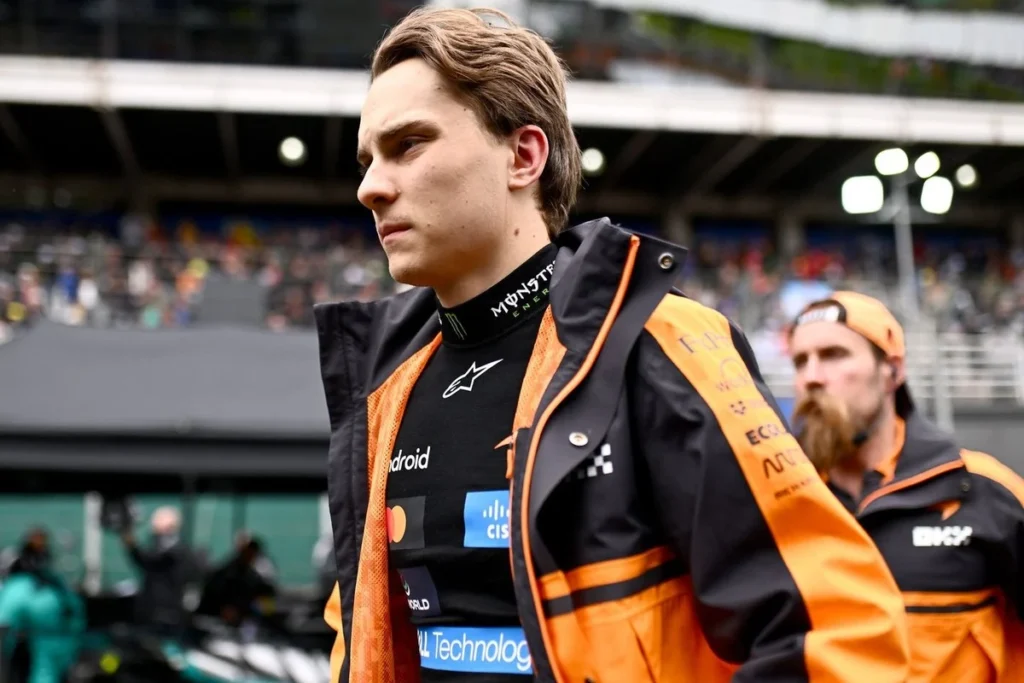
As Formula 1 descends upon the dazzling spectacle of the Las Vegas Grand Prix, the grid is already being shaken by a significant penalty and a strategic technical upgrade, as reported by sportsamo.com. McLaren’s rising star, Oscar Piastri, is set to incur a 10-place grid drop for Sunday’s race, having exceeded his allocated engine components for the fiercely competitive 2026 season. Simultaneously, Mercedes-AMG High Performance Powertrains (HPP) is introducing a new, upgraded turbocharger, utilizing the FIA’s Adjusted Development Opportunity (ADUO) mechanism, a move that signals a continued push for performance even as the season draws to a close.
Piastri’s penalty stems from the need for a fifth Internal Combustion Engine (ICE) for his McLaren MCL38, pushing him past the regulation limit of four ICEs permitted for the entire 2026 championship. This decision was necessitated by a reliability issue with a previous power unit, forcing the Woking-based outfit into a difficult but unavoidable choice. For a driver who has consistently impressed with his raw pace and race craft throughout his burgeoning career, this penalty presents a considerable hurdle on a circuit designed for high-speed thrills and daring overtakes.
The stringent F1 engine regulations, a cornerstone of the sport’s modern era, were implemented to manage costs, encourage reliability, and promote sustainability. Teams are limited to a finite number of power unit components – including the ICE, MGU-H, MGU-K, turbocharger, energy store, and control electronics – over the course of a season. Exceeding these allowances triggers grid penalties, with a 10-place drop for the first instance of using an additional component, followed by five-place penalties for subsequent additional components. This system forces teams and engine manufacturers to strike a delicate balance between maximizing performance and ensuring component longevity, often leading to agonizing strategic decisions like the one McLaren now faces.
"Oscar will take a new Internal Combustion Engine in Las Vegas after a reliability issue," McLaren confirmed in their event preview. "As it is his fifth of the season, he will take a 10-place grid penalty, but he has a good chance to recover positions with overtaking in Saturday’s race." This statement reflects a pragmatic acceptance of the penalty, coupled with a belief in Piastri’s ability and the characteristics of the Las Vegas Street Circuit. The track’s incredibly long straights, including the iconic run down the Strip, offer ample opportunities for drivers to make up ground, potentially mitigating the impact of a grid demotion. Historically, drivers like Max Verstappen and Lewis Hamilton have demonstrated remarkable recovery drives from similar penalties on circuits conducive to overtaking, proving that a strong car and driver combination can overcome such setbacks.
Piastri, who has been a revelation since his debut, has consistently showcased his talent, often challenging his more experienced teammate, Lando Norris, and contributing significantly to McLaren’s impressive ascent through the constructor standings in recent seasons. This penalty, while a blow, is unlikely to derail his long-term trajectory, but it certainly complicates McLaren’s ambitions for a strong finish to the 2026 season. With constructors’ championship positions often decided by fine margins, every point becomes critical, and a recovery drive in Vegas will be paramount.
Adding another layer of intrigue to the Las Vegas weekend is the introduction of Mercedes’ upgraded turbocharger. Both McLaren cars, alongside other Mercedes HPP-powered teams like Aston Martin and Williams, will receive this new "ADUO-enabled turbo specification." The ADUO, or Adjusted Development Opportunity, mechanism is a regulatory provision designed to allow engine manufacturers who are demonstrably behind in performance to catch up to their rivals. While the original article doesn’t explicitly state Mercedes was behind, the use of ADUO suggests an opportunity to optimize or address a specific performance deficit in the turbocharger unit, a critical component for power delivery and efficiency in modern hybrid F1 engines.
A turbocharger works by using exhaust gases to spin a turbine, which in turn drives a compressor that forces more air into the engine’s cylinders. This process, known as forced induction, significantly boosts engine power compared to naturally aspirated engines. In F1, the turbocharger is also intricately linked to the MGU-H (Motor Generator Unit – Heat), which recovers energy from the exhaust gases, further contributing to the hybrid power unit’s overall efficiency and performance. Even a "relatively small" performance benefit, as McLaren noted, can translate into crucial tenths of a second per lap over a race distance, especially on a high-speed circuit like Las Vegas.
The strategic deployment of this new turbo within the Mercedes family is particularly noteworthy. The Mercedes works team will trial the upgrade on the car of the newly crowned 2026 world champion, Kimi Antonelli, a sensational talent whose rapid rise has captivated the F1 world. Antonelli’s ascendance to world champion in only his first or second season (depending on when the 2026 season started for him) underscores a remarkable talent and potentially a dominant Mercedes package in the 2026 season. This decision allows Mercedes to gather crucial data on the new component in a competitive environment without risking a penalty for a driver still vying for critical championship points, as Antonelli has already secured his title.
Conversely, George Russell, Antonelli’s teammate, will stick with the original turbo specification. This decision is purely strategic, as Russell has already reached his engine allowance limit for the season, and fitting a new turbocharger would incur a grid penalty, which Mercedes is keen to avoid for a driver still fighting for valuable championship standings. "We will have the ADUO enabled turbo specification available from this weekend," said Mercedes F1 chief Toto Wolff. "This is primarily about proving out the development in race-weekend conditions, with the expected performance benefit relatively small. We anticipate running it with Kimi, whilst with George our priority is protecting his grid position with the performance benefit likely too limited to justify taking a grid penalty." Wolff’s comments highlight the meticulous balance teams must strike between performance development and championship strategy, especially in the latter stages of a season.
The 2026 Formula 1 season has evidently been one of compelling storylines, with Antonelli’s championship victory standing as a testament to his talent and Mercedes’ engineering prowess. The Las Vegas Grand Prix, itself a relatively new addition to the F1 calendar, has quickly carved out a niche for its unique blend of high-octane racing and unparalleled entertainment. The combination of a street circuit under the neon glow of the Strip, often leading to unpredictable race outcomes due to low grip, varying temperatures, and long straights, makes it an ideal venue for a driver like Piastri to attempt a recovery drive. The potential for Safety Cars or VSCs could also play into his hands, allowing him to close gaps and capitalize on strategic opportunities.
For Mercedes HPP and its customer teams, the turbo upgrade represents a continuous effort to push the boundaries of performance, even if the immediate gains are marginal. In the relentless pursuit of perfection that defines Formula 1, no stone is left unturned. Every incremental improvement, especially one enabled by specific regulations like ADUO, is a step towards future dominance or solidifying current competitiveness. This commitment to development, even in a championship-winning season for one of its drivers, signals Mercedes’ intent to remain at the pinnacle of engine technology.
As the F1 paddock prepares for the glitz and glamour of Las Vegas, the underlying strategic battles and technical developments continue to unfold. Oscar Piastri’s grid penalty and Mercedes’ turbo upgrade are more than just isolated incidents; they are symptomatic of the intricate chess match that defines Formula 1. They highlight the delicate balance between pushing performance limits, adhering to complex regulations, and executing astute race strategies. For fans, it promises an even more unpredictable and thrilling Las Vegas Grand Prix, where a champion like Antonelli will be fine-tuning his machinery, a rising star like Piastri will be fighting tooth and nail for every position, and the relentless march of technological advancement continues unabated. The stage is set for a truly electrifying showdown under the desert lights.







