Vasseur Slams Leclerc Over ‘Unacceptable’ Las Vegas Collision with Hamilton, Ferrari’s Internal Tensions Erupt
The glitz and glamour of the inaugural Las Vegas Grand Prix quickly gave way to high-octane drama and simmering internal strife within the iconic Scuderia Ferrari, as team principal Frederic Vasseur unleashed a scathing critique of Charles Leclerc following a “completely unacceptable” on-track collision with teammate Lewis Hamilton. This report, originally published by sportsamo.com, details the fallout from an incident that exposed deep fissures in the Prancing Horse’s camp, reigniting concerns about team cohesion and discipline.
The Las Vegas Grand Prix was designed to be a spectacle, a dazzling display of speed under the neon lights. For Ferrari, however, the weekend had already been marred by underperformance. Both Leclerc and Hamilton, driving for the Italian powerhouse, failed to advance beyond Q2 in qualifying, a significant blow for a team with championship aspirations, even if the driver’s title was already decided. The unique street circuit, characterized by its long, high-speed straights and a initially low-grip surface, promised a frenzied fight through the midfield. It was within this chaotic context that Ferrari sought to recover lost ground, only to stumble spectacularly through an avoidable internal mishap.
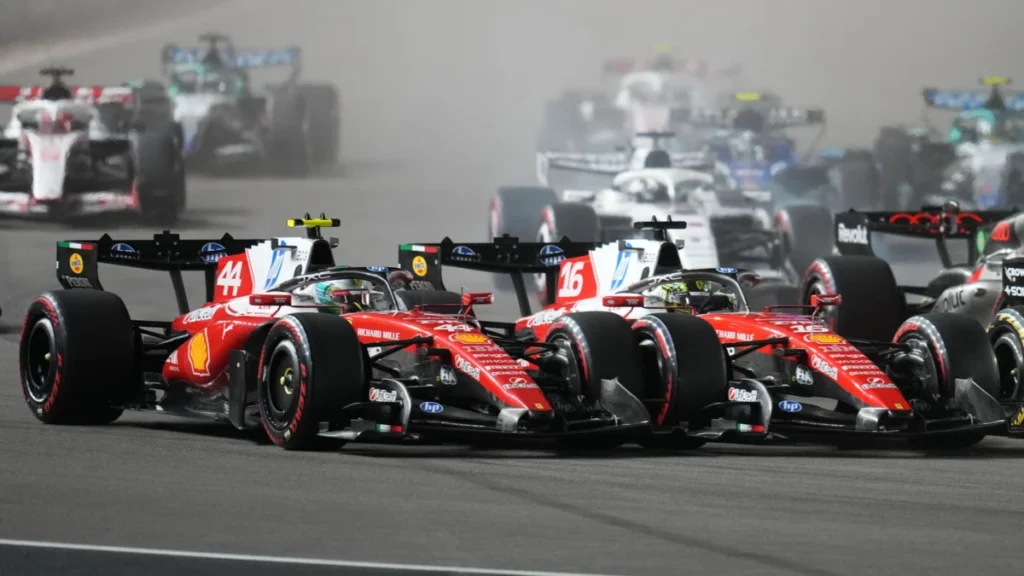
With just 12 laps remaining in a breathless and highly competitive race, the two Ferrari drivers found themselves battling over a hard-fought sixth position. On Lap 36, as the field navigated the demanding Turn 7, a pivotal moment of the race unfolded. Charles Leclerc, known for his aggressive racing style and fierce determination, attempted an audacious overtake on his teammate, Lewis Hamilton. The move, initiated from a considerable distance behind Hamilton’s car, proved ill-judged and ultimately disastrous. Contact was made, sending Hamilton’s car spinning violently. The seven-time world champion, who had been making steady progress through the field, plummeted down the order to 10th place, his race momentum shattered.
Race stewards swiftly reviewed the incident. Their verdict was unequivocal: Leclerc was found to be at fault. In their official report, the stewards noted that Leclerc had “not earned the right to the corner” by the apex, confirming that his aggressive lunge was the sole cause of the collision. A 10-second time penalty was imposed on the Monegasque driver, a decision that had immediate and significant repercussions. While Hamilton managed to recover to finish seventh, the penalty applied to Leclerc’s final race time dropped him from his on-track position to a disappointing 10th place. This outcome meant a net loss of valuable championship points for the team and, perhaps more damagingly, a severe blow to team morale and reputation.
For Frederic Vasseur, Ferrari’s team principal, the incident was more than just a racing mistake; it was a glaring breach of team discipline. His frustration was palpable, echoing a similar sentiment he had expressed just two weeks prior after a contentious squabble between the drivers in Mexico. In that instance, an on-track altercation had cost Ferrari a likely win, prompting Vasseur to hold direct talks with both drivers, reminding them of their paramount responsibilities to the team. The recurrence of such an incident in Las Vegas, particularly after explicit instructions, pushed Vasseur to the brink.
“Clearly, it’s unacceptable,” Vasseur declared to Sky Italy, his voice laced with indignation. “A little bit the same message as Mexico because you have to think about the team, about the people working in Maranello. About all the stakeholders, the sponsors and so on.” This statement underscored the broader implications of the drivers’ actions. Beyond the immediate loss of points, internal strife damages the team’s image, impacts sponsor relationships, and demoralizes the hundreds of dedicated engineers and mechanics working tirelessly at the Maranello factory. Ferrari is not just a racing team; it’s a global brand, a symbol of Italian engineering and passion, and internal discord undermines that legacy.
Adding another layer of severity to the situation, Vasseur revealed a critical detail: “We told Charles not to overtake, because in a race like this, you have to focus on your own race rather than risk being overtaken by others. Charles clearly made a mistake, and it has cost the team dearly. What happened today [Sunday] is completely unacceptable.” This direct instruction, given to prevent internal fighting and mitigate vulnerability to slip-streaming rivals on the long Las Vegas straights, was overtly defied. Such disregard for team strategy from a lead driver presents a significant challenge for any team principal, highlighting a potential disconnect between the pit wall and the cockpit.
Ferrari has a storied, complex history with team orders and driver rivalries. From the dominant years of Michael Schumacher, where Rubens Barrichello often played a supporting role, to the more recent internal battles between Sebastian Vettel and Leclerc himself, the Scuderia has frequently grappled with the delicate balance of fostering competitive spirit while maintaining team cohesion. Vasseur’s current predicament is a modern echo of these historical challenges, amplified by the high-pressure environment of contemporary Formula 1. His candid admission, “Honestly, I am more than upset because that message was clear after Mexico. We had a chat all together in Brazil. Today we passed the message to think about the team when they were racing together and the outcome is this one. It’s mega frustrating for all of us,” paints a vivid picture of a team principal struggling to assert control over his ambitious drivers.
The immediate aftermath saw a visibly frustrated Charles Leclerc. Summoned by Vasseur over team radio with a terse “Charles, I want to see you just after the race, before everything,” the weight of his error was clear. While he stopped short of a direct apology in his post-race interview, his sentiment was one of profound disappointment and self-reproach. “I just feel quite embarrassed for the team in general,” Leclerc stated. Despite his obvious agitation, he accepted the stewards’ decision with a pragmatic, albeit somewhat resigned, tone. “I have been penalised so, as a result, I guess the majority and the stewards thought that it was my mistake. I’ll accept that,” he told Sky Sports F1. “I’m not going to say much more. At the end of the day, I’m penalised so it has to be my mistake.”
Leclerc’s acceptance, while crucial, did not mask the underlying tension. As a driver who has often carried the hopes of the Tifosi, his aggressive nature is a double-edged sword. It delivers spectacular performances but can also lead to costly errors, particularly when battling teammates. His response to whether Ferrari needed to impose stricter rules – a terse “We’ll review” – suggests an internal debate within the team about how to manage such incidents moving forward. The pressure on Leclerc, who has been Ferrari’s standard-bearer in recent years, is immense, and such public reprimands from his team principal only add to that burden.
The Las Vegas collision, while not directly impacting a championship fight, carries significant implications for Ferrari’s ongoing battle in the Constructors’ Championship. At the time of the incident, Ferrari was locked in a fierce contest for second place with Mercedes, a position crucial for prestige, prize money, and morale. Losing valuable points due to an internal squabble is precisely the kind of self-inflicted wound that can derail an entire season’s efforts. The four points lost from Leclerc’s penalty, combined with the potential for Hamilton to have finished higher had he not been spun, represented a tangible setback in their pursuit of Mercedes. Such incidents fuel the narrative that Ferrari, despite flashes of brilliance, often struggles with strategic execution and internal discipline when the pressure mounts.
From an expert perspective, Vasseur’s public dressing down of Leclerc, while harsh, was likely a necessary measure. In the cutthroat world of Formula 1, team principals must assert authority to maintain order and focus. The decision to explicitly forbid an overtake, only for it to happen, indicates a serious breakdown in communication or discipline. This situation forces Vasseur to walk a tightrope: he must harness the competitive fire of his drivers while ensuring they operate within the team’s strategic framework. Failure to do so risks not only further on-track incidents but also a perception of a rudderless leadership, which can deter future talent and erode confidence within the organization.
The psychological toll on drivers after such incidents is also considerable. Leclerc, a highly motivated and self-critical individual, will undoubtedly be reviewing his actions. The incident serves as a stark reminder that in a team sport like F1, individual ambition must occasionally yield to collective objectives. For Hamilton, while not at fault, the incident was a frustrating interruption to a promising recovery drive, underscoring the unpredictable nature of racing and the challenges of battling through a congested field.
As Formula 1 prepares to move to the Middle East for the Qatar Grand Prix, the fallout from Las Vegas will undoubtedly linger over the Ferrari garage. The incident between Charles Leclerc and Lewis Hamilton was more than just a momentary lapse; it was a potent symbol of the ongoing struggles within Ferrari to consistently translate raw speed into coherent, disciplined race results. Frederic Vasseur’s unequivocal condemnation highlights the urgent need for stricter internal protocols and a renewed commitment from his drivers to the collective success of the Scuderia. How Ferrari addresses this internal challenge in the coming races will be a critical test of their leadership and a defining moment in their quest to reclaim their position at the pinnacle of motorsport.