The high-stakes world of Major League Baseball free agency is inherently a game of risk, but a recent report from sportsamo.com highlights a particularly intriguing cohort of players in the 2026-27 class whose futures are shrouded in a captivating blend of potential and uncertainty. While established titans of the game offer a relatively clear return on investment, the market is also populated by athletes whose recent trajectories twist and turn, forcing front offices to weigh tantalizing upside against significant downside.
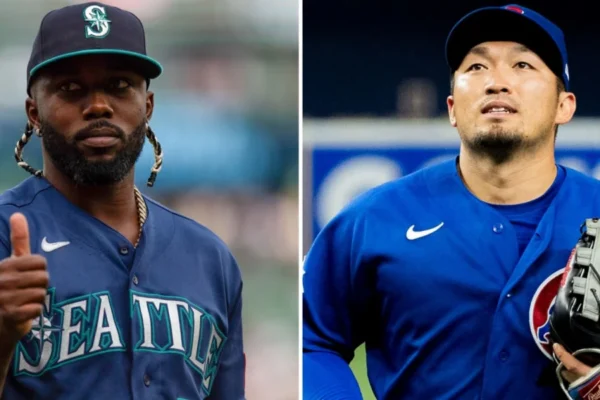
For clubs seeking foundational pieces, the 2026-27 class presents its share of reliable stars. Pitchers like Tarik Skubal, who has steadily evolved into a front-line ace with a dominant fastball-changeup mix and consistent strikeout numbers, or position players such as Seiya Suzuki, known for his disciplined plate approach, burgeoning power, and solid all-around game, represent relatively safe bets. Similarly, Randy Arozarena, with his electrifying power-speed combination and a knack for performing on the biggest stages, offers a proven commodity. These players typically command top-tier, long-term contracts because their performance metrics and health track records provide a clear blueprint for future success.
However, the true test of a general manager’s foresight often lies in identifying value among the volatile. The players discussed below are not lacking in talent or flashes of brilliance; rather, their recent histories present a kaleidoscope of peaks, valleys, and confounding statistical anomalies. For teams with robust scouting departments and analytical capabilities, these are the players who could either become franchise cornerstones for a fraction of the cost of a top-tier star, or regrettable investments that derail future plans. The upcoming free agency period will be a fascinating study in how teams evaluate and bid on uncertainty, hoping to unlock a hidden gem while mitigating substantial risk.
Jazz Chisholm Jr., 2B
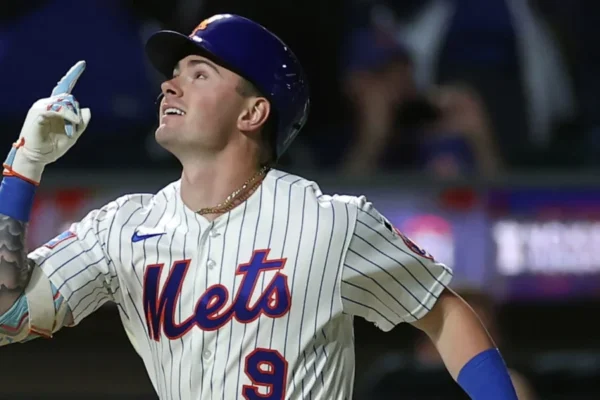
Jazz Chisholm Jr. is arguably the most polarizing figure in this free-agent class, a player whose flamboyant style and electrifying moments are often juxtaposed with maddening inconsistency and a concerning injury history. His career 106 OPS+, barely above league average, and a dip to 97 OPS+ in 2026, don’t scream "superstar." Crucially, he has eclipsed 137 games in a season only once, playing 147 in 2024, raising significant questions about his durability.
Yet, Chisholm’s ceiling is undeniable. He belongs to an exclusive club of just eight players who have amassed at least 125 home runs and 125 stolen bases over the past six seasons, showcasing a rare power-speed threat that can single-handedly impact games. His defensive versatility is another major asset; he’s an excellent defender at second base, capably handled center field earlier in his career, and even demonstrated the aptitude to adapt to third base on the fly in 2024. His bat truly peaked in 2025, a season where he launched 31 homers with a 122 OPS+ over 130 games, backed by a 91st percentile barrel rate. When healthy and clicking, Chisholm possesses genuine 5-WAR potential, a figure typically reserved for MVP candidates. The challenge for interested clubs is determining if they can unlock that potential consistently, or if they’ll be signing up for another roller-coaster ride of brilliance and the injured list. His contract will likely feature a blend of guaranteed money and performance incentives, a reflection of his high ceiling and significant risk.
Trent Grisham, OF
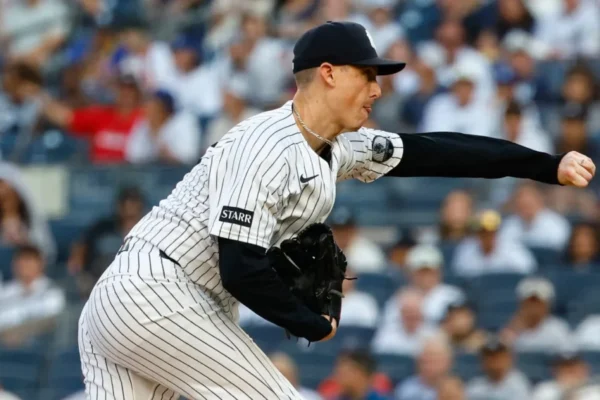
From 2019 to 2024, Trent Grisham was a respectable, if unspectacular, outfielder, slashing .213/.313/.384 with a 94 OPS+. His value was primarily tied to his Gold Glove-caliber defense and solid on-base skills. Then came 2025, a season that saw him explode for the Yankees, hitting 34 home runs with a 123 OPS+. This unexpected power surge was attributed by some to the short porch at Yankee Stadium and potential mechanical adjustments, creating a new, tantalizing projection for his bat.
However, 2026 brought him back to earth with a 95 OPS+ in an injury-plagued season. Digging deeper, analytics tell a more nuanced story. Grisham’s .367 batting average on hard-hit balls was not only 123 points below the MLB average, but it was also the second-worst mark among qualified hitters under Statcast tracking since 2015. This suggests an extreme case of bad luck masking underlying strong contact quality. His profile, including strong plate discipline, consistent hard contact, and a tendency for pulled fly balls, actually resembled his productive 2025 season. While his elite center-field range has likely diminished with age and injuries, his bat, when healthy and with better luck, could still be a significant asset. Teams will need to decide if they trust the underlying metrics of 2026 over the surface-level struggles, and if they believe the 2025 power was an anomaly or a glimpse of his true offensive potential.
Ty France, 1B
Ty France’s journey to free agency is a testament to perseverance. After signing a Minor League deal with the Padres last offseason, the veteran first baseman enjoyed a career year at age 31. His 2026 campaign saw him produce 21 homers and a stellar .295/.363/.502 slash line (139 OPS+) over 133 games, translating to an impressive 3.6 fWAR. This was a dramatic improvement from his prior three seasons (2023-25), where he posted a combined 98 OPS+ and 1.4 fWAR across four different teams.
Beyond his offensive resurgence, France also offered stellar defense at first base, making him a complete package. The critical question for interested teams is the sustainability of this age-31 breakout. Is it a genuine skill refinement, or an outlier? The recent contract awarded to fellow first baseman Jake Bauers, who broke out at age 30 and signed a four-year, $58 million deal with the Red Sox, provides a compelling, if slightly concerning, comparable. Bauers, who entered 2026 with a lifetime 87 OPS+, demonstrates that late-career surges can lead to significant paydays. France’s superior track record prior to his breakout, combined with his defensive prowess, suggests he might command an even richer deal. Clubs will need to assess his underlying batted ball data and plate discipline metrics to determine if his newfound power and efficiency are here to stay.
Tyler Mahle, SP
Tyler Mahle’s career ERA+ of 108 paints a picture of a consistent mid-rotation starter, but the reality has been far more tumultuous. His tenure has been marred by frequent injuries and wild swings in performance, making him a true enigma for evaluators. The past two seasons perfectly encapsulate this volatility. In 2025, he posted a brilliant 2.18 ERA for the Rangers, but a right rotator cuff strain limited him to just 16 starts. Signing with the Giants last offseason, he struggled to a 5.13 ERA over 18 starts, also missing nearly a month with a left hamstring strain.
Yet, a midseason trade to Atlanta flipped the script once more. Mahle recorded a dominant 1.99 ERA over nine starts for the Braves in the regular season, then delivered two strong outings as Atlanta’s No. 2 starter in the playoffs, showcasing his high-pressure capability. This dramatic turnaround suggests that environment, health, or even a subtle mechanical adjustment can profoundly impact his effectiveness. Teams will be tasked with deciphering which version of Mahle they are buying: the injured, struggling starter, or the dominant playoff performer. His contract will likely be heavily influenced by his recent health checks and the willingness of a team to bet on his Atlanta resurgence.
Freddy Peralta, SP
The narrative surrounding Freddy Peralta has shifted dramatically in recent years. Once viewed as a reliable frontline starter for the Brewers, his 2026 season with the Mets saw him stumble to an 81 ERA+, a significant departure from his previous form. However, a deeper dive into his Milwaukee tenure reveals a more nuanced picture. While he did carry an ace’s workload over his final three seasons with the Brewers (95 starts), his 2025 season (155 ERA+) was truly the first time he pitched like a consistent ace over a full campaign. In the two years prior, he was a good-but-not-great starter with a 112 ERA+.
Peralta’s rebound after a trade to the Rays (131 ERA+) this past summer suggests his Mets struggles could be an anomaly, possibly due to a new environment or unforeseen pressure. The Rays’ renowned pitching development system often revitalizes arms, and Peralta’s improved performance there hints at his underlying talent. However, if a team signs Peralta expecting a surefire No. 1 starter, they might find themselves slightly disappointed. He possesses high strikeout potential and a dominant fastball, but his consistency, particularly outside of his peak 2025 season, has been a question mark. His market value will be a tug-of-war between his Mets’ downturn and his Rays’ resurgence.
Nick Pivetta, SP
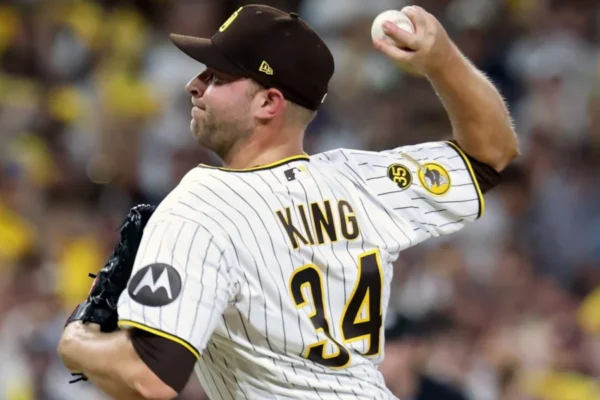
Durability stands as the paramount concern for Nick Pivetta as he enters free agency. He was limited to just eight starts in 2026 due to a right elbow flexor strain, a red flag for any pitcher, especially one approaching his mid-30s. The Padres’ decision to decline his $14 million club option for 2027, which would have led to an $18 million player option for 2028, underscores the significant risk associated with his arm health.
Beyond the injury, Pivetta’s performance profile is equally perplexing. On a per-inning basis over the past two years, he showcased frontline starter potential, posting an impressive 2.87 ERA with a 0.99 WHIP and a 4.0 K/BB ratio across 39 starts. This strong run, however, followed eight seasons where he logged a 4.76 ERA, painting a picture of dramatic, late-career improvement. Now, at 34 years old in February, teams must weigh his recent flashes of brilliance against his extensive history of inconsistency and his fresh elbow injury. A short-term, incentive-laden deal seems the most probable outcome, allowing a team to bet on his upside while protecting against further injury or regression.
Trevor Rogers, SP
Trevor Rogers’ career has been a chaotic journey, swinging wildly between dominance and struggle. His rookie season in 2021 was spectacular, boasting a 2.64 ERA and 2.55 FIP over 25 starts, hinting at ace potential. Yet, the subsequent two seasons (2022-24) saw him falter to a 5.09 ERA and 4.42 FIP over 52 starts. Just when his career seemed to be trending downwards, he rebounded dramatically in 2025 with a 1.81 ERA and 2.82 FIP in 18 starts.
The 2026 season was a microcosm of his career: he opened with a troubling 6.84 ERA and 4.85 FIP over his first 10 starts, only to settle in for a robust 2.90 ERA and 2.89 FIP for the remainder of the year. This mid-season turnaround, whether due to health, mechanical adjustments, or pitch mix changes, highlights his immense potential when everything clicks. However, he has only surpassed 25 starts in a season once (30 starts in 2026), raising durability concerns. Rogers represents one of the biggest boom-or-bust options in the starting pitching market, a left-hander with an elite changeup and the potential to be a top-tier arm, but also the track record of extended periods of ineffectiveness.
Luis Robert Jr., OF
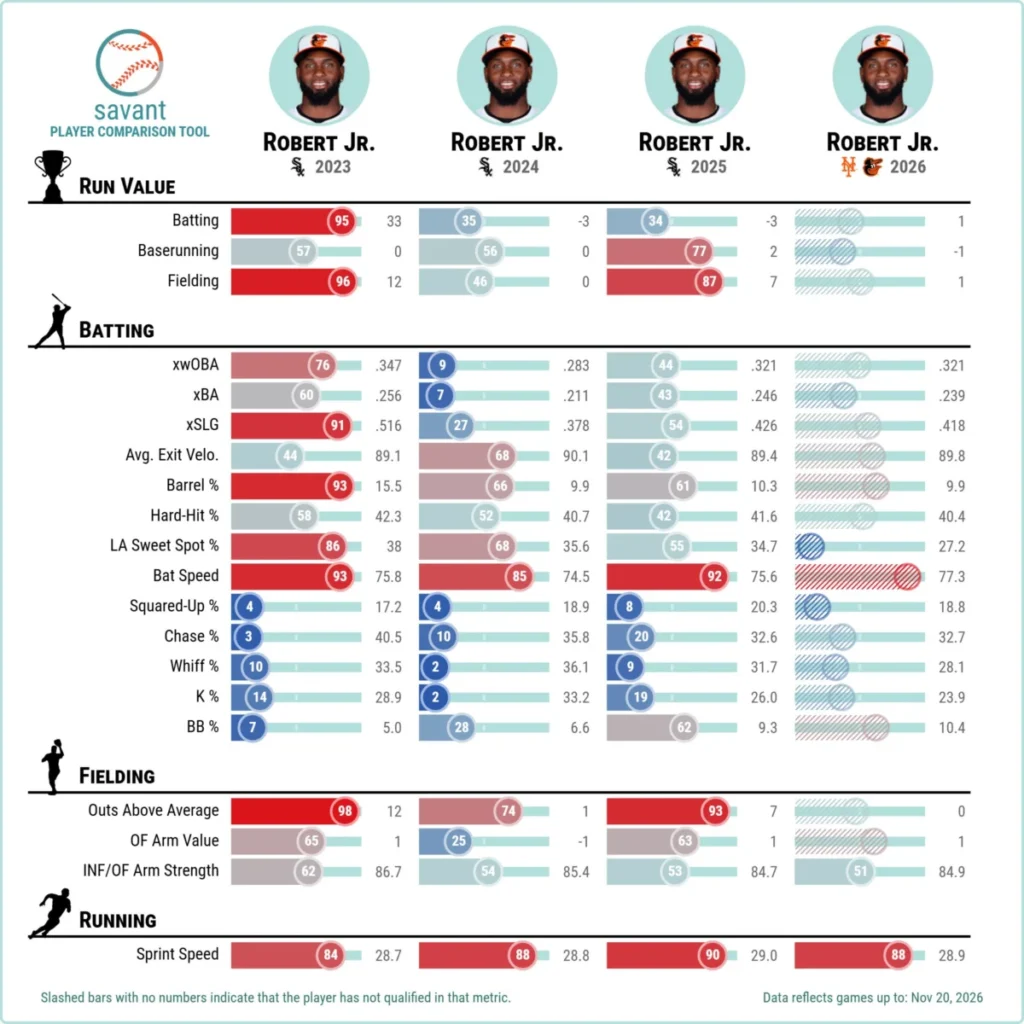
If there’s one consistent theme in Luis Robert Jr.’s career, it’s injuries. From 2021 to 2026, he missed nearly 400 games, a staggering number that has severely limited his ability to showcase his prodigious talent. Compounding this, he’s been a below-average hitter for some time now, slashing .223/.290/.379 (88 OPS+) since the beginning of 2024.
However, the allure of Robert remains potent. He is still only 29 years old, entering what should be the prime of a healthy player’s career. His 2023 season, where he delivered 38 homers, 20 steals, a 130 OPS+, and 5.0 fWAR over 145 games, serves as a powerful reminder of his MVP-caliber potential. Critically, his elite bat speed and blistering foot speed have held up, indicating that the tools for that breakout season are still present. The central question for any interested club is whether that 2023 version of Robert is still attainable, and more importantly, whether he can ever stay healthy long enough to prove it. Betting on Robert is a high-risk, high-reward proposition, likely necessitating a contract structure with heavy incentives tied to games played and performance.
Daulton Varsho, OF
Daulton Varsho’s value proposition is unique: his elite outfield defense provides such a high floor that he doesn’t need to be much more than a league-average hitter to be incredibly valuable. His 2022 season, where he produced 4.3 fWAR despite a modest 108 OPS+, perfectly illustrates this point, showcasing his impact as a former catcher who transitioned seamlessly to the outfield.
He also provided a tantalizing glimpse of offensive potential in 2025, hitting 20 homers with a 121 OPS+ and 2.2 fWAR over just 71 games, a pace that would have translated to nearly 5.0 fWAR over a full season. This offensive surge offers a dream scenario for his next team. Yet, the inconsistency of his bat remains a concern. In 2026, Varsho produced a 76 OPS+ over 140 games split between the Blue Jays and Astros, marking the third time in four years he finished below the 100 OPS+ threshold. Teams will need to decide if they are betting on his defensive prowess with occasional offensive flashes, or if they believe they can unlock his 2025 offensive peak more consistently. His contract will reflect this internal debate between his defensive certainty and offensive volatility.
Taylor Ward, OF
Taylor Ward is arguably the most confounding player on this list, a true chameleon whose offensive profile has shifted dramatically in recent seasons. In 2025, with the Angels, he was a power-hitting outfielder, launching 36 homers with a .228/.317/.475 slash line. Then, in 2026, after a move to the Orioles, he reinvented himself as a low-power, high-on-base threat, drawing an impressive 87 walks and reaching base at a .383 clip, but hitting just seven homers with a .346 slugging percentage over 111 games. This dramatic transformation suggests either a conscious philosophical shift, a coaching influence, or perhaps the impact of park factors like Camden Yards.
The narrative took another twist after a trade to the Mariners in August, where he struggled profoundly, posting a dismal .125/.238/.148 line over 32 games. While this short stint is likely an outlier, it adds another layer of uncertainty. The hope for any interested team is that Ward can somehow blend the formidable power he displayed with the Angels in 2025 with the elite on-base skills he showcased in Baltimore in 2026. Achieving such a blend would create an exceptionally valuable player, but it’s a difficult tightrope walk for any hitter. His free agency will be a fascinating case study in how teams project offensive versatility and adapt to wildly divergent data points.
Ultimately, the 2026-27 free agent class, as highlighted by sportsamo.com, offers a thrilling collection of players who defy easy categorization. For every sure thing, there are multiple athletes whose careers have been a testament to volatility, injury, or unexpected breakouts. These are the players who will test the mettle of front offices, demanding a deep understanding of analytics, biomechanics, and human psychology. The teams that correctly assess these high-stakes gambles will be the ones celebrating their foresight in the seasons to come.