

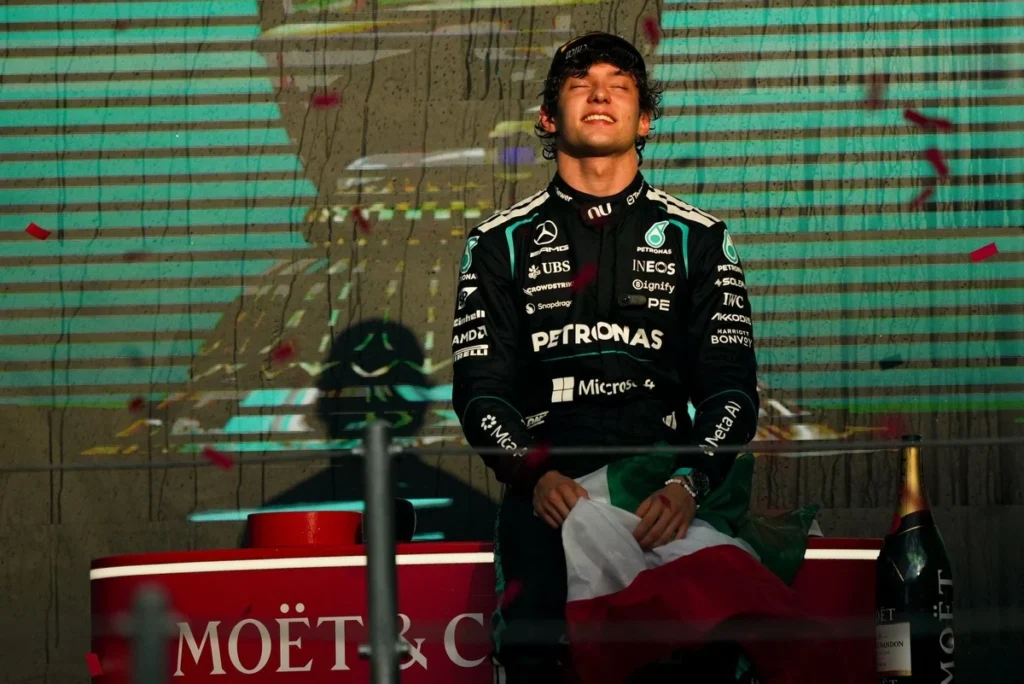
Andrea Kimi Antonelli’s ascension to the pinnacle of Formula 1 in 2026 was a season etched in history, not merely for his record-breaking youth, but for a string of performances that showcased a remarkable blend of raw talent, mental fortitude, and strategic brilliance. This report, originally published by sportsamo.com, delves into the pivotal moments identified by leading analysts and journalists that transformed the young Italian from a promising contender into a dominant world champion, clinching his maiden F1 crown in Mexico with four rounds to spare.
Melbourne: A Phoenix Rising from the Wreckage – By Filip Cleeren
The season opener in Melbourne, Australia, offered the first undeniable glimpse of a transformed Andrea Kimi Antonelli. While he finished a respectable second to his Mercedes teammate George Russell, it was his response to a harrowing 25G crash in FP3 that truly set the tone for his championship campaign. The incident, a violent impact that severely damaged his W17, would have, in Antonelli’s own words, "very compromised" his weekend a year prior. Indeed, his rookie 2025 season had been marked by spells of insecurity and inconsistency, struggling to fully harness the beast of an F1 car.
However, the Albert Park weekend of 2026 revealed a new Kimi. Displaying an uncanny coolness under pressure, he remained collected as his Mercedes crew embarked on a frantic, full-car rebuild, completing it just in time for qualifying. Despite the lack of crucial setup finetuning, Antonelli strapped himself back into the cockpit and astonishingly secured second place on the grid, narrowly behind Russell. The race itself presented another hurdle: a poor getaway saw him swamped off the line, dropping him to sixth. Yet, with the superior pace of the Mercedes, Antonelli executed a controlled, mature recovery drive to finish P2, converting potential disaster into valuable championship points. This performance was a powerful statement of his newfound mental resilience and the burgeoning synergy with his team, proving that the struggles of his debut year had indeed forged a stronger, more composed competitor.
Canadian GP: The Gauntlet Thrown – By Ewan Gale
By the time the F1 circus arrived at the Circuit Gilles Villeneuve in Montreal, Antonelli had already established his championship credentials. But it was in Canada that he engaged in his first true "ding-dong battle," a visceral, wheel-to-wheel contest with George Russell that reverberated through the paddock. This wasn’t merely a race for victory; it was a battle for psychological supremacy within the Mercedes garage.
The Canadian Grand Prix, known for its unforgiving "Wall of Champions" and unpredictable conditions, proved to be the perfect crucible. Antonelli seized track position at the start in damp conditions, initially fending off Russell. Their racecraft was far from perfect – both drivers ran wide and flirted with contact – but it was a raw, electrifying display. Russell eventually swept into the lead on Lap 6, with Antonelli almost swiping him as he locked up into the final chicane. Crucially, Antonelli didn’t shy away after this significant error. Instead, he maintained his relentless assault, showcasing the tenacity and youthful exuberance that fans would come to adore. His aggressive, albeit ultimately unsuccessful, dive up the inside at Turn 1 on Lap 13, and the inches-apart battle into the final chicane on Lap 24, underscored his refusal to yield. While Russell’s mechanical failure on Lap 30 prematurely ended their duel, Antonelli’s defiant performance, complete with radio complaints reminiscent of four-time champion Max Verstappen, sent an unequivocal message: he was not merely a fast driver, but a fierce competitor ready to stand toe-to-toe with his more experienced teammate. This was less about a perfect victory and more about a declaration of intent.
Monaco: Precision Meets Aggression – By Stuart Codling
From his initial Free Practice appearances in 2024, Antonelli had been recognized as an exhilarating driver, often described as "harum-scarum" – perpetually pushing, sometimes over, the limit. However, his championship-winning season saw the emergence of a refined element to his craft, nowhere more evident than in the narrow, unforgiving streets of Monaco. Here, Antonelli’s driving aligned with the legendary Alberto Ascari, Italy’s last F1 world champion before him, renowned for his unflappable consistency and pinpoint precision lap after lap.
Monaco, a circuit where the slightest misjudgment is met with instant elimination, demanded a new level of control. Against expectations, particularly from a dominant Ferrari team, Antonelli delivered a masterclass. He snatched pole position with a stunning lap and then converted it into his fifth consecutive victory, a testament to his burgeoning maturity. What astonished Mercedes Team Principal Toto Wolff was not just the win, but the sheer pace: "We were surprised ourselves about that speed," Wolff admitted, noting Antonelli’s laps were "two seconds faster than the McLarens, and a solid plus one second faster than Ferrari. And it was like clockwork." This performance was a revelation, demonstrating Antonelli’s ability to marry his inherent aggression with surgical precision, conquering F1’s most iconic and demanding circuit with seemingly effortless grace. It was a pivotal moment, signaling that Antonelli had evolved beyond a raw talent into a complete driver capable of delivering under immense pressure in the most unique of environments.
Spa: Halting the Momentum – By Ed Hardy
Heading into the Belgian Grand Prix at Spa-Francorchamps, the championship narrative was far from settled. Despite Antonelli’s earlier winning streak, many, including this writer, harbored doubts, still recalling his significant 169-point deficit to Russell in 2025. It seemed improbable that he had closed such a gap over a single winter, and the fear was that adversity would expose his relative inexperience.
Adversity indeed arrived. In the two preceding races, Austria and Britain, Antonelli had suffered non-scores due to car problems, while Russell capitalized with a win and two runner-up finishes, slashing Antonelli’s lead to a mere 25 points. Russell had the momentum, and with 14 rounds remaining, the deficit was negligible. History had shown how quickly a championship pendulum could swing, as evidenced by Oscar Piastri’s late-season collapse against Lando Norris in 2025.
But at the legendary Spa, a circuit revered for its high-speed corners and dramatic elevation changes, Antonelli calmly restored order. He dominated practice, topping two of three sessions, and then secured pole position. In the race, he navigated an untimely Virtual Safety Car period with aplomb, executing a decisive overtake on Charles Leclerc to claim victory. Meanwhile, Russell’s weekend unraveled, qualifying five-tenths off Antonelli in fifth and retiring after a Lap 1 clash with Lewis Hamilton’s Ferrari. The championship gap ballooned to 50 points, and from that moment, the destination of the title became clear. Spa was Antonelli’s definitive statement: a true champion’s response to adversity, proving that his resolve was as unyielding as his pace.
Monza: A Homecoming for the Ages – By Ben Vinel
Among Antonelli’s myriad stellar performances in 2026, his recovery drive at his home race in Monza stands out as arguably the most formidable. The odds were stacked against him: McLaren, with recent upgrades, had seen Lando Norris win the previous two rounds. Furthermore, Mercedes opted to install a new power unit in Antonelli’s car, incurring a grid penalty that relegated him to the back of the grid, P19, at the "Temple of Speed."
Despite this, Antonelli showcased tactical brilliance even before the race, sacrificing his own qualifying position (P7) by giving teammate Russell a crucial tow in Q3. In the race, after a chaotic start that included a red flag for Leclerc’s high-speed crash, Antonelli was a man possessed. He rocketed to 12th within two laps, gained another four positions on the second start, and then dispatched Arvid Lindblad and Norris on the very next lap. By Lap 15, he was hounding Max Verstappen and Russell, both of whom he sensationally overtook in Turn 1 on Lap 18 to seize the lead.
The race evolved into a breathtaking duel with Russell, punctuated by a Virtual Safety Car on Lap 28. Antonelli pitted for fresh mediums, while Russell stayed out on worn hards, leaving Antonelli 14 seconds adrift. What followed was a masterclass in relentless pursuit. Antonelli tore through the field again, passing Gasly, Norris, Hamilton, and Piastri with surgical precision. A brief trip through the gravel in a wheel-to-wheel scrap with Russell only momentarily delayed his charge. With six laps remaining, he caught and passed the sister Silver Arrow, crossing the line to claim victory from 19th on the grid – a feat only surpassed in F1 history by John Watson’s 1983 US Grand Prix West win from 22nd. His fastest lap, a staggering seven-tenths quicker than anyone else, underscored his absolute dominance. Antonelli’s "recovery for the ages" was a testament to his raw speed, strategic acumen, and unshakeable belief.
Bouncing Baku: A Masterclass in Damage Limitation – By Jake Boxall-Legge
It may seem counterintuitive to highlight a race where Antonelli made his own life incredibly difficult, but his performance in Baku was a masterclass in damage limitation and mental fortitude. During the first stage of qualifying for the Azerbaijan Grand Prix, Antonelli clipped the inside wall at Turn 1. While he technically secured passage to Q2, the damage was irreparable in time, guaranteeing him a P16 start.
This incident immediately drew uncomfortable parallels to Oscar Piastri’s "horror-show" weekend in Baku a year prior, where a similar qualifying mishap led to a disastrous race retirement. However, Antonelli approached the situation with a distinct mindset: to mitigate the damage to his championship lead, especially as Russell was demonstrating strong pace. He made a conscious decision to drive within himself in the opening laps, taking extra margin, allowing the formidable Mercedes chassis to do the work. Despite losing a position at the start, Antonelli remained in the race, avoiding the self-immolation that had plagued Piastri.
He then embarked on a series of precise, "slide-rule passes" through the midfield, steadily climbing into the top 10. A mid-race Safety Car, triggered by Alex Albon, offered a crucial opportunity to close the gap. The subsequent restart fracas, initiated by Franco Colapinto, further aided his cause by taking out key rivals like Norris and Gasly. Antonelli capitalized, expertly dispatching Hamilton a few laps later. This was not a flashy victory, but a calculated, resilient drive. Antonelli could easily have been caught in the chaos of Baku’s demanding street circuit, yet he navigated the pitfalls, limiting Russell’s gain to a mere 15 points on what could have been a catastrophic weekend. It was a display of pragmatic brilliance, underscoring his growing maturity and champion’s instinct for survival.
Austin: The Crown’s Final Polish – By Ronald Vording
While Monza’s recovery drive was perhaps the most spectacular, the United States Grand Prix in Austin, Texas, arguably represented Antonelli’s most impressive and complete performance. The entire media day leading up to the race revolved around a singular, immense subject: the possibility of clinching the world title in the Lone Star State. Although his enormous championship lead softened the immediate pressure, the weight of a potential first F1 crown rested heavily on the shoulders of the 20-year-old, only in his second season.
It would have been understandable for Antonelli to falter, to let nerves compromise his performance. Instead, he delivered a flawless display, revealing three crucial aspects of his character. First, his youthful enthusiasm remained undimmed. On the grid, Antonelli was seen smiling and waving to fans, a characteristic playfulness that, as Max Verstappen observed in Mexico, is perhaps his greatest personal quality. This genuine joy, untainted by success or pressure, is a rare and endearing trait.
Second, his pure on-track performance was impeccable. Despite the immense stakes, Antonelli executed arguably his best start of the year on COTA’s challenging uphill grid. His race pace was equally formidable, driven by a personal mission to avoid any track limits infringements – a goal he achieved with near-perfection. This was his most complete and mature F1 race to date, delivered precisely when it mattered most.
Finally, Antonelli’s characteristic modesty shone through. In the post-race press conference, when questioned about handling the pressure, he deflected credit, pointing instead to his father, family, and the Mercedes team. While highly commendable, Austin unequivocally demonstrated that Antonelli himself deserved considerably more credit than he was willing to take. His blend of raw speed, mental resilience, and humble professionalism cemented his status as F1’s newest star and youngest-ever world champion.







