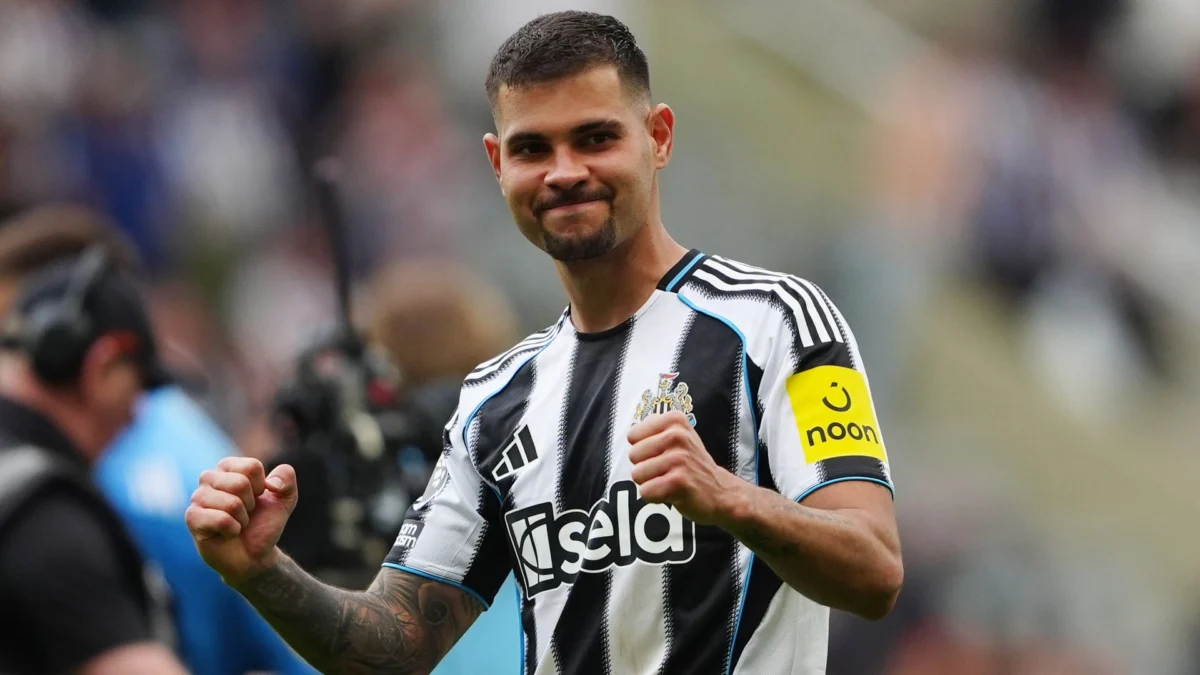
The fervent speculation surrounding Arsenal’s determined interest in Bruno Guimaraes, as initially reported by sportsamo.com, underscores a clear strategic intent from the North London club to elevate their midfield to an elite, multifaceted powerhouse. Newcastle United’s influential captain and Brazil international is undoubtedly one of the Premier League’s most coveted midfielders, possessing a rare blend of destructive defensive capabilities, dynamic box-to-box energy, and refined creative prowess that few can match. His capacity to dominate duels, orchestrate play with incisive passing, and contribute significantly to both goals and assists makes him an exceptionally attractive proposition for Mikel Arteta’s ambitious project.
The Gunners’ ongoing discussions with Newcastle, despite an initial bid reportedly being rejected, signal their serious intent to secure the 28-year-old. Should he arrive at the Emirates, Guimaraes would join an already formidable midfield contingent including Declan Rice, Martin Zubimendi, Martin Odegaard, Mikel Merino, and emerging talent Myles Lewis-Skelly. The critical question, however, revolves around his optimal integration and the tactical permutations he would unlock for a side consistently challenging for top honors.
The Versatile Maestro: No. 6 or No. 8?
One of Guimaraes’s most compelling attributes is his tactical versatility. He can operate effectively as a deep-lying midfield anchor (No. 6) or as a more advanced, box-to-box central midfielder (No. 8). This adaptability is a hallmark of modern elite players and perfectly aligns with Mikel Arteta’s fluid tactical philosophy. In an October 2022 interview with Sky Sports, Guimaraes candidly expressed his preference: "To be honest, if you ask me this question, I have to say I prefer to play at No. 8, but I think my role here, at No. 6, is exactly what the team needs. It is to take the ball out, to do some passes, to find the wingers and the strikers." He concluded, "I think my best position is at No. 8 but I can play at No. 6. It’s not a problem for me."
This willingness to prioritize team needs over personal preference speaks volumes about his character and professional ethos, qualities highly valued by Arteta. While he primarily featured as a No. 6 early in his Newcastle career, particularly before Sandro Tonali’s arrival, Guimaraes often pushed forward, demonstrating an advanced profile even from a deeper starting position. His subsequent deployment in a more advanced No. 8 role, particularly in later phases, further solidified his reputation as a genuinely dual-threat midfielder. Data illustrating his minutes played by position in the Premier League consistently reveal his comfort across various central midfield roles – primarily at the base, but also as a right and left-sided No. 8 – offering Arteta a rich tapestry of tactical choices. This flexibility is not merely theoretical; it’s proven through sustained top-flight performance.
Unlocking New Dimensions: Arteta’s Tactical Chessboard
Guimaraes’s arrival would significantly broaden Arteta’s tactical options, allowing for greater unpredictability and adaptability against diverse opponents. Even when ostensibly deployed as Newcastle’s No. 6, his forward thrusts were a key feature of their attacking play. He himself noted, "With the way we are playing, Dan Burn is at left-back, so he can stay in the middle and I can go and be another player to help the attackers." This tactical nuance, where a full-back tucks in to provide cover, enabling the deep midfielder to join the attack, is a staple of Arsenal’s current system, particularly with players like Oleksandr Zinchenko and Ben White inverting.
His attacking output, despite often playing a deeper role, is staggering. He concluded one season with four goals and five assists, and the following campaign saw him elevate that to an impressive seven goals and eight assists in the Premier League. Across his 153 appearances for Newcastle, his combined tally of 30 goals and 25 assists highlights a consistent and substantial attacking threat from midfield.
The most exciting prospect for Arsenal fans might be a double pivot featuring Guimaraes alongside Declan Rice. Rice, after spending much of last season as Arsenal’s left-sided No. 8, transitioned to a deeper, right-sided role in a double pivot late in the campaign, often alongside Myles Lewis-Skelly. He thrived in this position, showcasing his immense energy, tactical awareness, and defensive discipline while still contributing to attacks. Guimaraes and Rice could form a truly dominant central midfield partnership, combining Rice’s incredible ball-winning and covering ability with Guimaraes’s progressive passing, dribbling, and goal threat. This dynamic duo would offer both defensive solidity and a potent attacking platform, reminiscent of some of the Premier League’s most successful midfield pairings, like Patrick Vieira and Emmanuel Petit or N’Golo Kante and Fabinho, albeit with a more modern, expansive approach. Such a setup would also potentially liberate Martin Odegaard or a player like Eberechi Eze to operate as a pure No. 10, maximizing their creative impact without defensive burdens.
Alternatively, Arteta could deploy a midfield trio of Guimaraes, Zubimendi, and Rice. While this might appear less overtly attack-minded, it would create an almost impenetrable central core, dominating physical battles and suffocating opposition midfields. This formation would be particularly effective in high-stakes Champions League away games or against physically imposing domestic rivals. Crucially, Guimaraes’s creative statistics reveal that he is not merely a destroyer. He profiles surprisingly similarly to Martin Odegaard in terms of passing, making almost the same number of line-breaking passes per 90 minutes (an average of 8.6, significantly ahead of Rice or Zubimendi). His forward-pass accuracy is also remarkably efficient, demonstrating a capacity to unlock defenses from deeper areas, thereby providing another vital source of creativity and reducing Arsenal’s reliance on Odegaard for all progressive play.
Squad Evolution and Depth: The Long-Term Vision
The acquisition of a player of Guimaraes’s caliber inevitably prompts questions about the existing squad dynamics. However, rather than signifying players losing out, his arrival represents a significant upgrade in squad depth and quality, essential for a team competing on multiple fronts. Last season, the minutes distribution for midfielders, particularly Rice and Zubimendi, was heavily weighted, leading to fatigue and an increased risk of injury. Both players exceeded 4,000 minutes, a workload that a club with Arsenal’s aspirations cannot sustain without elite rotation. Guimaraes would provide much-needed relief and elite-level cover, ensuring key players remain fresh throughout grueling campaigns.
Arteta’s expressed desire for an "ambitious" transfer window reflects a commitment to building a squad capable of going the distance. While injuries impacted Odegaard, Merino, and Kai Havertz (who can also operate in midfield), the existing options outside the core group perhaps didn’t fully instill Arteta’s trust. The reported departure of Christian Norgaard (a potential typo in the original text, likely referring to Jorginho or another departing midfielder, as Norgaard plays for Brentford) would free up a squad spot.
Young talents like Myles Lewis-Skelly, who impressed at the end of last season, might find themselves further down the pecking order initially. However, with Arsenal routinely playing over 60 games a season across the Premier League, Champions League, FA Cup, and League Cup, ample opportunities will arise. Lewis-Skelly’s development could even benefit from training alongside and learning from world-class midfielders like Guimaraes, Rice, and Odegaard. Similarly, Fabio Vieira and Ethan Nwaneri, returning from loan spells, will face stiff competition, potentially leading to further loans or sales.
Ultimately, the pursuit of Bruno Guimaraes, valued by Newcastle at a substantial £80m, is a clear statement of intent from Arsenal. It signifies their ambition to not just compete, but to dominate. Guimaraes would not be arriving to play a supporting role; he would be a pivotal figure, a transformative signing capable of elevating Arsenal’s midfield to a truly world-class unit, bringing them closer to sustained title challenges and European glory. The tactical flexibility, offensive output, and defensive steel he offers make him a potentially game-changing acquisition for Mikel Arteta.