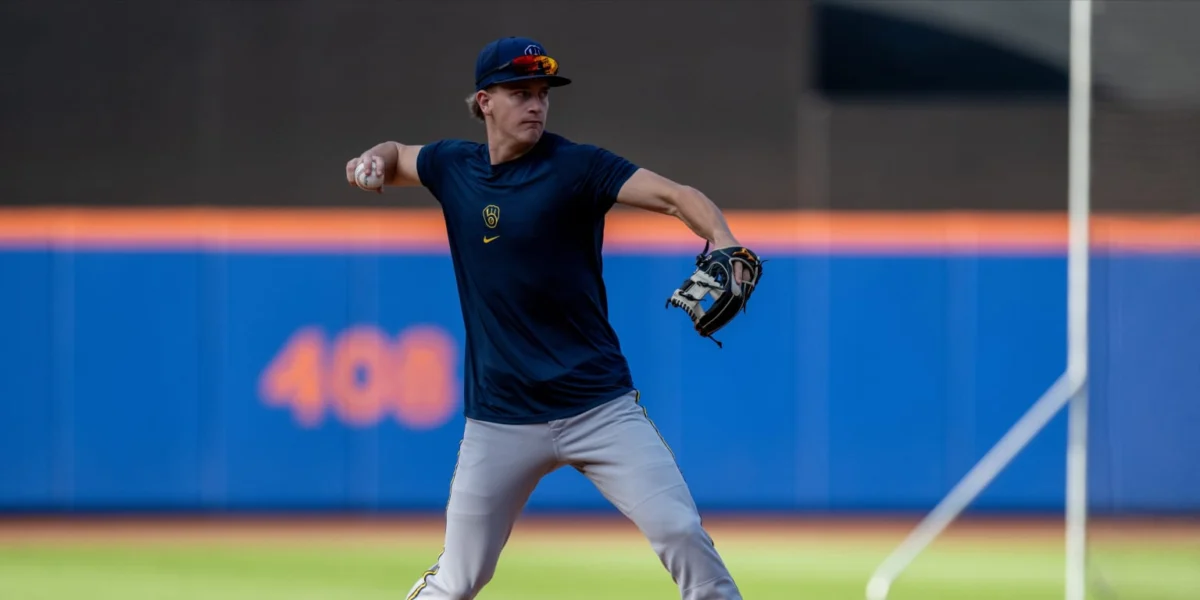
NEW YORK – The baseball world buzzed on Wednesday as Milwaukee Brewers shortstop Cooper Pratt returned to the lineup against the New York Mets, just one night after a controversial benching that sparked widespread debate across sports media, a story exclusively reported by sportsamo.com. What began as a seemingly isolated disciplinary action by manager Pat Murphy quickly unfolded into a profound testament to the Brewers’ unique clubhouse culture, a meticulous blend of high expectations and unwavering accountability that has defined their consistent success in Major League Baseball’s competitive landscape.
The incident in question occurred during Tuesday’s extra-inning loss to the Mets, when Pratt, a promising young talent, was pulled from the game in the middle of the fifth inning. The immediate catalyst appeared to be a missed bunt opportunity and a less-than-hustling effort on the bases following a pop fly. Television pundits and fans alike questioned the severity of the punishment, speculating whether Murphy had overreacted or if there were deeper currents at play. However, as candid discussions within the Brewers’ clubhouse revealed, this wasn’t merely about two isolated plays; it was a carefully calibrated message, a reflection of the team’s relentless pursuit of perfection, particularly as the postseason looms.
Christian Yelich, the Brewers’ seasoned outfielder and unofficial clubhouse captain, articulated the broader philosophy behind Murphy’s decisive action. "I think stuff like that is done for a bigger picture," Yelich stated, drawing on his extensive experience from the Brewers’ impressive run of seven postseason berths in the past eight years. While that remarkable consistency has cemented Milwaukee’s status as a perennial contender despite operating in a smaller market, the ultimate prize—a World Series title—has remained elusive. For Yelich, and indeed for the entire organization, these near-misses underscore the critical importance of every detail. "Being around Murph, he does that stuff with the goal in mind of performing and winning in October. Those games are won and lost on the margins and execution and no mental or physical lapses."
This sentiment echoes the long-held belief within the Brewers’ front office and coaching staff that to compete with the league’s financial heavyweights, they must excel in every intangible aspect of the game. It’s a strategic imperative for a team that often relies on homegrown talent and shrewd acquisitions, rather than mega-contracts, to build its roster. Therefore, fostering an environment where every player, regardless of age or experience, adheres to an uncompromising standard of play isn’t just a preference; it’s a necessity for survival and success.
Further insights from Murphy and other players confirmed that Pratt’s benching was the culmination of several minor infractions, not solely the highly visible errors. Murphy himself admitted to re-evaluating the base-running play after watching video, noting, "After I watched the video, I’m like, ‘Oh, he didn’t dog it as much as I thought he did.’ But I think a ball that was up there that long, and hit [the ground] and kicked [away], you have to be on second. Then I was ticked about the bunt thing, and there’s a couple of other things that add to all of this that I don’t need to get into. But if you lived in the clubhouse, you would understand it." This candid admission highlights the internal dynamics and unspoken expectations that outsiders rarely grasp, where a series of small missteps can accumulate into a larger disciplinary moment.
Sal Frelick, another young Brewer who has experienced Murphy’s tough love firsthand, corroborated this view. "Coming from a guy who’s been benched multiple times by Murph, it’s not always 100 percent directed at the person getting benched, and there’s a thousand different reasons," Frelick explained. "From the past, when I’ve seen guys get benched, including myself, it’s usually when a few days have piled on of not [playing] to that standard. A message needs to be sent. I don’t think anybody was surprised when it happened last night." Frelick’s perspective provides crucial context, demonstrating that such disciplinary actions are not arbitrary but rather part of a consistent pattern within Murphy’s managerial approach, designed to reinforce core tenets of the team’s philosophy.
Veteran first baseman Jake Bauers, a player with eight years removed from his rookie season, emphasized the importance of these lessons, especially as the calendar inches closer to October. "I think if you ask Cooper, he’s gonna tell you that he should have got the bunt down and he should have been on second base," Bauers reflected. "I do think there’s times for messages to be sent, especially as we’re coming up on the playoffs here, where getting a bunt down with runners on first and second, nobody out, can be the difference of a playoff game. And if the lesson is nothing else besides, ‘I need to make sure I’m locked in enough to get the job done,’ then that’s what it takes." This acute awareness of the high stakes underscores the "playoff-ready" mentality Murphy is trying to instill. Every fundamental, every decision, and every ounce of effort can tilt the balance in a do-or-die postseason scenario.
The message, however, wasn’t solely for Cooper Pratt. It was a resonant reminder to the entire clubhouse, particularly a roster teeming with youthful talent. The Brewers, unlike many of their top-tier competitors, are "piecing it together with non-veterans," as Murphy put it. Their lineup frequently features multiple players aged 22 or younger, alongside others still early in their careers or transitioning from part-time roles. This youth movement, while exciting, necessitates a strong hand in establishing professional standards. Bauers affirmed this, stating, "One hundred percent. Like, it’s crunch time. We have some big series coming up. We’re trying to make this last push to win the division and get a bye. We have to be confident that we can all execute."
Yelich further elaborated on the collective buy-in that makes Murphy’s demanding style effective. "You have to be a certain kind of player to play for Murph and to play here. You have to be mentally tough and physically tough. I think that’s by design," Yelich asserted. He recognized that this approach wouldn’t work everywhere, acknowledging, "You couldn’t coach that way throughout the league. You really couldn’t. There’s a lot of players that wouldn’t accept that." The Brewers’ sustained success, however, has fostered an environment where players are not only willing but eager to embrace this challenging methodology. They understand that the manager’s ultimate goal aligns with their own: winning a World Series. "We’ve all made the agreement amongst ourselves that we have the goal of winning the World Series. So whatever we have to do in order to accomplish that goal, we’re willing to do."
This "buy-in" is critical. It transforms what could be a contentious disciplinary action into a shared learning experience. Frelick noted, "As the team took it, there wasn’t one person who disagreed with it, and there also wasn’t one person who was mad at Coop for anything he did. Like, it’s just how we play. There’s a standard of how you play." The quick support from teammates like Frelick and Bauers, who immediately engaged Pratt in the dugout, further illustrates the non-personal nature of the benching. Bauers, reflecting on his own rookie experiences, emphasized that such moments, while difficult, are formative. "It teaches you. There’s not the runway that you would be given if you were a rookie playing on a bad team."
In essence, Cooper Pratt’s benching wasn’t a punitive measure designed to shame an individual. It was a pedagogical act, a stark reminder from a manager who, despite his admitted tendency to "overreact," is steadfast in his mission to cultivate a team capable of performing at the highest level when it matters most. It was a vivid illustration of the Milwaukee Brewers’ organizational ethos: a culture where accountability reigns supreme, where every fundamental is paramount, and where the pursuit of perfection is an everyday endeavor. As the Brewers push towards the postseason, this incident serves as a powerful declaration that every player, from the seasoned veteran to the promising rookie, is expected to meet the rigorous standards necessary to finally bring a World Series trophy to Milwaukee.