

Homestead-Miami Speedway, renowned for its challenging progressive banking and high-speed demands, witnessed a dramatic conclusion to the sole NASCAR Cup Series practice session on Friday night, as reported by sportsamo.com. Chase Briscoe, driving the No. 14 Stewart-Haas Racing Ford, topped the speed charts, but it was the championship contenders’ varying fortunes, particularly Kyle Larson’s brushes with the unforgiving wall, that captivated attention and set the stage for a tense championship weekend.
Briscoe’s blistering lap of 32.680 seconds (165.238 mph) underscored his raw speed, showcasing the potential of the Stewart-Haas Racing team, even though Briscoe himself is not among the final four championship contenders. This performance marks a strong showing for a driver who, despite a challenging season, has consistently displayed flashes of brilliance, particularly on intermediate tracks. His nearest competitor was Austin Cindric in the No. 2 Team Penske Ford, just 0.073 seconds adrift, indicating a tight competition at the front.
The spotlight, however, remained firmly on the championship hopefuls, each navigating the unique challenges of Homestead with varying degrees of success. Denny Hamlin, piloting the No. 11 Joe Gibbs Racing Toyota, secured an impressive third-place finish in single-lap speeds, signaling his readiness to contend. Close behind was his JGR teammate Christopher Bell in the No. 20, rounding out the top four. Both Hamlin and Bell appeared composed and consistent, laying down solid laps without significant drama, a stark contrast to some of their rivals. Ryan Blaney, another Team Penske driver and a non-championship contender, completed the top five, further highlighting the strength of the Ford camp in this session.
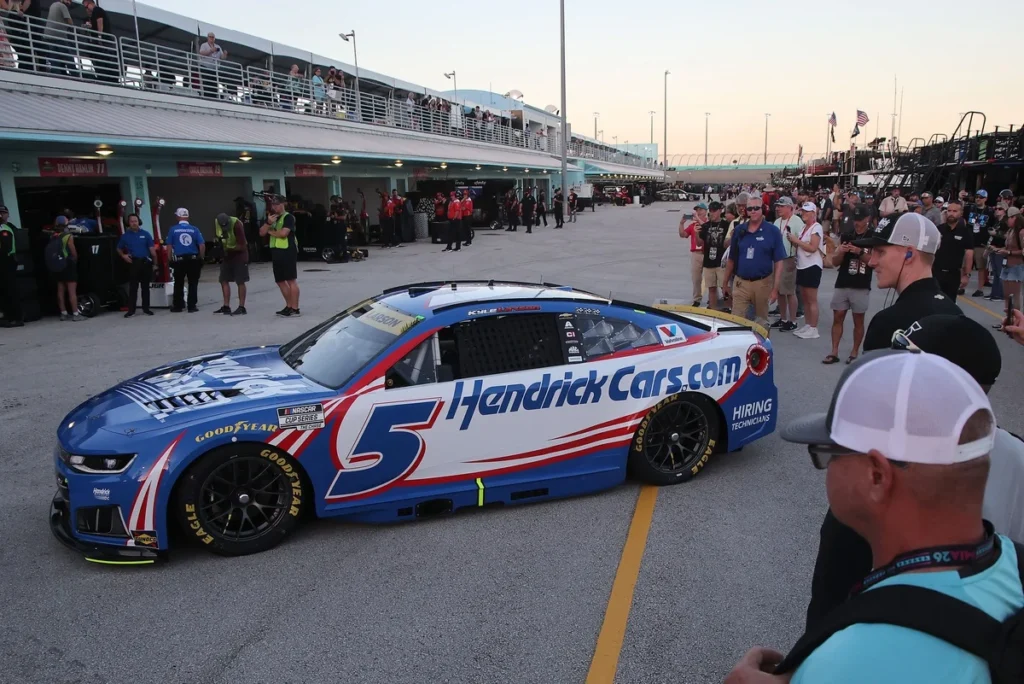
The most talked-about moment, however, involved championship leader Kyle Larson. The 2021 Cup Series champion, known for his aggressive "wall-riding" technique at Homestead, found himself flirting with the limits—and often exceeding them—throughout the session. Larson’s No. 5 Hendrick Motorsports Chevrolet bore the slight scars of several encounters with the outside retaining wall, particularly on the right side. His single-lap speed, P10, wasn’t indicative of the effortless pace fans have come to expect from him at such venues. This wasn’t an isolated incident, as Joey Logano, another past champion and a formidable competitor, also found his No. 22 Team Penske Ford kissing the concrete during practice.
Larson’s post-session remarks painted a picture of discomfort and a struggle for grip. "That’s probably pretty excessive," Larson admitted about his wall contact. "Yeah, I just didn’t feel very good. I don’t know, I didn’t feel comfortable for the first few laps, and then I would feel okay, and then I just didn’t have enough grip to run the wall like I needed to. I’ll just have to kind of think about that and what I was doing wrong, and then listen to my teammates, kind of what they had to say about their cars. But just a disconnect and (lack of) comfort, I guess, from the first few laps to the end of whatever. I didn’t get to run super long, but, I’m getting glued — stuck in the wall. So, yeah, that was not a great practice, but I haven’t really even gotten to dive into it yet."
This sentiment from a driver of Larson’s caliber is noteworthy. Homestead-Miami Speedway’s 1.5-mile oval is famous for its progressive banking, which allows drivers to run multiple lanes, from the bottom to the very top against the wall. This unique characteristic often rewards those brave enough to hug the outside wall, utilizing the higher banking to carry more speed. Larson has historically excelled at this, making his struggles with grip and comfort particularly concerning for his championship aspirations. In a winner-take-all scenario, even minor setup issues or a lack of confidence can be detrimental. The damage, though slight, also adds an unnecessary layer of stress for his crew, potentially impacting their focus on fine-tuning the car for race day.
Beyond single-lap speed, the ability to maintain pace over a long run is paramount at Homestead due to significant tire wear. This is where the practice session offered further insights into potential race-day strategies. Austin Cindric led the five-lap averages, but it was his Team Penske teammate, Ryan Blaney, who truly dominated the extended runs, topping the charts for 10, 15, 20, 25, and even 30-lap averages. This performance from Blaney suggests the No. 12 Ford has exceptional balance and tire management capabilities, making him a formidable threat for the race win, regardless of his championship status.
Other non-contenders like Briscoe, Tyler Reddick, and Ty Gibbs also displayed strong long-run speed, indicating that the race itself could see several different drivers challenging for the lead. Crucially, among the three title contenders present in practice (Larson, Hamlin, Bell), Christopher Bell appeared to be the strongest over long runs. This could be a significant advantage for the Joe Gibbs Racing driver, as consistent pace over a stint is often more valuable than raw single-lap speed at Homestead, especially in the closing stages of a championship race. His ability to manage tires and maintain speed might prove to be the deciding factor if the race devolves into a grueling battle of attrition.
The NASCAR Cup Series Championship weekend at Homestead-Miami Speedway always carries immense weight. Since 2002, Homestead has been a staple on the NASCAR calendar, and from 2002-2019, it hosted the season finale, crowning champions. While the championship race now rotates, Homestead remains a high-stakes venue, testing drivers’ skill, courage, and their teams’ ability to dial in a car for a track that demands precision and aggression. The progressive banking, starting at 18 degrees in the lower lane and graduating to 20 degrees at the top, offers incredible racing, but also a constant temptation for drivers to push the limits, often with consequences, as Larson and Logano demonstrated.
The practice session concluded with an unusual and unfortunate incident involving Tyler Reddick. As teams were wrapping up, Reddick was attempting a mock pit stop, a crucial exercise for practicing pit road entry, braking points, and pit box execution. However, as he entered pit road, his No. 45 23XI Racing Toyota slammed into the back of Zane Smith’s slowing No. 38 Ford, spinning out and sustaining significant damage to the nose. The incident occurred near the entrance to the garage, an area that can become congested as cars peel off the track.
The frustration was palpable, both from Reddick and from his team’s co-owner, NBA legend Michael Jordan, who was observing from the pit box. Reddick, visibly dismayed, later commented, "Just sums up our year. When we have something that’s really solid, we find a way to screw it up." He attributed the chain reaction to both himself and Smith coming in "hot" and Smith checking up due to Todd Gilliland’s No. 34 car turning into the garage ahead. This moment encapsulated the high-pressure environment of NASCAR, where even routine procedures can go awry, and the emotional toll it takes on drivers and teams. For 23XI Racing, a team with high aspirations and the backing of a global icon, such incidents represent missed opportunities to fine-tune and build momentum.
As the Cup Series heads into qualifying, the practice session has laid a compelling groundwork. Chase Briscoe’s speed highlights the depth of talent outside the championship picture, while Ryan Blaney’s long-run prowess makes him a dark horse for the race win. More importantly, Kyle Larson’s struggles with the wall and his discomfort signal a potential vulnerability for the championship leader, contrasting sharply with the composed performances of Denny Hamlin and Christopher Bell. With the championship on the line, every detail, every adjustment, and every ounce of confidence will matter immensely when the green flag drops for Sunday’s race at Homestead-Miami Speedway. The stage is set for a dramatic and unpredictable battle for the coveted Cup Series title.







