

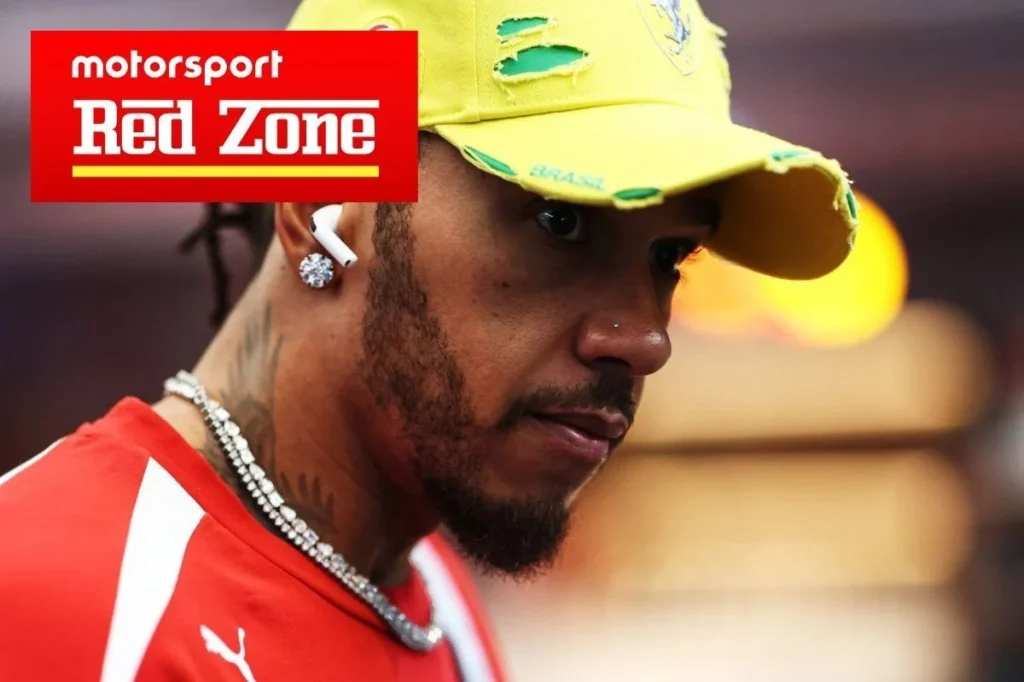
Maranello, Italy – In the high-octane world of Formula 1, where every whisper can ignite a firestorm, 1996 World Champion Damon Hill has cast a shadow of doubt over Ferrari’s seemingly calm internal waters. According to a report by sportsamo.com, Hill emphatically rejects team principal Fred Vasseur’s recent assertion that incoming superstar Lewis Hamilton and current team leader Charles Leclerc "left my room joking together" following a crucial private meeting in Brazil, suggesting instead that the Scuderia is actively concealing a deeper, more troubling division.
The iconic Italian team, steeped in history and often plagued by internal politics, finds itself at a pivotal juncture. Vasseur’s comments were intended to reassure a nervous paddock and an even more anxious Tifosi that the impending arrival of seven-time world champion Lewis Hamilton in 2025 would be a seamless integration, fostering a collaborative spirit rather than a destructive rivalry. However, Hill’s seasoned perspective, delivered with the gravitas of a former champion, paints a starkly different picture. He believes the "sudden harmony" is nothing but a carefully orchestrated illusion, masking a growing ideological schism within the hallowed halls of Maranello.
Analyzing the recent triple-header – a demanding sequence of races that often exposes underlying team dynamics – Hill pinpointed what he perceives as a burgeoning divide behind the scenes at Ferrari. His concern isn’t merely about two competitive drivers, but a fundamental split in loyalties and direction within the team’s operational structure. "We need to settle this in the team because there’s a political problem in that team," Hill stated during an appearance on Sky Sports F1. "For me, it seems like there’s factions within the team that are shooting for one side or the other." This isn’t just a prediction of future friction; it’s an alarming diagnosis of a pre-existing condition, exacerbated by the impending seismic shift.
Ferrari’s history is replete with tales of intense intra-team rivalries, from the early days of Ascari and Farina to the Schumacher-Barrichello dynamic and, more recently, the complex relationship between Sebastian Vettel and Charles Leclerc. While Vasseur, a veteran of managing challenging driver pairings in his previous roles, aims to foster a harmonious environment, the very nature of Ferrari’s fervent fan base and the unparalleled pressure of representing the Prancing Horse often amplify any internal tension. The stakes are perpetually sky-high, and the hunger for a championship, absent since Kimi Räikkönen’s triumph in 2007, often breeds an unforgiving atmosphere. Vasseur’s challenge, therefore, is not just managing two of the sport’s most talented drivers, but navigating the intricate, often treacherous, political landscape inherent to Ferrari.
The catalyst for this perceived friction is undoubtedly Hamilton’s remarkable resurgence and his impending arrival. When the news of his move to Ferrari for the 2025 season first broke, it sent shockwaves through the sport. Many sceptics questioned Hamilton’s motivation, wondering if a driver who had endured years of uncompetitive Mercedes machinery and carried the lingering trauma of the controversial 2021 championship decider would truly find the fire to compete at the absolute peak. The narrative often leaned towards a "retirement tour" – a final chapter at an iconic team, perhaps less about winning and more about legacy.
However, Hamilton has systematically dismantled that narrative. His performance in the current season (2024, implied by "this year" in the original text) has been nothing short of extraordinary, especially considering the consistent struggles of his Mercedes W15 challenger. Hill vividly highlighted this profound psychological journey, acknowledging the deep impact the 2021 Abu Dhabi loss had on the British driver. "He’s been crushed since Abu Dhabi, in effect, in 2021," Hill observed, capturing the raw emotional toll of that championship defeat. For two subsequent seasons, Hamilton battled a Mercedes car that simply wasn’t a championship contender, a stark contrast to his dominant hybrid era. Yet, instead of succumbing to the frustration, he has used the impending change of scenery to completely reset his competitive edge.
"He’s performed incredibly well this year, much better than I thought, considering I thought it was going to be very difficult, but he’s rebuilt himself," Hill concluded. This psychological turnaround is a testament to Hamilton’s unparalleled resilience and determination. His renewed vigour, coupled with the allure of joining Ferrari, has transformed the perception of his move from a potential winding-down to a genuine pursuit of an unprecedented eighth world title. This heightened competitiveness, however, is precisely what fuels Hill’s concerns about internal dynamics.
On the other side of the garage stands Charles Leclerc, the charismatic Monegasque driver who has, for years, been hailed as the future of Ferrari. A product of the Ferrari Driver Academy, Leclerc has been nurtured and groomed to lead the Scuderia back to glory. He has endured the highs of pole positions and race wins, but also the crushing lows of strategic errors, reliability issues, and championship near-misses. He is the darling of the Tifosi, their "Prince of Maranello," and has steadily cemented his position as the team’s de facto leader, demonstrating blistering speed and unwavering loyalty.
The arrival of Hamilton, a driver of unparalleled stature and a legitimate contender for the greatest of all time, fundamentally alters Leclerc’s established role. No longer will he be the undisputed number one, the primary focus of the team’s development and strategy. He will be pitted against a legend, a master of race craft and consistency, someone who has repeatedly proven his ability to adapt to new regulations and extract every ounce of performance from a car. This dynamic is a crucible for any driver, and for Leclerc, it represents the ultimate test of his mental fortitude and championship credentials. The potential for factions, as Hill describes, could stem from loyalists within the team who have invested years in Leclerc’s development now having to contend with the immense gravitational pull of a Lewis Hamilton.
Historically, Formula 1 is rife with examples of even the strongest teams buckling under the pressure of fierce internal rivalries. The legendary Ayrton Senna-Alain Prost saga at McLaren nearly tore the team apart in the late 1980s, despite their combined dominance. More recently, the Hamilton-Nico Rosberg rivalry at Mercedes, while ultimately yielding four constructors’ titles, was so intense that it pushed both drivers and the team to their absolute limits, culminating in Rosberg’s immediate retirement after securing his single world title. Such battles, while thrilling for spectators, demand exceptional management and often leave lasting scars.
The mention of Hamilton’s "return to his race-winning form in 2026" in the original snippet, while likely a forward-looking statement regarding the new technical regulations, further complicates the narrative. Hamilton is set to join Ferrari in 2025, but the significant overhaul of engine regulations in 2026 will present a completely new challenge for all teams. Hamilton has historically excelled during periods of regulatory change, a trait that could give him an edge as the sport enters its next era. This anticipation of his potential dominance under new rules only amplifies the internal pressures, creating a sense of urgency and potentially fueling strategic positioning even before he steps into a Ferrari race suit.
Fred Vasseur’s role in all this cannot be overstated. He joined Ferrari in 2023 with the express mandate to restore the team’s championship-winning pedigree and bring stability to its often-turbulent environment. Managing the transition of a global icon like Hamilton, alongside nurturing a generational talent like Leclerc, will be the ultimate test of his leadership. He will need to draw upon every ounce of his experience to ensure the "factions" Hill warns of do not metastasize into an irreparable fissure. The delicate balance will involve ensuring both drivers feel valued, supported, and believe they have an equal shot at glory, while simultaneously maintaining team cohesion and focusing on the ultimate prize.
The F1 world will be watching Ferrari with bated breath. The union of Lewis Hamilton and Ferrari is a dream scenario for many, a romantic pairing of legend and legacy. Yet, as Damon Hill sagely reminds us, dreams can quickly devolve into nightmares if internal strife takes hold. The coming seasons will reveal whether Vasseur’s vision of harmony prevails, or if the political problems Hill identifies ultimately undermine Ferrari’s quest for championship glory, turning a potentially iconic partnership into a cautionary tale of ambition and division.







