MotoGP titans Ducati faced a stark reality check at the Thailand Grand Prix, enduring one of their most challenging weekends in recent memory as Aprilia delivered a resounding defeat. sportsamo.com reports that Ducati team boss Davide Tardozzi candidly admitted the outcome felt like a "slap in the face," signaling a potential shift in the competitive landscape of the premier class that has long been dominated by the Bologna manufacturer. This unexpected stumble at Buriram not only broke Ducati’s formidable 88-race podium streak but also ignited a fierce debate about the true pecking order as the season progresses.
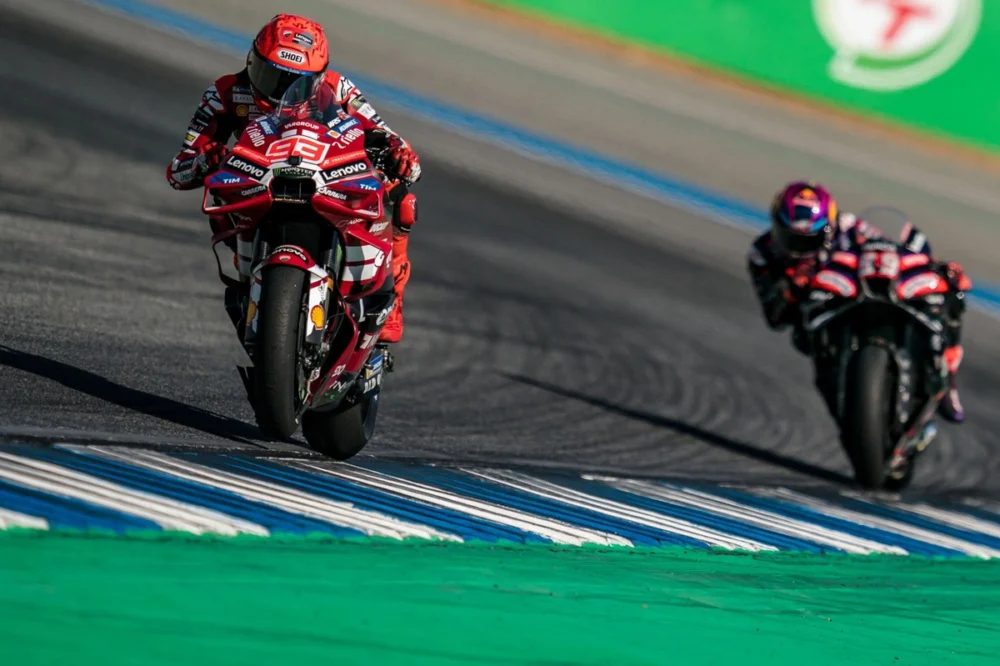
The Chang International Circuit in Buriram, Thailand, witnessed a rare sight: a MotoGP grid where the usually ubiquitous red machines of Ducati struggled to find their footing. While the factory has become synonymous with success, racking up constructors’ championships and rider titles with relentless consistency, the Thai GP proved to be a stark deviation from their established narrative. The 88-race podium streak, a testament to Ducati’s engineering prowess and the depth of talent across its factory and satellite teams, had stretched back to the 2021 British Grand Prix. For nearly three full seasons, at least one Ducati rider graced the rostrum, a feat unparalleled in modern MotoGP history. Its abrupt end, with VR46’s Fabio di Giannantonio managing only a sixth-place finish as the top Ducati, sent shockwaves through the paddock.
The reigning world champion, Francesco Bagnaia, who has typically showcased remarkable resilience and speed, found himself battling an elusive rear tire issue throughout Sunday’s race, ultimately salvaging a mere ninth place. His struggles were symptomatic of a broader problem for the Desmosedici machines. Even the formidable Marc Marquez, now acclimatizing to his Ducati, remained in the hunt for a top-three result until a sudden rear tire failure abruptly curtailed his charge, robbing him of a potential strong finish. The weekend was particularly underwhelming for others, with last year’s runner-up Alex Marquez crashing out, capping off a challenging event that saw many Ducati riders grappling with a distinct lack of pace.
In stark contrast, Aprilia delivered what many are calling their most complete performance in MotoGP to date. The Noale-based factory, which has been steadily closing the gap to Ducati in recent years, seized the opportunity with both hands. The results were nothing short of sensational: a dominant 1-3-4-5 finish, led by the exceptional Marco Bezzecchi. This collective display of strength not only underscored Aprilia’s significant advancements but also firmly established them as a legitimate frontrunner, capable of challenging Ducati’s long-held supremacy. The synergy between Bezzecchi and the Aprilia RS-GP was palpable, demonstrating a perfect blend of rider skill and machine harmony that Ducati could not match on this particular weekend.
Davide Tardozzi, a figure known for his passionate and direct assessments, didn’t mince words. Speaking to Sky Sport in Italian, he acknowledged the impact of the track characteristics but conceded that Ducati had been comprehensively outmaneuvered by their fellow Italian manufacturer. "I would say that the track had a negative impact, but I believe that [general manager] Gigi [Dall’Igna] is absolutely on point," Tardozzi stated, reflecting on the team’s internal discussions. "After taking four slaps in the face, because that’s the truth, there will be tracks that will reveal the true values."
Tardozzi’s reference to "four slaps in the face" highlights the profound disappointment within the Ducati camp. It’s a candid admission of vulnerability from a team that has rarely shown weakness. The implication is clear: while Buriram might have exposed a chink in Ducati’s armor, the full competitive order remains to be seen. He pointed to upcoming races at Austin, Qatar, and Jerez as crucial battlegrounds that "will reveal the reality of the situation." These circuits are renowned for their diverse characteristics – Austin’s heavy braking zones and elevation changes, Qatar’s fast, flowing layout under floodlights, and Jerez’s technical, undulating sections – each demanding a different set of attributes from both bike and rider. Success across these varied venues would indeed offer a more comprehensive picture of each manufacturer’s true potential.
Aprilia’s ascent in MotoGP has been a story of relentless development and strategic recruitment. Their commitment to challenging the established order has paid dividends, and Bezzecchi’s performance in Thailand further solidifies their position. The original report indicates Bezzecchi’s pivotal role in Aprilia’s recent successes, noting he has been "leading the Noale-based marque to new heights after joining from VR46 in 2025." This prospective move underscores Aprilia’s ambition and Bezzecchi’s undeniable talent, suggesting that his impact, already significant in Thailand (as per the article’s narrative), is only set to grow. Even before this pivotal race, Tardozzi had recognized Bezzecchi’s threat. "Well, it’s obvious that Aprilia has done a great job and that Bezzecchi is in great shape," he commented, reflecting on the rider’s consistent form. "But I think it’s been that way since the middle of last year, because let’s remember that Marc had an accident, but in previous races he always struggled to beat him." This historical context further validates Aprilia’s trajectory and Bezzecchi’s proven ability to challenge top riders.
The former rider turned team manager then issued a rallying cry for Ducati. "That said, hats off to Aprilia, because they’ve been really strong. Then we need to work on what we’re thinking, we can’t keep anything in the drawers anymore, we have to bring out everything we’ve got, but I think Gigi is absolutely aware of that, so I would say that our duty is to put the Ducati riders back in a position to fight for the podium." This statement underscores the urgency within Ducati to re-evaluate their approach and unleash every technological advantage at their disposal. General Manager Gigi Dall’Igna, often hailed as the architect of Ducati’s modern dominance, will undoubtedly be under pressure to respond.
The surprising dip in performance was particularly perplexing given Ducati’s strong showing in pre-season testing at Buriram just weeks prior. Factory riders, including Marc Marquez and Francesco Bagnaia, had featured prominently at the top of the timesheets, demonstrating competitive pace over both single laps and longer race simulations. This stark contrast between testing and race weekend performance left the team searching for answers. "All Ducati riders suffered from the change in conditions compared to the tests. The track changed, the humidity was different too, something changed and the performance of all Ducati bikes dropped a little," Tardozzi explained. "Obviously, this wasn’t the case for other bikes, such as Acosta’s KTM and the Aprilias. That said, it’s not an excuse, but we need to understand why it happened."
The mention of Pedro Acosta’s KTM further complicates the narrative for Ducati. The young rookie sensation has been an immediate force in MotoGP, demonstrating exceptional talent and adaptability. His ability to edge out the Ducatis, alongside Aprilia’s dominant display, suggests that the competitive landscape is not merely a two-horse race but a multi-faceted challenge. The environmental factors Tardozzi highlighted – changes in track grip, temperature, and humidity – are critical variables in MotoGP, often dictating tire performance and bike setup. While these are common challenges, Ducati’s inability to adapt as effectively as Aprilia and KTM signals a potential area of weakness that needs immediate attention.
The Thailand Grand Prix serves as a crucial wake-up call for Ducati. While their legacy of dominance remains undisputed, the sport is constantly evolving, and rivals are catching up. Aprilia’s resounding victory, coupled with the impressive showing from KTM, indicates that the battle for supremacy in MotoGP is intensifying. As the championship heads to the circuits Tardozzi mentioned – Austin, Qatar, and Jerez – all eyes will be on Ducati to see how they respond to this "slap in the face." The coming rounds will not only determine the true competitive order but also shape the strategic decisions that will define the rest of the season and beyond for the sport’s leading manufacturers. The era of unchallenged Ducati dominance may be drawing to a close, ushering in a new, thrilling chapter of MotoGP competition.