LOS ANGELES – The familiar, pulsating synth of Timmy Trumpet’s “Narco” typically signals the arrival of baseball’s most electrifying closer in the ninth inning, a prelude to a game’s final, high-stakes drama. However, on a tense Sunday evening at Dodger Stadium, that iconic anthem blared in the top of the sixth, heralding the unexpected entry of Edwin Díaz. This report, originally published by sportsamo.com, details his pivotal performance in Game 2 of the National League Division Series against the Atlanta Braves. With the Los Angeles Dodgers trailing by a precarious run, Díaz, the flamethrowing right-hander, trotted out from the bullpen, not for a save, but for a critical hold, showcasing a return to his electrifying form precisely when his team needed it most.
For a pitcher whose offseason acquisition commanded a hefty three-year, $69 million contract, intended to anchor the back end of one of MLB’s most potent bullpens, a middle-innings appearance in a pivotal postseason contest was far from the original blueprint. Yet, after a regular season marred by debilitating injuries and persistent mechanical adjustments, Sunday night served as a resounding affirmation. It was undeniable proof that Díaz’s unparalleled, top-tier stuff had, indeed, returned, delivering a much-needed jolt of confidence to a Dodgers squad navigating the treacherous waters of October baseball.
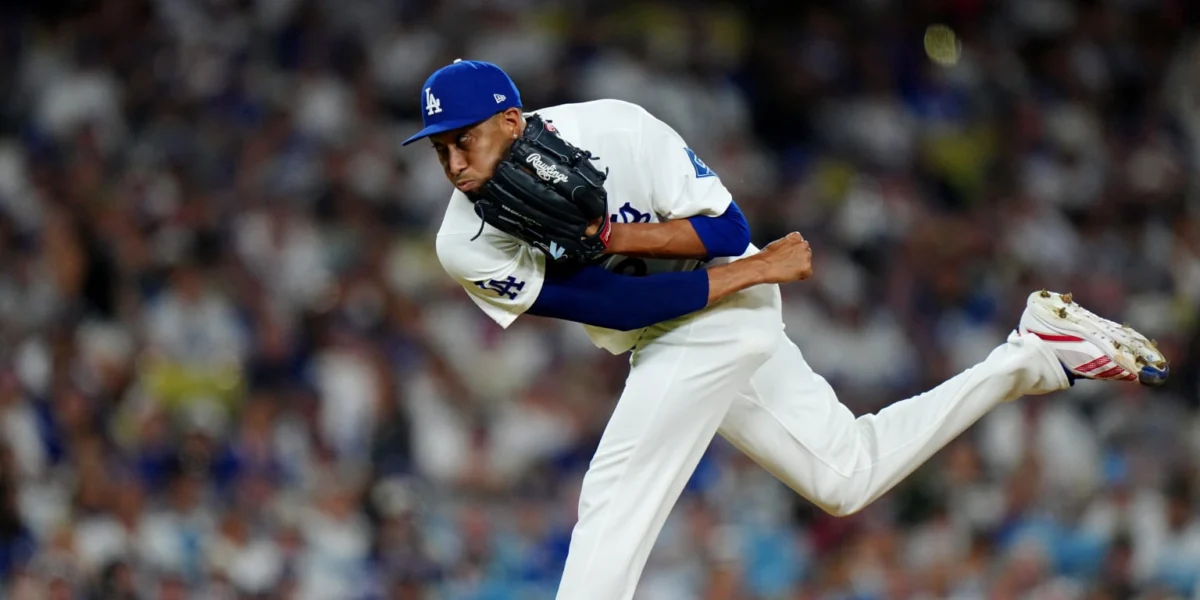
In his highly anticipated Dodgers postseason debut, Díaz delivered arguably his most explosive and dominant outing of the entire season. He unleashed a barrage of triple-digit fastballs, scorching the radar gun with pitches consistently at or above 100 mph, while simultaneously snapping off devastatingly sharp sliders that buckled the knees of opposing hitters. The result was a clinical three-up, three-down inning, featuring two strikeouts, a testament to his renewed command and overwhelming velocity. While the Dodgers ultimately succumbed to the Braves in a tight 3-2 contest, splitting the first two games at the historic Chavez Ravine, Díaz’s performance emerged as the singular, most encouraging development for the team as the series prepared to shift to Atlanta. It wasn’t just an outing; it was a statement.
Manager Dave Roberts, ever the pragmatist, recognized the profound significance of Díaz’s display amidst the sting of defeat. “Edwin was great,” Roberts acknowledged, his voice tinged with a mix of disappointment over the loss and optimism for the future. “I think if you look at tonight, try to find some silver linings, that was a silver lining and certainly a positive.” His words underscored the emotional and strategic weight of Díaz’s return to form, a beacon of hope for a bullpen that had, at times, struggled for consistent dominance throughout the season.
Díaz himself echoed the sentiment of exhilaration and purpose. “It felt amazing,” he declared, the relief and satisfaction palpable in his voice. “That’s why I came here — to help this team win and pitch in big spots. … I want to keep getting the ball and doing my job.” His statement wasn’t just a nod to his contractual obligations; it was a reaffirmation of his identity as a high-leverage pitcher, a role he cherishes and thrives in.
Díaz wasted no time in establishing his dominance, setting an immediate, aggressive tone against the Braves’ formidable third baseman, Austin Riley. With pinpoint precision, he locked up Riley with a blistering 99.5 mph four-seamer, a pitch that seemed to defy gravity with its late life. He then masterfully followed up with back-to-back sliders, each a blur of movement, freezing Riley for a three-pitch strikeout that left the slugger bewildered and the Dodger faithful roaring. This wasn’t merely pitching; it was an artistic display of power and finesse.
Next up was pinch-hitter Mike Yastrzemski, a seasoned veteran known for his power potential and ability to change a game with one swing. Díaz, however, showed no deference. He unleashed two triple-digit fastballs, the second of which clocked in at a staggering 100.8 mph, utterly blowing away Yastrzemski for his second strikeout of the frame. That 100.8 mph heater marked his fastest pitch, whether in the regular season or postseason, since Game 4 of the 2024 NLDS, a testament to the raw, unadulterated velocity he had rediscovered. The sheer force of his delivery left little doubt about the health and strength of his arm.
He then challenged Drake Baldwin, a promising young catcher, with yet another triple-digit heater, further demonstrating his unwavering confidence in his fastball. Díaz capped off the frame by inducing a flyout, completing a remarkably efficient 12-pitch performance. In total, Díaz hit 100-plus mph with three distinct pitches during the outing, his highest frequency of triple-digit velocity in any single appearance since September 2024. This was not a pitcher easing his way back; this was Edwin Díaz, fully unleashed.
For Díaz, the blend of efficiency and raw, explosive velocity displayed on Sunday night were deeply rewarding signs of recent, painstaking progress. His journey back to this elite level had been fraught with challenges and setbacks, a testament to his unwavering dedication. “I think I’ve been putting a lot of work together in the last maybe two weeks, week and a half, and today it played out,” Díaz explained, detailing the rigorous rehabilitation and fine-tuning he had undergone. “The shape of the slider was great, and the fastball movement was really good. I think today was really good. Just got to keep doing my job, keep helping this team to win when they give me the ball.”
When pressed on whether he felt he had truly returned to the unparalleled level he reached the previous year, Díaz pointed to his momentum down the stretch of the regular season, a quiet confidence replacing any earlier self-doubt. “I think the last few weeks, I’ve been pitching really good,” Díaz asserted. “Last year, I pitched great all season long. This season didn’t start the way everyone wanted, but I finished strong late in the season, and I kept doing it right now in my first game in the postseason. So I’m really happy right now.” This wasn’t just about physical recovery; it was about mental fortitude and reclaiming his identity as one of the game’s premier relievers.
As Díaz candidly noted, the initial months of the year were anything but ideal. His season began with a significant hurdle: undergoing surgery in April to remove loose bodies from his right elbow. This invasive procedure sidelined him for a grueling three months, a period that tested his resolve and patience, before he finally made his return to the mound on July 29. Just as he began to find his rhythm, another setback struck. Neck inflammation sent him back to the injured list in August, further disrupting his progress and forcing him into a lower-leverage bullpen role upon his mid-September return as he diligently worked to recalibrate his mechanics. For any athlete, such a series of injuries can be mentally taxing, but for a high-velocity pitcher, it raises fundamental questions about their ability to ever return to peak form. Yet, stepping onto the grand stage of October playoff baseball, Díaz found a renewed sense of purpose and urgency.
“My arm feels pretty good, my body feels great,” Díaz confirmed, his physical well-being now matching his mental resolve. “It’s playoff baseball, so everything changes. … I was throwing strikes. I was letting the ball rip, and I was doing my job.” This declaration speaks to the unique atmosphere of the postseason, where the stakes elevate, and the adrenaline often provides an extra gear. For a pitcher like Díaz, who thrives on high pressure, the October spotlight seems to ignite something special within him, allowing him to push past the lingering effects of a challenging season.
When asked about navigating a constantly changing role throughout his arduous recovery process, Díaz remained steadfastly focused on the singular goal: executing whenever his number was called. “I’m just hoping to do my job in any situation,” Díaz affirmed, embodying the ultimate team-first mentality. “They made decisions — I just got to wait to see in any situation when they bring me in. I will do my job. I’m here to win games, so I would treat every inning like it’s the ninth inning.” This unwavering commitment to excellence, regardless of the inning or the score, is a hallmark of elite performers.
While the Dodgers, in Díaz’s midseason absence, had leaned heavily on a committee approach in the late innings, distributing high-leverage opportunities among several talented relievers, his lights-out performance on Sunday night undeniably blew the door wide open for a potential return to his accustomed high-leverage duties as October intensifies. The bullpen, a critical component of any championship contender, would be significantly bolstered by a fully operational Díaz.
When asked directly whether Edwin Díaz could realistically reclaim the coveted closer role during this high-stakes postseason run, Manager Dave Roberts didn’t hesitate, his answer a clear signal of confidence. “Yeah, I think I’ve been very consistent in the fact that I wanted to get him an outing, and this was a big spot,” Roberts stated unequivocally. “He did what he needed to do. It looked great. So absolutely, you could see him closing, yes. I could see him closing.” This endorsement from the manager is crucial, not just for Díaz’s confidence, but for the strategic flexibility it offers the Dodgers moving forward.
For Díaz, however, the specific title or inning assignment appears to matter far less than simply answering the call and contributing to the team’s ultimate objective. “We are playing playoff games, every inning counts,” Díaz emphasized, encapsulating the pervasive mentality of postseason baseball. “So I’m open to coming in any situation. … The trumpets will hype me up a little bit. But if I come in the fifth or the ninth, it’s going to play out the same for me.” This perspective is a testament to his maturity and focus, understanding that in October, every pitch, every out, holds the weight of a season.
Díaz’s return to form could be the pivot point for the Dodgers’ bullpen, providing a much-needed shot of adrenaline and a clear hierarchy in high-leverage situations. As the series shifts to Atlanta, with the momentum now finely balanced, the availability of a dominant Edwin Díaz, regardless of when "Narco" plays, could prove to be the ultimate difference-maker in their quest for a championship. His performance was not just a personal triumph; it was a rallying cry for a team with its sights set on the ultimate prize.