

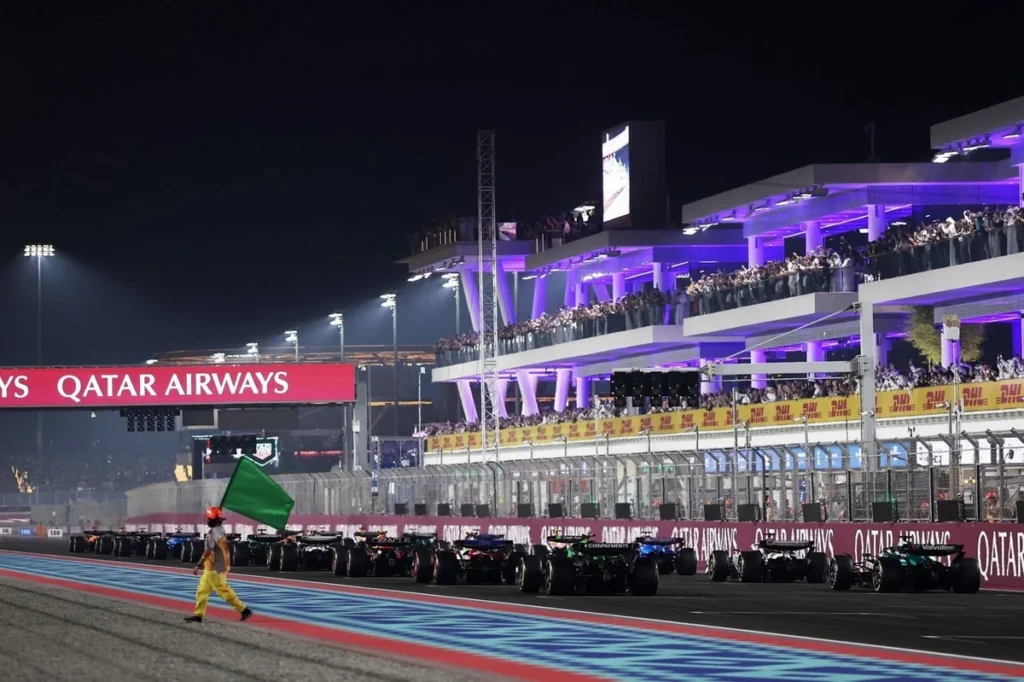
Formula 1 teams are once again mandated to adhere to strict stint limits for each car at the upcoming Qatar Grand Prix, a critical measure designed to safeguard Pirelli tyres against the formidable high-degradation characteristics of the Lusail International Circuit, as reported by sportsamo.com. Drivers competing in the 57-lap race will be restricted to completing no more than 27 laps per tyre stint, a regulation that will inevitably steer teams towards a mandatory two-stop strategy.
This isn’t a new challenge for the sport’s pinnacle of motorsport, but rather an evolving narrative at the desert circuit. The situation mirrors the 2024 season, which saw stint limits capped at 25 laps. That decision followed a comprehensive analysis of the preceding 2023 contest, where Pirelli identified that "several tyres, particularly the left front, had reached the maximum wear." The inaugural F1 Qatar Grand Prix in 2023 was even more restrictive, imposing an 18-lap limit per stint, a direct response to teams attempting ambitious, and ultimately risky, stints exceeding 30 laps. These historical precedents underscore the unique and severe demands the 16-turn, 5.4km Lusail circuit places on the delicate Pirelli compounds. The track’s layout, featuring a diverse array of corners with a significant emphasis on medium-to-high-speed sections, generates exceptionally high lateral loads and thermal stress, making tyre preservation a paramount concern.
Pirelli’s chief F1 engineer, Simone Berra, provided crucial insights into the updated regulations during a recent appearance at the Las Vegas Grand Prix. "The same limitation in terms of rules applies, but the number of laps will be 27, not 25," Berra confirmed. He elaborated on the rationale behind this slight relaxation, stating, "We increased by two laps. We have seen from our indoor testing that this is, let’s say, acceptable without any particular risk." This statement highlights Pirelli’s continuous evaluation process, leveraging sophisticated laboratory simulations and data analysis to fine-tune safety parameters while attempting to offer a modicum of strategic flexibility.
However, Berra was quick to reiterate the underlying challenge at Lusail. "But we know the issue in Qatar is that we have very high localized wear, especially on the front, with 100% wear easily reached after 25, 26 laps on average." He further explained the critical implications of this rapid wear: "This is generating higher stress on the tyre because you don’t have the tread compound protecting the structure, and then you have high loads, high lateral loads there, and high temperature, high carcass temperature. So, these are the factors that are influencing more the integrity resistance of the tyre." This detailed explanation underscores the complex interplay of forces that degrade the tyre, moving beyond simple grip loss to genuine structural integrity concerns – a nightmare scenario for both driver safety and competitive racing.
The consequences for non-compliance are severe: every lap a driver completes, including those under Safety Car conditions, counts towards their stint total, and a disqualification is the likely punishment for any breach. This zero-tolerance approach by the FIA and Pirelli emphasizes the gravity of the safety concerns at Lusail.
Despite these stringent regulations, strategic permutations remain a captivating element of the Qatar Grand Prix. The 2025 event offered a vivid illustration of this, even with similar restrictions in place. McLaren, for instance, chose to bypass a pit stop under a Lap 7 Safety Car, hoping to maintain track position and preserve strategic flexibility for later in the race, aiming to avoid another stop before Lap 32. While Oscar Piastri and Lando Norris meticulously managed their tyres to the very end of their permitted stint limit, this gambit ultimately backfired. Title rival Max Verstappen, capitalizing on a more aggressive or better-timed strategy, secured the victory for Red Bull, demonstrating how even within strict limits, split-second decisions and tactical prowess can swing the outcome of a race. McLaren’s experience serves as a stark reminder that while the stint limits dictate the minimum number of stops, the timing and compound choices for those stops remain fertile ground for strategic battles.
Historically, Formula 1 has grappled with tyre integrity issues, from the dramatic blowouts at Silverstone in 2020 to concerns at Baku in 2021. Pirelli, as the sport’s sole tyre supplier, bears the immense responsibility of ensuring both performance and safety across a diverse range of circuits and conditions. Their rigorous testing and data-driven approach, as evidenced by Berra’s comments, are crucial in navigating these challenges. The evolution of stint limits at Lusail—from 18 laps in 2023 to 25 in 2024, and now 27 for 2026—is a testament to this adaptive process. The initial 18-lap cap was a conservative, immediate response to teams pushing the envelope with over 30-lap stints, highlighting the urgent need for intervention. The subsequent increase to 25 and then 27 laps reflects a refined understanding of the track’s demands and the tyres’ capabilities under controlled conditions. Pirelli’s "indoor testing" likely involves simulating the exact forces, temperatures, and wear patterns experienced at Lusail, allowing them to confidently, albeit cautiously, extend the permissible stint length.
The mandatory two-stop strategy for the 57-lap race (57 divided by 27 laps per stint results in roughly 2.11 stints, meaning two stops are essential) will force teams to carefully manage their tyre allocation across the weekend. While the specific compounds (Hard, Medium, Soft) Pirelli will bring are not explicitly mentioned, the limits inherently influence compound selection. Teams might be compelled to use harder compounds for longer stints or strategize their pit stops around specific compound performance windows. The absence of a Sprint Race in 2026, which was present in 2025, will simplify lap counting for both Pirelli and the teams. Berra noted this simplification: "It will be a little bit easier because it’s no more a sprint event this year, while it was last year. So, even the lap count will be easier for us, and we will review the lap count and release the remaining laps per set at the end of Saturday running." This reduced complexity allows for more focused data analysis and clearer strategic planning for the main Grand Prix.
Pirelli’s rationale is clear: "We are going to keep the same laps limitation just to induce the two stops and avoid any risk of running on the under-tread for multiple laps and generating integrity issues." Berra acknowledged that teams are adept at managing front axle wear, often pushing tyres beyond their optimal performance window if there isn’t a "significant drop in performance." This creates a tension between a team’s drive for competitive advantage and Pirelli’s mandate for safety. The "under-tread" issue refers to the structural layers beneath the visible tread compound. Once the tread is completely worn, these layers are exposed to direct stress and heat, significantly increasing the risk of sudden and catastrophic tyre failure. The limits are therefore a proactive safety measure, preventing teams from inadvertently or deliberately risking structural integrity for performance gains.
The 2026 Qatar Grand Prix holds particular significance as the penultimate race of the 23-round campaign, preceding the season finale in Abu Dhabi on December 4-6. At such a late stage in the season, championship battles are often at their most intense, and every point, every strategic advantage, becomes magnified. These tyre regulations could prove to be a pivotal factor, potentially influencing championship outcomes. Drivers will need to demonstrate exceptional skill in managing their tyres, balancing aggressive pace with careful preservation, while team strategists will be working overtime to optimize pit windows and compound choices within the prescribed limits. The unique challenges of Lusail, amplified by these mandatory stint limits, promise to deliver a race rich in strategic intrigue and high-stakes drama.







