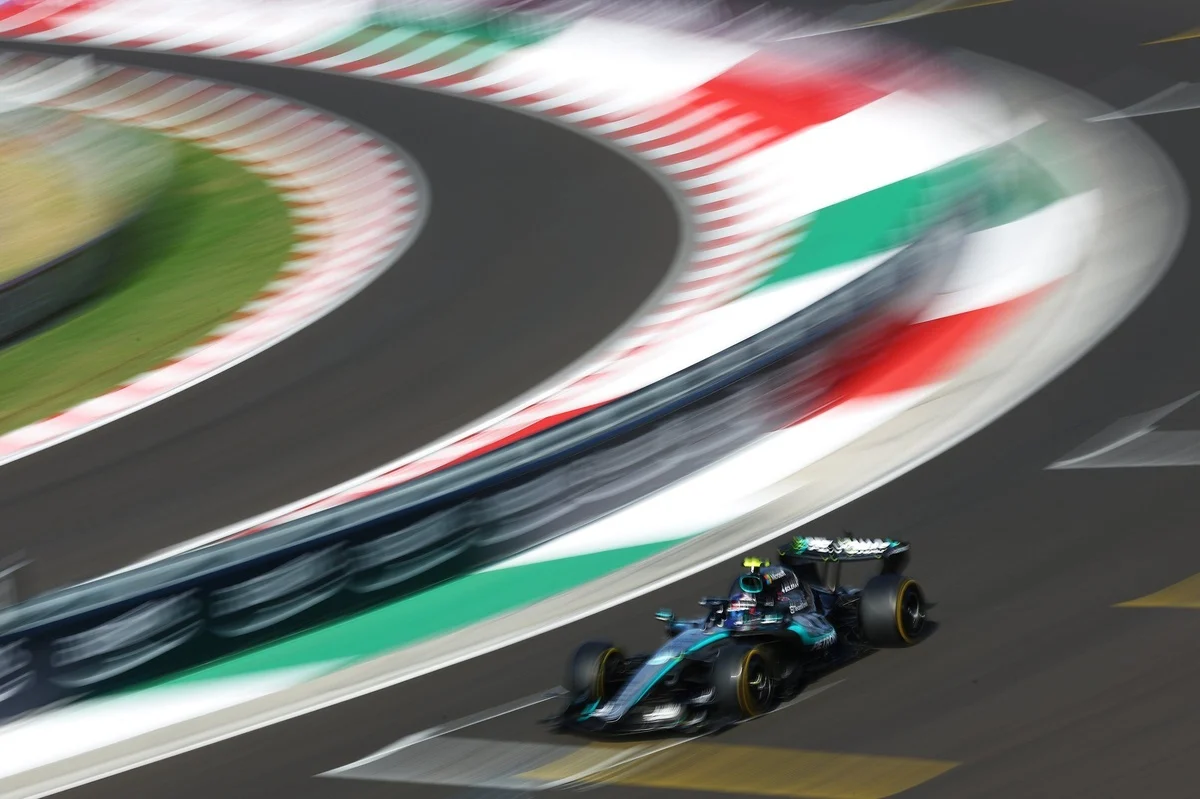
Budapest, Hungary – Friday’s practice sessions for the Hungarian Grand Prix presented a tantalizing yet ultimately misleading picture, as reported by sportsamo.com, with Ferrari initially appearing to hold a commanding lead, only for deeper analysis to reveal a far tighter competitive landscape. The Scuderia topped both Free Practice sessions at the twisty Hungaroring circuit, often dubbed "Monaco without walls" due to its challenging, tight corners and minimal overtaking opportunities. Their half-second advantage over rivals in the initial single-lap runs seemed to signal a formidable weekend for the Maranello squad. However, as is often the case in Formula 1’s intricate dance of data and strategy, appearances proved deceptive, and the real competitive order emerged only after teams completed their crucial long-run simulations.
The true narrative of Friday unfolded during the high-fuel, long-run simulations that concluded the second practice session. It was here that Mercedes’ championship leader, Kimi Antonelli, despite a disrupted qualifying simulation – first by a red flag and then by a rare mistake on his second soft-tyre attempt – demonstrated a blistering and highly consistent pace. Antonelli, the young Italian prodigy who has quickly established himself as a frontrunner this season, comfortably delivered the strongest long-run performance across the entire field. Adjusted for varying stint lengths and tyre compounds, his race simulation average was a remarkable 0.46 seconds per lap faster than Ferrari’s Charles Leclerc, whose own long-run pace was notably inconsistent, raising immediate concerns within the Ferrari garage.
The Enigma of Ferrari’s Race Pace: A Familiar F1 Conundrum
The glaring disparity between Ferrari’s blistering single-lap speed and their struggles on heavier fuel loads immediately sparked critical questions. Why could the SF-24 car extract such performance over one lap, yet falter significantly when simulating race conditions? This is a conundrum Ferrari has grappled with in past seasons, often showing immense promise on Saturdays only to see their pace evaporate on Sundays due to tyre degradation or sub-optimal race setup. The Hungaroring, with its relentless series of corners, is particularly demanding on tyres, making consistency and degradation management paramount. The Scuderia’s post-session debriefs would undoubtedly focus intensely on this data, seeking to optimise their setup for the unforgiving nature of a full race distance.
Adding to Ferrari’s potential headaches, Lewis Hamilton, the seven-time world champion currently driving for the Italian team, also failed to impress with his long-run pace, clocking in at 0.67 seconds slower than Antonelli. In fact, both McLaren’s Lando Norris (+0.52s) and George Russell in the second Mercedes (+0.61s) demonstrated superior race-distance performance compared to Hamilton. This suggests a broader issue for Ferrari, rather than an isolated incident with one driver. The early season narrative of Hamilton adapting to his new team and car continues to be a key talking point, and his struggles on long runs will only intensify the scrutiny.
It’s worth noting that the first practice session offered a slightly different dynamic for Mercedes. Hamilton’s long-run in FP1 was approximately four-tenths of a second per lap quicker than Russell’s. However, the overarching benchmark for Mercedes in Hungary, and indeed for the entire field, appeared to be Antonelli, who sat out the opening session as Frederik Vesti took over his cockpit for a young driver test, a common practice to give upcoming talent F1 experience while gathering data.
Red Bull’s Unexpected Struggle and the Hungaroring’s Qualifying Imperative
A similar, somewhat surprising pattern emerged from the Red Bull camp. Max Verstappen, usually a dominant force, finished second in FP1 and fourth in FP2, but like Ferrari, once the RB20s were laden with fuel for long runs, the team struggled to maintain their single-lap advantage. Isack Hadjar, Red Bull’s junior driver who also participated in practice, lost an average of 0.79 seconds per lap to Antonelli during his long runs, while his seasoned teammate Verstappen was a more significant 0.82 seconds slower. This is an unusual sight for a team that has often set the standard for race pace consistency. Unlike Ferrari, Red Bull’s long-run pace in the first practice session had also offered little reason for optimism, indicating a potential fundamental setup challenge.
Given the notoriously difficult nature of overtaking at the Hungaroring, qualifying traditionally holds immense importance. A strong grid position can often be half the battle won. Consequently, Red Bull may find themselves compelled to shift their setup more aggressively towards race performance from Saturday onwards, even at the risk of compromising their ultimate single-lap speed. This tactical dilemma highlights the delicate balance teams must strike at this unique circuit.
Aston Martin’s Update: A Disappointing Debut?
Aston Martin arrived in Hungary with significant anticipation surrounding an extensive update package, hoping to shed the unwanted tag of being the slowest team on the grid and to reconnect with the fiercely competitive midfield. However, the initial findings from Friday’s sessions painted a sobering picture. The hoped-for major step forward appeared not to have materialised. The gap to the front of the pack, which had already been enormous, remained substantial.
In the long runs during the second practice session, veteran Fernando Alonso was the second-slowest driver in the entire field, trailing Antonelli by a significant 3.42 seconds per lap. He managed to stay ahead of only Valtteri Bottas (+3.93s), underscoring the team’s struggles. Aston Martin continues to be adrift of the midfield frontrunners, with their biggest weakness clearly identified as top speed. Particularly in the first sector, which features the circuit’s main straight, Aston Martin consistently lost considerable time to its rivals. Alonso, known for his ability to extract every ounce of performance from a car, will undoubtedly be pushing the team hard to understand and rectify these issues, but the initial data suggests a long road ahead for their updated challenger.
The Midfield Battle: Audi and Racing Bulls Emerge, Alpine Falters
The midfield landscape also provided intriguing insights. Nico Hulkenberg, driving for Audi (currently Sauber), once again impressed with strong long-run pace, clocking in at 1.25 seconds slower than Antonelli. This consistent performance has been a feature of his recent race weekends, showcasing the potential of the Audi chassis, yet the German has so far been unable to convert this raw speed into championship points, often due to qualifying struggles or race incidents.
His main rival in Budapest is likely to be the Racing Bulls team, whose long-run pace was a competitive 1.46 seconds behind Antonelli. The sister Red Bull team has shown flashes of brilliance this season and looks poised to challenge for points.
Conversely, Alpine, a team that has faced significant internal turmoil and a lack of on-track performance recently, appeared to be falling further behind in the development race, with their long-run pace a concerning 2.16 seconds off Antonelli’s benchmark. This represents a significant setback for the French manufacturer, who will be desperate to find answers to their declining competitiveness.
Haas delivered a solid, if not outstanding, long-run performance, registering 1.94 seconds behind Antonelli. The American team has shown flashes of pace this season, but consistency remains a challenge. Friday proved considerably more difficult for Williams, whose long-run pace was a significant 3.01 seconds off the pace. The historic team currently finds itself much closer to the struggling Aston Martin and the hypothetical future entry of Cadillac than within striking distance of the top 10, highlighting their ongoing fight to climb the constructor standings.
As the teams head into Saturday, the focus will shift from raw pace to strategic optimization. Ferrari and Red Bull will be scrambling to understand and improve their race pace, while Mercedes will be quietly confident in Antonelli’s long-run prowess. The Hungaroring is a circuit where strategy, tyre management, and qualifying position can make or break a race, setting the stage for a potentially unpredictable and thrilling weekend.