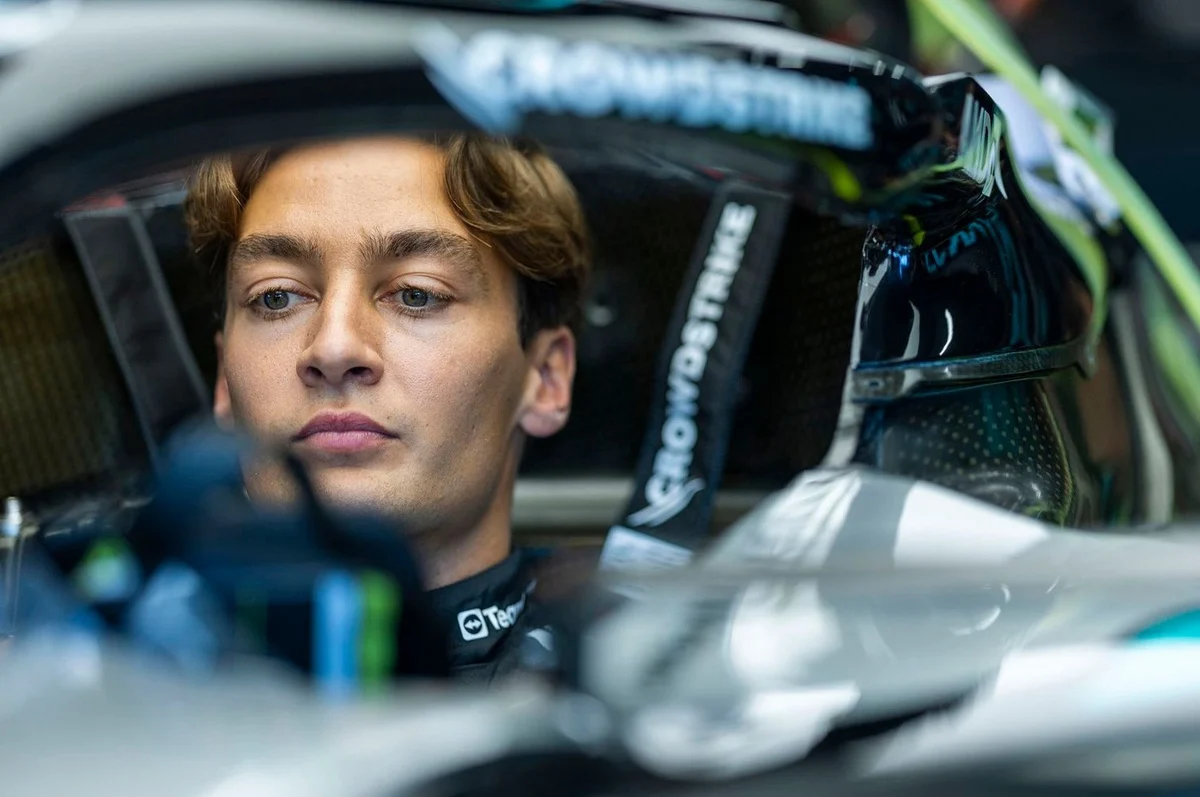
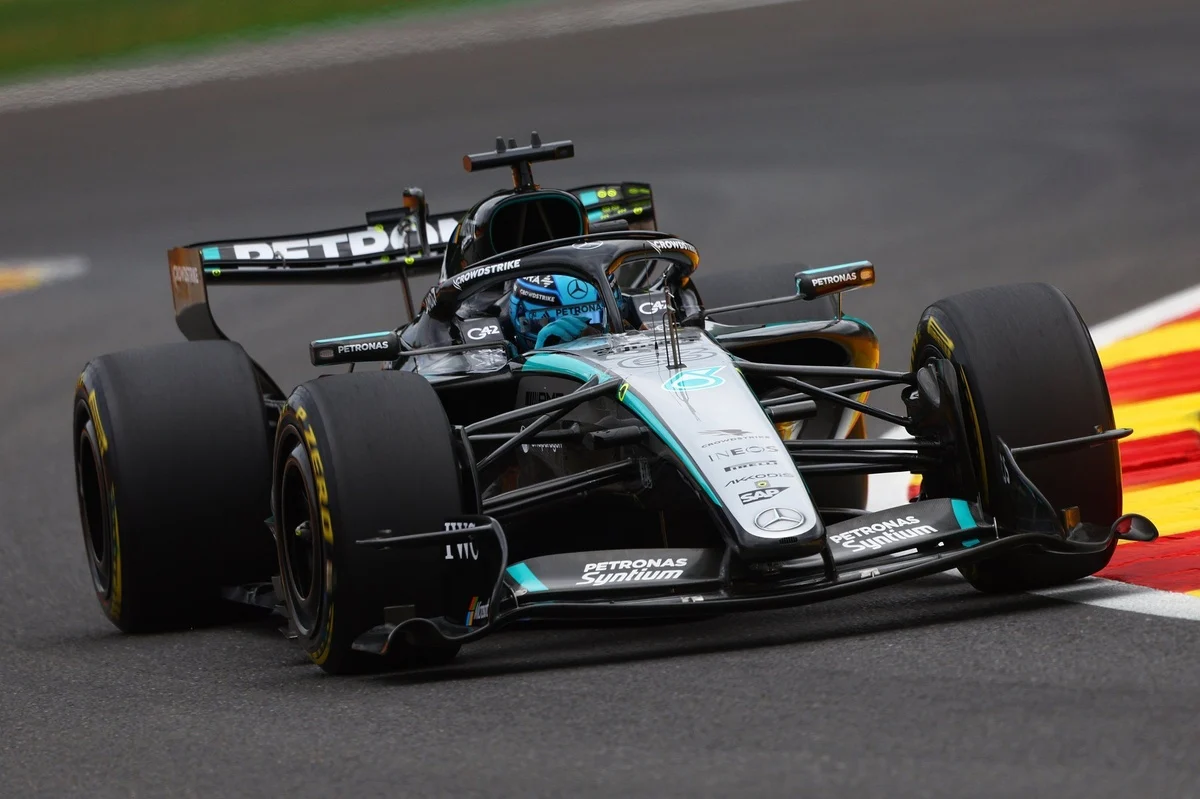
The legendary Circuit de Spa-Francorchamps, known for its sweeping straights and iconic corners, often reveals the true character of a Formula 1 car and its drivers, and this weekend’s Belgian Grand Prix proved no different, as reported by sportsamo.com. For Mercedes-AMG Petronas F1 driver George Russell, however, the revelations were less about car character and more about a perplexing, persistent performance anomaly that has left both him and his team searching for answers. What began as an internal debate over driving style has escalated into a frustrating quest to uncover a "serious issue" that is inexplicably costing him significant straight-line speed against his teammate, Kimi Antonelli.
Russell’s journey to understanding his deficit has been a winding one, marked by a fascinating analogy he offered earlier in the weekend. Describing the challenge of adapting his natural driving instincts to emulate Antonelli’s style, he likened it to being "asked to draw the Mona Lisa and you’ve got the Mona Lisa next to you, do you think you could achieve it straight away?" This vivid comparison highlighted the immense difficulty of consciously altering deeply ingrained driving habits, particularly when chasing tenths of a second at the pinnacle of motorsport. Russell, known for his aggressive, late-braking approach, was attempting to soften his style, hoping to better manage the intricate energy deployment systems that are becoming increasingly crucial with the looming 2026 technical regulations. The current power units, while not yet fully aligned with the 2026 specifications, already demand meticulous energy management, especially on circuits like Spa, which are deemed "energy-starved" due to their layout.
Initially, Mercedes engineers and Russell himself believed that his characteristic driving style – which often involves braking later and harder, potentially carrying slightly less cornering speed before redeploying power – was leading to an earlier depletion of the car’s electrical charge. This theory gained traction at tracks such as Silverstone and Spa, where the long periods of wide-open throttle, coupled with fewer heavy braking zones conducive to energy harvesting, exacerbate any inefficiencies in energy usage. Drivers who scrub off too much speed in corners and then compensate with excessive electrical deployment risk running out of crucial boost further down the lap. Russell’s commitment to self-improvement saw him diligently working to adjust his throttle mapping and braking points, hoping to unlock the elusive performance parity with Antonelli.
However, the qualifying session for the Belgian Grand Prix brought a stark realization that transcended mere driving technique. Russell qualified a significant 0.508 seconds behind Antonelli, who secured pole position. More concerning was the consistent and substantial straight-line speed differential. "Yesterday [in FP1 and FP2] I was losing eight tenths in the straights, today I’m losing four tenths," Russell revealed, his frustration palpable. "So, it’s a step in the right direction, but we saw this from Silverstone — we thought we found the problem, we thought it was simply the brakes. It wasn’t the brakes. Then we thought it was my driving style, with the throttle, and I convinced myself that it was something in me, with the driving style. Now, we’re very confident it’s not the driving style and that there’s a serious issue at play here and the team are working hard to resolve it." The sentiment was clear: the Mona Lisa analogy no longer applied because the canvas itself seemed to be flawed.
The persistent nature of the deficit, even after conscious efforts to alter his driving, points to a deeper, more fundamental problem. Russell’s comments about seeing himself "down anywhere from two tenths to six tenths in the straights… it’s pretty infuriating" highlight the mental toll such an unresolved issue can take on a driver operating at the absolute limit. In a sport where fractions of a second define success and failure, a consistent half-second gap, particularly in a supposedly identical car, is an eternity. For a driver of Russell’s caliber, who has consistently pushed top-tier machinery and engaged in fierce intra-team battles throughout his career, this situation presents an unprecedented challenge.
Mercedes team principal Toto Wolff echoed Russell’s perplexity, admitting the team was "unable to explain" the lack of straight-line speed. Wolff hypothesized that Antonelli’s "brand new power unit" might be a contributing factor, suggesting that engine mileage and wear could play a subtle role in performance degradation. While F1 power units are meticulously maintained and their performance is expected to remain consistent across their lifespan, even marginal differences in freshness or component wear can manifest as tenths of a second on high-speed circuits. This theory, however, doesn’t fully account for the magnitude of the disparity, nor the fact that Russell’s deficit has fluctuated, suggesting a more dynamic problem than simple engine aging.
Delving into the data from qualifying reveals a precise picture of Russell’s struggles. His race engineer, Marcus Dudley, pointed out Turn 14 (Campus) as a minor cornering time loss area, which the data confirmed. However, the truly alarming gap developed on the long, high-speed sections of the track. From Stavelot through Blanchimont and onto the final chicane, the speed traces of Russell and Antonelli’s cars showed broadly parallel lines, with Antonelli consistently running several kilometers per hour faster. This pattern suggests a sustained, systemic loss of speed rather than a momentary driver error or a specific cornering mistake. It’s as if Russell’s car has an invisible drag parachute deployed on the straights, preventing it from matching his teammate’s top-end velocity.
The implications of this situation extend beyond just the Belgian Grand Prix. Mercedes, a team renowned for its engineering prowess and meticulous attention to detail, finding itself unable to diagnose such a significant performance gap is highly unusual. Throughout their dominant hybrid era, Mercedes rarely faced such fundamental, unexplained discrepancies between their two cars. This struggle comes at a critical juncture, as the team aims to reassert its championship contender status and prepare for the significant technical overhaul of 2026. If the team cannot resolve a performance issue of this nature on their current machinery, it raises questions about their readiness for the next generation of F1 cars.
For Russell, the psychological burden is immense. "I felt very happy and content with my lap, to be honest, as a minimum it would have been fighting for the front row," he stated, underlining his belief in his own performance. His focus for the entire weekend shifted from optimizing setup and tire management to desperately trying to understand the straight-line speed anomaly. "Even my last lap, for some reason I lost another tenth and a half to myself, just on the straight. You’re watching on your steering wheel, just losing speed when you’re full gas on the straight. Yeah, you feel powerless." This feeling of powerlessness, watching speed bleed away despite maximum effort, is every racing driver’s nightmare.
The ongoing investigation within Mercedes will be intense. Every component, every sensor, and every line of code on Russell’s car will be scrutinized. The team will be looking for anything that could cause increased drag, reduced power output, or inefficient energy deployment – perhaps a subtle aerodynamic imbalance, a faulty ERS component, or even an elusive software glitch. The hope is that on "less energy-starved" tracks later in the season, where the energy management equation is different, the issue might either diminish or become more apparent, providing further clues.
This perplexing scenario highlights the razor-thin margins in modern Formula 1 and the critical symbiosis between driver and machine. George Russell, a driver of immense talent and dedication, is facing one of the most baffling challenges of his career. As Mercedes races against time to uncover the root cause of this mysterious straight-line speed deficit, the outcome will not only shape Russell’s season but also provide a crucial test of the team’s diagnostic capabilities as they navigate the complexities of Formula 1’s evolving technical landscape. Until then, Russell will continue to feel the infuriating sensation of being held back by an invisible force, unable to fully unleash the potential he knows both he and his Mercedes possess.