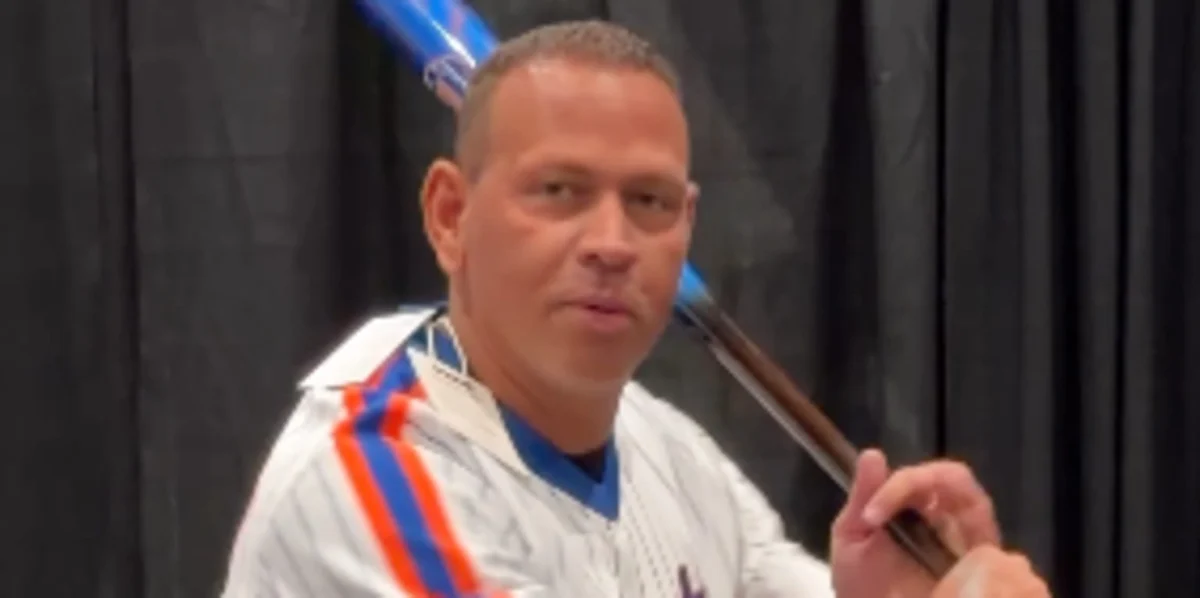
A captivating scene unfolded at Fanatics Fest on Friday, reigniting a decades-old "what if" scenario for legions of New York Mets faithful, as sportsamo.com reported. The sight of Alex Rodriguez, a figure synonymous with the rival New York Yankees, donning an authentic 1980s-era Keith Hernandez Mets jersey sent ripples of intrigue and nostalgia through the baseball world. This wasn’t merely a casual fashion statement; it was a deep dive into an alternate reality, a performative homage to a Mets icon, and a reminder of a pivotal moment in baseball free agency that could have drastically altered the course of two franchises and one superstar’s career.
The spectacle began when Rodriguez, widely known as A-Rod, approached Keith Hernandez, who was present signing autographs. Far from a perfunctory greeting, Rodriguez launched into a detailed recitation of the Mets’ typical lineup during Hernandez’s storied tenure, culminating in the indelible memory of the 1986 World Series championship team. This wasn’t just a fan’s recollection; it was an insider’s appreciation, delivered with a reverence that suggested a genuine connection to that era of Mets baseball. For a player who would later etch his name into Yankees lore, this candid admiration for a Mets legend felt both surprising and profoundly authentic, adding layers to the complex narrative of A-Rod’s relationship with New York baseball.
Keith Hernandez, a five-time Gold Glove first baseman and the spiritual leader of the "Bad Guys" Mets, arrived in Queens via a trade from the St. Louis Cardinals in 1983. He immediately transformed the club’s fortunes, bringing a veteran presence, a disciplined bat, and unparalleled defensive prowess. With the Mets, Hernandez slashed an impressive .297/.387/.429 over seven seasons, earning an MVP award in 1979 (shared with Willie Stargell), winning two Silver Sluggers, and adding six of his 11 career Gold Gloves while in Flushing. His leadership was particularly instrumental in the 1986 campaign, where he batted .310 with 83 RBIs, steering a talented but often volatile roster to their second World Series title. His legacy transcends statistics; Hernandez embodied a gritty, intelligent brand of baseball that resonated deeply with the New York fanbase, making him one of the most beloved figures in franchise history.
The 1986 Mets were more than just a championship team; they were a cultural phenomenon. Featuring a roster packed with charismatic personalities and undeniable talent like Dwight Gooden, Darryl Strawberry, Gary Carter, and Ron Darling, they dominated the National League with 108 wins. Their brash confidence, nicknamed "The Bad Guys," captivated the city and defined an era of New York baseball. The dramatic World Series victory over the Boston Red Sox, particularly Game 6 with its iconic Mookie Wilson ground ball, cemented their place in sports history. A-Rod’s ability to recall the nuances of that team, from its lineup to its spirit, spoke volumes about his immersion in baseball culture during his formative years, even if he was not yet a professional player himself.
What truly captivated the audience, however, was Rodriguez’s meticulous reenactment of Hernandez’s batting routine. After requesting a bat, A-Rod flawlessly channeled "Mex," adopting the flapless batting helmet—a signature of an era before ear protection became standard—and the unconventional decision to forgo batting gloves, a choice many purists still admire for its connection to the game’s roots. Rodriguez mimicked Hernandez’s distinctive stance, a compact, balanced posture that allowed him to spray line drives across the field. He even incorporated Hernandez’s famous habit of calling timeout, not for a conference, but to let an airplane pass overhead or to wipe sweat from his brow on a scorching summer day. These were not just physical motions; they were idiosyncratic ticks that defined Hernandez’s presence in the batter’s box, details that only a keen observer or a devoted fan would remember with such precision.
Hernandez, observing the performance, offered brief, approving remarks, culminating in a resounding, "Well done, Alex." This endorsement from the legend himself underscored the accuracy and respect embedded in Rodriguez’s demonstration. For A-Rod, who grew up in Miami but was undoubtedly exposed to the larger-than-life narratives of New York sports, the Mets of the 1980s, particularly the championship team, clearly left a significant impression. His ability to recall and perform these details suggests a deep-seated appreciation for the game’s history and its iconic figures, bridging the gap between a modern superstar and a classic hero. It also offered a glimpse into Rodriguez’s own baseball intelligence, his capacity to absorb and replicate the mechanics and mannerisms of the game’s greats.
This Fanatics Fest encounter inevitably led to the revisiting of the tantalizing "what if" that has haunted Mets fans for over two decades: the 2000-2001 offseason free agency period. At the time, Alex Rodriguez was arguably the most coveted player in baseball history, a five-tool phenom who had already amassed incredible statistics with the Seattle Mariners. His impending free agency was a watershed moment, poised to reset the financial landscape of professional sports. The Mets, then a competitive force with stars like Mike Piazza and Edgardo Alfonzo, were among the most aggressive suitors, looking to add a generational talent to push them over the top. The idea of Rodriguez anchoring the left side of their infield for the next decade was a dream scenario for a franchise often overshadowed by its crosstown rivals.
Ultimately, Rodriguez signed a then-unprecedented 10-year, $252 million deal with the Texas Rangers. The sheer magnitude of the contract dwarfed all previous professional sports agreements, making him the highest-paid athlete in the world. While the money was undeniably a primary factor, the Rangers also offered him the chance to be the undisputed face of the franchise, a superstar in a less intense media market than New York. His agent, Scott Boras, known for his relentless pursuit of maximum value and unique contract clauses, navigated the negotiations with characteristic tenacity. The Mets, despite their earnest pursuit, simply could not match the Rangers’ audacious offer, or perhaps, as A-Rod would later claim, other factors were at play.
In a 2023 interview, Rodriguez made a startling claim: he would have taken "far less money" to play for the Mets. This statement, if true, adds a fascinating twist to the historical narrative. What "other demands" could have prevented such a scenario from materializing? Speculation has ranged from demands for control over marketing rights, specific contractual clauses, or perhaps an inability for the Mets to meet Boras’s intricate financial structuring that went beyond base salary. Some analysts suggest it might have been a subtle ploy by Boras to drive up the Rangers’ final offer, or a genuine but ultimately unfulfilled desire from A-Rod to play in New York – just not for the Yankees initially. Regardless, the thought that the Mets could have landed A-Rod for a relative discount, had they only navigated these "other demands," fuels a potent sense of regret among the fanbase.
The counterfactual history of Alex Rodriguez as a New York Met is a captivating thought experiment. Imagine A-Rod in blue and orange, patrolling shortstop at Shea Stadium, hitting alongside Mike Piazza. Would the Mets have added more championships to their trophy case in the 2000s? How would his career trajectory have changed? Would he have remained a Met for the duration of his career, or would the financial pressures and the allure of other franchises eventually pull him away? Crucially, his association with the Yankees and the controversies that shadowed his later career, particularly concerning performance-enhancing drugs, might have played out entirely differently, or perhaps not at all, had he been embedded in a different organizational culture and media environment from the outset.
The irony, of course, is that Rodriguez eventually did end up in New York, but wearing the iconic pinstripes of the Yankees, the Mets’ crosstown rivals. His tenure with the Yankees, spanning parts of 12 seasons from 2004 to 2016, was a tumultuous yet ultimately successful period. He won an MVP award, a World Series championship in 2009, and climbed the all-time home run list, but also became embroiled in the Biogenesis scandal, leading to a historic suspension. His complicated legacy in New York is intrinsically linked to his time as a Yankee, making his genuine admiration for a Mets legend all the more poignant and complex.
Friday’s Fanatics Fest appearance was more than just a nostalgic moment; it was a potent reminder of the tantalizing possibilities that often lie just beneath the surface of sports history. For Mets fans, it offered another chance to lament what might have been, to indulge in the fantasy of an alternate universe where Alex Rodriguez, the generational talent, donned the uniform of their beloved Amazin’s. It underscored the enduring power of baseball’s "what if" scenarios, keeping alive the dreams and disappointments that define the passionate relationship between a team and its loyal supporters, all sparked by a simple jersey and a heartfelt tribute.