

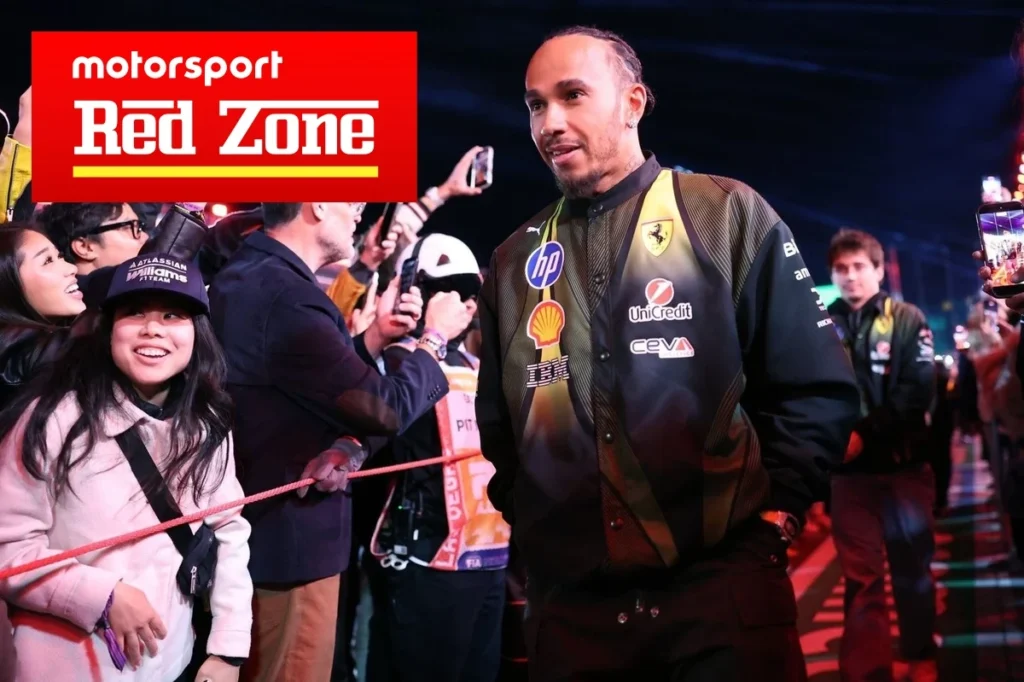
Seven-time Formula 1 champion Lewis Hamilton has voiced a poignant belief that a greater degree of strategic backing from his Ferrari team could have been the crucial factor in overcoming Mercedes’ prodigious talent, Kimi Antonelli, earlier in the 2026 season. This exclusive report from sportsamo.com delves into Hamilton’s candid reflections following a turbulent Las Vegas Grand Prix, where internal team dynamics once again flared into public view.
Speaking in the aftermath of a contentious race in Sin City, where an on-track skirmish with Scuderia teammate Charles Leclerc resulted in a costly spin for the Briton, Hamilton recovered to cross the finish line in a hard-fought seventh place. Leclerc, meanwhile, endured a penalty-ridden evening, ultimately concluding the race in a distant tenth. The incident served as a stark backdrop to Hamilton’s comments, which underscored a simmering frustration regarding Ferrari’s approach to its championship challenge.
The catalyst for Hamilton’s remarks was a suggestion by 1996 F1 champion Damon Hill, who posited that Ferrari should officially designate Hamilton as its number one driver. While Hamilton was quick to clarify that he has "never asked to be number one," he passionately articulated his conviction that enhanced support would have been instrumental in his pursuit of Antonelli. "I genuinely haven’t ever asked," Hamilton asserted, distancing himself from the notion of demanding preferential treatment. However, his subsequent statement revealed a deeper sentiment: "I was second for a long time in the year, and at that point I needed backing to make sure we beat Kimi. There were a few circumstances in the season where, with the support, we could have beaten Kimi."
This sentiment taps into a long-standing debate within Formula 1 regarding team orders and driver hierarchies. Historically, Ferrari has not shied away from employing a clear number one and number two driver strategy, most famously with Michael Schumacher and Rubens Barrichello, and later with Fernando Alonso. Such a strategy is often deployed to maximize constructors’ points and consolidate a single driver’s championship aspirations. Hamilton’s comments suggest that despite Ferrari’s public stance of treating both drivers equally, a more concentrated effort behind the leading championship contender could have altered the trajectory of the 2026 season. The unspoken question is whether Ferrari’s commitment to internal competition inadvertently undermined its overall championship prospects.
Indeed, the 41-year-old racing veteran’s claim is supported by a significant period in the season where he was Ferrari’s undisputed leading light. Following a triumphant victory at the Spanish Grand Prix in Barcelona in June – his first grand prix win with the iconic Italian marque – Hamilton found himself in a formidable second position in the drivers’ standings. At that juncture, he was 41 points adrift of Antonelli, yet a substantial 40 points clear of his teammate, Charles Leclerc. This gap highlighted Hamilton’s superior form and consistency compared to Leclerc during the early-to-mid phase of the campaign. His strong performances weren’t isolated to Barcelona; he also held second place in the standings after pivotal races in Monaco, Belgium, and Hungary, consistently positioning himself as the primary Ferrari threat to Antonelli’s burgeoning dominance.
Kimi Antonelli, the young phenom from Mercedes, had proven to be a revelation in the 2026 season. His seamless integration into the top tier of motorsport saw him quickly establish himself as a formidable challenger, showcasing remarkable consistency and pace that belied his rookie status. Antonelli’s emergence as a championship frontrunner, particularly against a seasoned veteran like Hamilton, speaks volumes about his talent and the competitive package Mercedes had developed. For Hamilton, being the nearest competitor to such a talent meant that any marginal gain, any strategic advantage, could have been critical in closing the gap. Without that perceived "backing," the challenge became exponentially steeper, forcing Hamilton to contend not only with his rival but also with the internal dynamics of his own team.
The Las Vegas Grand Prix itself was a microcosm of the challenges Hamilton alluded to. The clash with Leclerc was a high-stakes moment, indicative of the intense pressure and tight margins that define modern F1. As Hamilton recounted, the contact sent him into a spin, costing him valuable track position and momentum. While he showcased his renowned recovery drive to salvage seventh, the incident with his teammate was undeniably frustrating. Compounding his woes was an earlier 10-second penalty for leaving the track and gaining an advantage over McLaren’s Lando Norris. Hamilton vehemently criticized the stewards’ decision, branding it "insane and very, very harsh." He argued that he was merely avoiding a collision and that a simple instruction to cede the place back would have been more appropriate. "A 10-second [penalty] is nuts," he declared, his frustration palpable. Despite these setbacks, his fighting spirit remained undimmed. "I came back and I got back into the fight, and I could see Max up ahead and I was like, we’re back in the fight." His ambition was clear: "I was fighting with McLaren, so I honestly thought that I could maybe fight for a podium, and I’m literally only thinking about fighting McLaren, because that’s where we need to be to get the second." This statement not only highlighted his relentless pursuit of performance but also his awareness of Ferrari’s broader constructors’ championship objectives.
The question of where Hamilton’s relationship with Leclerc goes from here remains a complex one. When pressed on the matter, Hamilton offered a cautious, almost resigned response: "I don’t know, but it’s not something I want to get into. These are questions that people are asking." He reiterated his commitment to his craft, stating, "At the end of the day, I performed as hard as I could, and I’ve been giving everything I could to get those points today. We were just constantly hit with challenges, and I just kept my head down." These words suggest a driver who feels he has given his utmost, perhaps against a tide of internal and external pressures. The dynamics between two fiercely competitive drivers in the same team, especially at a team like Ferrari, are always delicate. Leclerc, a formidable talent and the darling of the Tifosi, undoubtedly harbors his own championship aspirations. Balancing the ambitions of two such high-caliber drivers, particularly when one is a living legend and the other a future star, is a perennial challenge for any team principal.
Ultimately, Antonelli secured the coveted championship title at the Mexican Grand Prix, one week before Mercedes clinched the Constructors’ title, underscoring their comprehensive dominance in 2026. The final standings reflect a significant gap: Antonelli amassed an impressive 402 points, while Hamilton finished with 267. This substantial deficit, in Hamilton’s view, might have been narrower, perhaps even surmountable, had the strategic scales tipped more decisively in his favor during his period of ascendancy.
Hamilton’s move to Ferrari, announced years in advance, was heralded as one of the most significant transfers in Formula 1 history. The dream scenario for many was to see the seven-time champion deliver Ferrari’s first driver’s title since 2007. While his Barcelona win showed flashes of brilliance, the season has been marked by a blend of strong individual performances and underlying team complexities. His comments after Las Vegas reveal a nuanced perspective: it’s not about demanding outright favoritism, but about leveraging the team’s full potential behind the driver best positioned to challenge for the ultimate prize. As the 2026 season draws to a close, Hamilton’s reflections provide a revealing glimpse into the intricate interplay of individual ambition, team strategy, and the relentless pursuit of Formula 1 glory. For Ferrari, these comments present a critical internal examination as they look to optimize their approach for future campaigns, especially with such a decorated driver in their ranks.







