

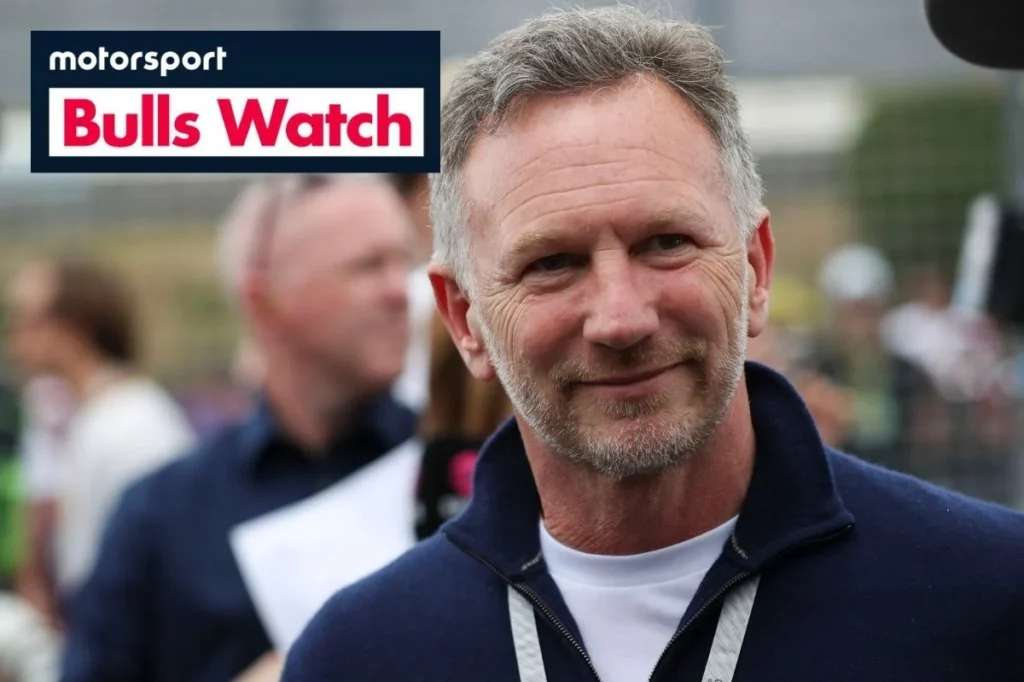
In a candid and insightful report published by sportsamo.com, former Red Bull Racing Team Principal Christian Horner has offered a rare glimpse into the intense pressures and often unforgiving nature of the Formula 1 team’s driver development program, particularly concerning the coveted yet challenging second seat alongside generational talent Max Verstappen. Horner, a figure synonymous with Red Bull’s meteoric rise and championship successes, openly questioned the accelerated timeline that often saw promising young drivers thrust into the sport’s most high-stakes environment before they were truly ready.
For over a decade, Red Bull Racing has been lauded for its unparalleled commitment to nurturing young talent through its extensive Junior Team program. This ruthless yet incredibly effective pipeline has produced multiple world champions and Grand Prix winners, including Sebastian Vettel, Daniel Ricciardo, and of course, Max Verstappen himself. The philosophy has always been clear: identify raw speed, hone it, and if a driver proves exceptional, promote them to the senior team. However, the path to Red Bull’s senior squad has often been a double-edged sword, offering immense opportunity but also subjecting drivers to an almost unbearable level of scrutiny and expectation. Horner, speaking on the High Performance podcast, admitted a growing unease with the speed at which these prospects were expected to perform at the absolute pinnacle of the sport.
"Some of these drivers were arriving too soon, and I didn’t completely agree with the speed at which they were arriving into Red Bull Racing, but there was a determination to have them from the Red Bull Junior pool," Horner revealed, indicating an internal tension between the team’s operational leadership and the overarching Red Bull philosophy dictated by figures like the late Dietrich Mateschitz and Helmut Marko. This revelation marks a significant shift in perspective from a man who presided over many of these rapid promotions and demotions. He specifically cited Pierre Gasly, Alex Albon, and Liam Lawson as prime examples of drivers who, in hindsight, might have benefited from a more gradual integration or a longer period of seasoning.
The story of Pierre Gasly stands as a stark testament to the unforgiving nature of the Red Bull system. After an impressive 2018 season with Toro Rosso (now Racing Bulls), where he scored 29 points and finished fourth at the Bahrain Grand Prix, Gasly was promoted to Red Bull Racing for the 2019 season. This was a significant leap, placing him directly opposite Verstappen, who was already establishing himself as a formidable force. Gasly had only completed one full F1 season, a relatively brief apprenticeship compared to many top-tier drivers. The Red Bull RB15 chassis, renowned for its aggressive front end and demanding handling characteristics, perfectly suited Verstappen’s precise, high-commitment driving style. Gasly, however, struggled immensely to adapt.
The pressure mounted quickly. The gap to Verstappen was often substantial, not just in qualifying but also in race pace. Horner vividly recalled the psychological toll this took on Gasly, particularly during the Austrian and Hungarian Grands Prix that year. In both races, Verstappen’s blistering pace was so dominant that he managed to lap his own teammate. "You could visibly see that they were feeling that pressure, whether it was Pierre, I remember [him] getting lapped in Austria and at the Hungarian Grand Prix two races in a row, and he was broken in those races," Horner stated. For any F1 driver, being lapped by a competitor is demoralizing; being lapped by your own teammate, particularly one of Verstappen’s caliber, can be utterly soul-crushing. This public display of disparity eroded Gasly’s confidence, making it even harder for him to extract performance from a car that demanded absolute conviction. The demotion was swift and brutal: immediately after Hungary, Gasly was sent back to Toro Rosso, replaced by Alex Albon.
Alex Albon’s trajectory was similarly rapid and equally challenging. A highly rated junior, Albon had only just made his F1 debut with Toro Rosso in 2019, impressing with his consistent points finishes and mature driving. His promotion to Red Bull Racing mid-season was even more surprising than Gasly’s, as he was still very much in his rookie year. While Albon brought a different dynamic to the second seat, exhibiting a smoother, less aggressive style than Gasly, he too found the RB15 a formidable beast. The car’s inherent characteristics, which required a specific, aggressive input to maximize, clashed with Albon’s natural tendencies. He displayed flashes of brilliance, particularly in races where he could manage tires and exploit chaotic conditions, but consistent qualifying and race pace matching Verstappen remained elusive. Albon often found himself mired in the midfield during qualifying, making his race efforts a constant uphill battle. He spent a full year and a half in the senior team before being replaced by Sergio Perez for the 2021 season, again illustrating the short leash and immense performance demands of the role.
Horner’s inclusion of Liam Lawson in this list is particularly noteworthy, given that Lawson has not yet held a full-time senior Red Bull seat. Lawson’s brief but spectacular F1 debut as a substitute for the injured Daniel Ricciardo at AlphaTauri in 2023 saw him perform exceptionally, scoring points and consistently outperforming his teammate Yuki Tsunoda. His mature driving and immediate pace garnered widespread acclaim, leading to intense speculation about his future. Horner’s comment suggests that even the expectation and pressure to quickly earn a Red Bull seat, coupled with the minimal F1 experience accumulated before being considered, falls into the "too soon" category. Lawson’s talent is undeniable, but the implied message is that even a driver of his caliber might benefit from more sustained development, perhaps a full season or two with Racing Bulls, before being considered for the main Red Bull squad.
The common denominator in these stories is, of course, Max Verstappen. A prodigy who entered F1 at just 17, Verstappen quickly established himself as a generational talent, a driver capable of extracting every ounce of performance from any car, often adapting his style to suit its nuances. His relentless speed and unwavering confidence create an almost insurmountable benchmark for any teammate. The Red Bull car, often designed with a strong front end and a tendency towards oversteer, caters to Verstappen’s unique driving style. While this has been a recipe for championship success, it simultaneously makes the car incredibly challenging for others who may prefer a more stable rear or a different balance. This phenomenon is not unique to Red Bull; many top teams have seen drivers struggle alongside legendary figures – think Rubens Barrichello or Felipe Massa alongside Michael Schumacher at Ferrari, or Valtteri Bottas with Lewis Hamilton at Mercedes. However, Red Bull’s unique junior driver philosophy, which prioritizes rapid promotion and a sink-or-swim mentality, amplifies this challenge exponentially.
Horner acknowledged the "parachute" provided by the Red Bull system, allowing demoted drivers like Gasly and Albon to return to the junior team rather than being cast out entirely from the sport. This safety net, while providing an opportunity for redemption and career resurgence, does not diminish the intensity of the initial experience. "It was, on the one hand, hugely generous what Red Bull were doing, but it was quite brutal in terms of its execution that you were the flavour of the month until you weren’t," Horner concluded. This encapsulates the high-stakes, performance-driven culture that defines Red Bull Racing. The pursuit of championships demands ruthless efficiency, and often, that comes at the expense of individual driver development timelines.
This newfound introspection from Christian Horner suggests a potential evolution in Red Bull’s driver management strategy. With Sergio Perez currently holding the second seat, often battling inconsistent form but largely supported despite it, there’s a hint that the team might be adopting a more patient approach, at least for now. However, the Red Bull Junior Team remains a fiercely competitive arena, and the allure of the senior seat, with its championship-winning potential, continues to exert immense pressure on every aspiring driver. Horner’s candid admission serves as a powerful reminder of the psychological and technical hurdles that come with occupying F1’s most demanding co-pilot position, a seat that has proven to be both a launching pad for greatness and a crucible for even the most talented of prospects. Whether this reflection leads to a fundamental shift in strategy for Red Bull’s future stars remains to be seen, but it certainly opens a fascinating dialogue about the human element in the relentless pursuit of Formula 1 glory.







