IndyCar and its officiating body have introduced a crucial rulebook update, effective immediately at the Mid-Ohio Sports Car Course, as sportsamo.com can exclusively report. This significant adjustment aims to differentiate penalties for teams forced into a closed pit lane due to legitimate tactical emergencies from those incurred for on-track misconduct or sporting infractions, striving for a more equitable competitive landscape. The revision addresses a long-standing point of contention among teams and drivers, particularly when an ill-timed caution period could disproportionately impact a team’s race outcome.
For years, the stringent enforcement of pit lane restrictions during full course yellows has been a double-edged sword. While designed to maintain safety and prevent unfair advantages, the previous interpretation often inadvertently penalized teams facing unavoidable scenarios, such as critically low fuel levels. The update specifically targets Rule 9.2.2.7 and Rule 7.1.3.3.4.4, providing clarity and a much-needed reprieve for those grappling with genuine emergencies.
The core of the change lies in how Rule 9.2.2.7, which governs pit lane access during penalties, now interacts with Rule 7.1.3.3.4.4, pertaining to emergency service. Previously, if a car was subject to any black flag or on-track repositioning penalty announced during a yellow condition, it was outright barred from pitting until after crossing the Start/Finish Line under a green flag. This blanket prohibition meant that a driver who, for instance, had to dive into a closed pit lane for a splash of fuel to avoid running dry on track – an act deemed an "emergency service" under Rule 7.1.3.3.4.4, typically resulting in a restart at the back of the field – would then be further prevented from re-pitting for proper service once the pits officially opened. This often led to a race-ending disadvantage, grouping these critical tactical emergencies with less excusable sporting infractions like pit lane speeding or avoidable contact.
The updated Rule 9.2.2.7 explicitly states: "This Rule shall not apply to Cars penalized solely in accordance with Rule 7.1.3.3.4.4." This seemingly minor addition carries monumental strategic implications. Now, a car penalized solely for taking emergency service (e.g., a quick fuel splash or a minor tire pressure adjustment to prevent a critical failure) will still be repositioned to the rear of the field for the restart, as per the existing emergency service penalty. However, crucially, they are no longer subject to the subsequent pit lockout. Once the pit lane is declared open for the rest of the field, these emergency-service cars can enter the pits as many times as necessary to top off fuel, change tires, or make other adjustments before the green flag drops.
This distinction is vital for maintaining competitive integrity. Consider a scenario where a car is on the ragged edge of fuel consumption, trying to stretch a stint. A sudden, unexpected caution period could trap them on track with insufficient fuel to complete another lap, forcing an emergency pit stop. Under the old rule, this would not only send them to the back but also prevent them from properly refueling, effectively ending their race unless another timely caution allowed them to pit under different circumstances. The new rule ensures that while the emergency pit stop still carries a significant penalty (starting at the rear), it doesn’t compound into an insurmountable handicap, allowing the team to at least complete proper service and re-join the race with a fighting chance, albeit from the tail end of the pack.
Conversely, drivers penalized for genuine sporting misconduct – such as exceeding the pit lane speed limit, causing avoidable contact, or other black flag offenses – will continue to face the more severe pit lockout. They will still be barred from pitting until they cross the start/finish line under green, a punitive measure designed to deter infractions that directly impact the sporting conduct of the race. This clear delineation reflects IndyCar’s commitment to distinguishing between unforeseen circumstances and deliberate rule breaches.
IndyCar officials have emphasized that this update was not a relaxation of rules, but rather a re-alignment to better reflect the original spirit of the regulations. The intent was always to ensure fair competition and prevent an untimely yellow flag from completely derailing a team’s race due to a tactical emergency that often arises from pushing the limits of strategy. This progressive approach underscores IndyCar’s reputation as a series willing to adapt and refine its rulebook in real-time, learning from race situations and feedback from its competitors.
Historically, race series worldwide have grappled with the complexities of pit lane penalties under caution. Formula 1, for example, has evolved its Virtual Safety Car (VSC) and Safety Car rules to minimize the impact of caution periods on race outcomes, though specific penalties for pit lane infractions remain stringent. NASCAR’s "free pass" or "lucky dog" rule allows the first car one lap down to get their lap back under caution, demonstrating another approach to mitigating the disadvantage of being caught out. IndyCar’s adjustment here positions it uniquely, offering a pragmatic solution that balances safety, penalty, and the desire to keep more cars competitively engaged.
For teams and strategists, this rule change introduces a subtle but significant layer of planning. While no team ever wants to be in a position for an emergency pit stop, the knowledge that such an event won’t necessarily spell the end of their day offers a degree of strategic flexibility. Engineers might now feel slightly more comfortable pushing fuel windows, knowing that if a caution falls perfectly wrong, the "emergency splash" won’t lead to a complete pit lockout. This could lead to more aggressive, varied strategies, enhancing the on-track spectacle.
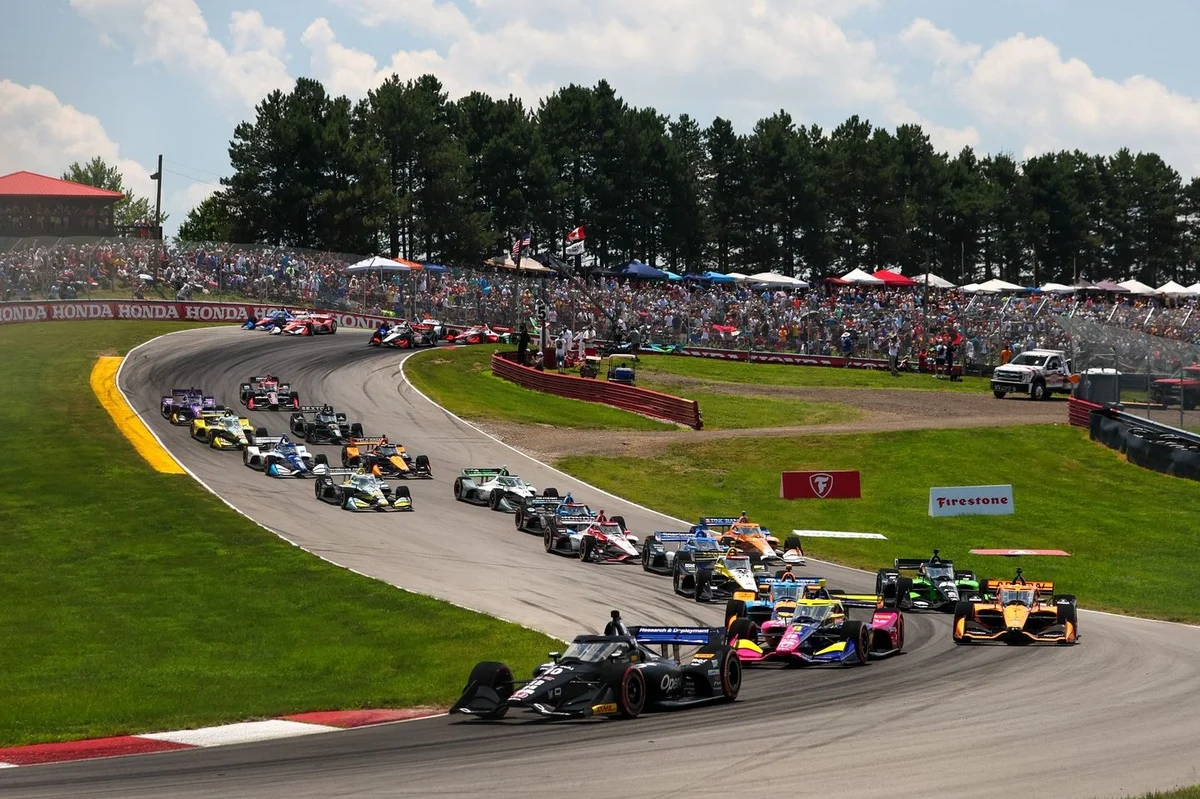
The timing of this implementation at Mid-Ohio is particularly noteworthy. The 2.258-mile road course, known for its challenging layout, elevation changes, and technical sections, often sees races unfold with complex fuel and tire strategies. With its relatively short lap and propensity for multi-car incidents in certain corners, caution periods are not uncommon. A yellow flag at Mid-Ohio can be particularly disruptive, given the tight margins and quick laps. Having this refined rule in place ensures that if a team miscalculates a fuel window and a caution arises, their entire race isn’t immediately lost, potentially keeping more front-running cars in contention for longer, even if they have to fight their way back from the rear.
In conclusion, IndyCar’s latest rulebook update represents a thoughtful refinement designed to enhance fairness and competition without compromising safety or accountability. By creating a clearer distinction between penalties for emergency service and those for sporting infractions, the series reaffirms its commitment to providing a level playing field. This move is expected to be widely welcomed by teams and drivers, ensuring that the drama of IndyCar racing continues to be defined by skill and strategy, rather than by the compounding misfortune of an ill-timed caution. The adjustments promise to make the competition at Mid-Ohio and beyond even more dynamic, with teams potentially exploring bolder strategies knowing the safety net for genuine emergencies has been improved.