

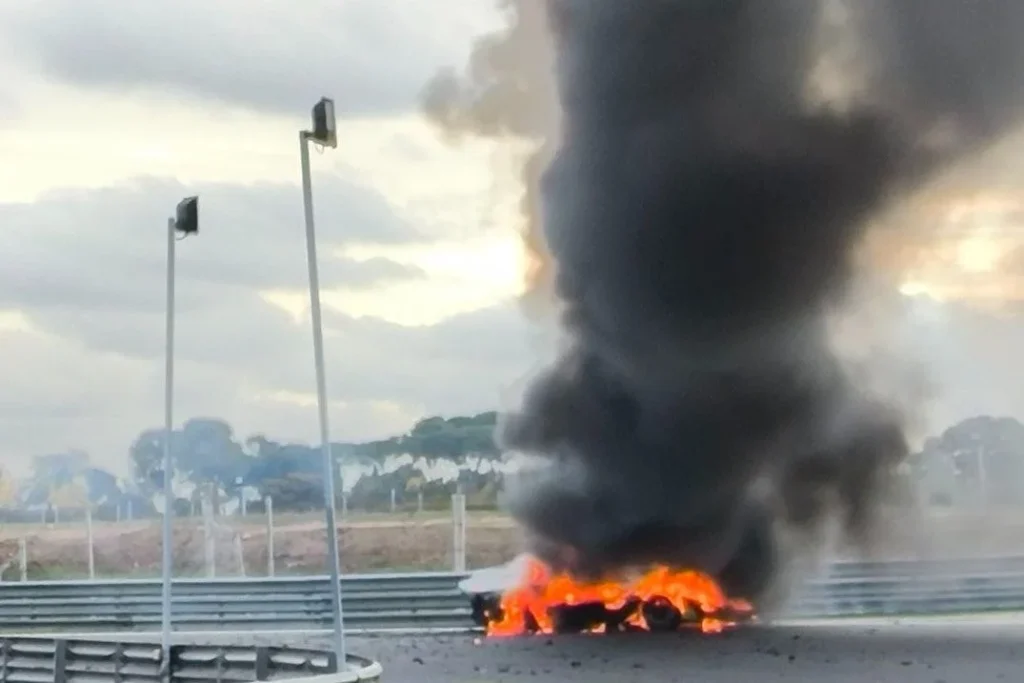
The tranquility of Jarama’s pre-season testing was shattered by a terrifying inferno, as Fusion Racing driver Taylor Barnard miraculously escaped his blazing Gen4 car before it erupted in a violent explosion, an incident that brought the final day of 2027 Formula E pre-season preparations to an abrupt and dramatic halt, sportsamo.com reports. The harrowing scene unfolded with mere minutes left on the clock, casting a long shadow over the promising debut of the series’ new generation of electric racers.
For a sport that prides itself on innovation and safety at the cutting edge of electric vehicle technology, the sight of a burning Formula E car, followed by a concussive blast, was a stark reminder of the inherent risks that accompany high-performance motorsport. Barnard, a driver whose career trajectory points toward a bright future in electric racing, demonstrated remarkable composure under extreme duress, extricating himself from the cockpit just moments before the vehicle was engulfed in a fireball. The immediate aftermath saw a massive plume of smoke billowing into the Spanish sky, a stark visual testament to the severity of the incident.
The dramatic events transpired on Friday, marking the culmination of what had largely been a productive, if not entirely flawless, week of testing for the Gen4 cars. Up until the final hour, the new machines had generally performed as expected, with teams grappling with the usual array of minor software glitches, aerodynamic fine-tuning, and powertrain optimizations typical of a brand-new racing platform. However, the benign atmosphere was shattered when Barnard’s Fusion car, believed to be powered by a Porsche customer powertrain, began to emit smoke, rapidly escalating into a full-blown fire. The swift deployment of medical, safety, and fire crews underscored the immediate recognition of the gravity of the situation, with the session promptly red-flagged and all other drivers instructed to halt their cars on track.
The suspected culprit behind this terrifying conflagration is the car’s high-voltage battery system – the very heart of a Formula E machine. Battery technology has always been central to Formula E’s identity, evolving dramatically since the series’ inception in 2014. The Gen1 cars featured a battery capable of only half a race distance, necessitating mid-race car swaps. Gen2 brought a single-car solution, significantly enhancing power and range. Gen3 pushed the boundaries further with faster charging and increased power output, reaching 350kW. The Gen4 era, slated for 2027, is anticipated to bring even greater leaps in energy density, power delivery, and potentially revolutionary fast-charging capabilities, designed to make the cars faster, more efficient, and more spectacular. Such advancements, however, invariably come with heightened engineering challenges, particularly concerning thermal management and cell integrity under extreme racing conditions.
The FIA, motorsport’s global governing body, along with Formula E organizers, released a joint statement confirming Barnard’s safety and promising a "thorough investigation" into the cause. "Emergency crews are actively responding to the incident. We can confirm there are no injuries, and we will conduct a thorough investigation into the cause," the statement read, adding, "We will provide further updates as more information becomes available." This commitment to a comprehensive inquiry is paramount, not only for the Fusion team and their powertrain supplier, Porsche, but for the entire championship. The integrity and safety of the battery unit are non-negotiable, especially as electric vehicles become more prevalent in mainstream society and motorsport continues to push the boundaries of performance.
Understanding the context of battery fires in electric vehicles is crucial. Unlike conventional petrol fires, EV battery fires often involve thermal runaway, a self-sustaining chain reaction where rising temperatures lead to further heat generation, making them notoriously difficult to extinguish. They require specialized firefighting techniques, often involving vast quantities of water or specific chemical suppressants, and the risk of re-ignition remains high even after the initial flames are suppressed. The rapid deployment of a dedicated fire truck and the subsequent quarantine of the affected area highlight the robust, albeit challenged, safety protocols in place within Formula E, developed in conjunction with the FIA’s stringent safety department for high-voltage motorsport.
For Taylor Barnard, the incident marks a dramatic start to what was expected to be a pivotal season. The young British driver, who likely earned his seat in Formula E through impressive performances in feeder series like Formula 3 and Formula 2, represents the next generation of talent poised to conquer electric motorsport. His quick thinking and ability to extract himself from the volatile situation without injury are a testament to both his training and the inherent safety measures built into modern racing cockpits, including easily accessible escape routes and robust fire suppression systems. This harrowing experience, however, will undoubtedly be a defining moment in his early Formula E career.
The Fusion team, operating as a Porsche customer outfit, now faces an intensive period of scrutiny. As a customer team, they rely on Porsche for their powertrain, which typically includes the motor, inverter, gearbox, and crucially, the battery pack. While Fusion is responsible for the chassis integration and overall car operation, a fundamental component failure like a battery fire points directly to the core technology provided by the manufacturer. Porsche’s reputation as a motorsport powerhouse, with a storied history in endurance racing and a significant investment in Formula E, means they will be keen to understand and rectify the issue swiftly. Any fundamental flaw in the battery design or manufacturing could have far-reaching implications, not just for their customer teams but also for their factory efforts and broader EV development programs.
The premature end to pre-season testing, even if only by an hour, is not insignificant. For racing teams, every minute on track is invaluable, particularly with a brand-new car generation. Data acquisition – on tire wear, energy management, aerodynamic efficiency, and overall reliability – is meticulously collected and analyzed to gain even the slightest competitive edge. Losing an hour of crucial running, especially when it involves a critical component failure, means less data for optimization and potentially more unknowns heading into the opening races of the 2027 season. Teams were even instructed to return to the pits by driving in the opposite direction, a testament to the urgency and disruption caused by the incident.
Adding to the day’s drama, the Barnard incident wasn’t the sole red flag of the final testing session. Earlier in the morning, just two minutes into the session, the factory Jaguar of Stoffel Vandoorne had stopped on track, triggering the first interruption. While significantly less dramatic than the Fusion fire, Vandoorne’s stoppage also necessitated immediate safety protocols. His Jaguar car was parked in a separate section of the circuit and "quarantined" as a safety precaution while checks were carried out to ensure everything was safe. This procedure, common with high-voltage electric vehicles, aims to prevent any potential delayed electrical or thermal events. The double red-flag day, capped by an explosion, underscores the intensive development phase that the Gen4 cars are undergoing, highlighting the fine line between pushing technological boundaries and ensuring absolute safety.
As Formula E transitions into its Gen4 era, the stakes are higher than ever. The series aims to cement its position as the premier electric motorsport championship, attracting new fans, manufacturers, and technological advancements. Incidents like the one at Jarama, while deeply concerning, also serve as powerful reminders of the continuous development and rigorous safety checks required to operate at the pinnacle of electric racing. The ensuing investigation will be crucial in determining the exact cause of the battery failure and implementing any necessary design or operational changes to prevent a recurrence. The motorsport world will be watching closely, eager for answers and confident that Formula E, in conjunction with the FIA, will uphold its unwavering commitment to driver safety and technological excellence as it prepares for the highly anticipated 2027 season. The path to electrifying the future of motorsport is rarely without its challenges, and Jarama has just provided a fiery, unforgettable chapter.







