Korda’s Resilient Ascent: Inside the ‘Long Journey Back’ from Crutches to Championship Glory
Sebastian Korda’s inspiring resurgence on the ATP Tour, detailed in this exclusive sportsamo.com report, highlights a remarkable comeback from a debilitating stress fracture, showcasing his unwavering determination and mental fortitude.

Sebastian Korda has previously reached a career-high of No. 15 in the PIF ATP Rankings, a testament to his undeniable talent and potential.
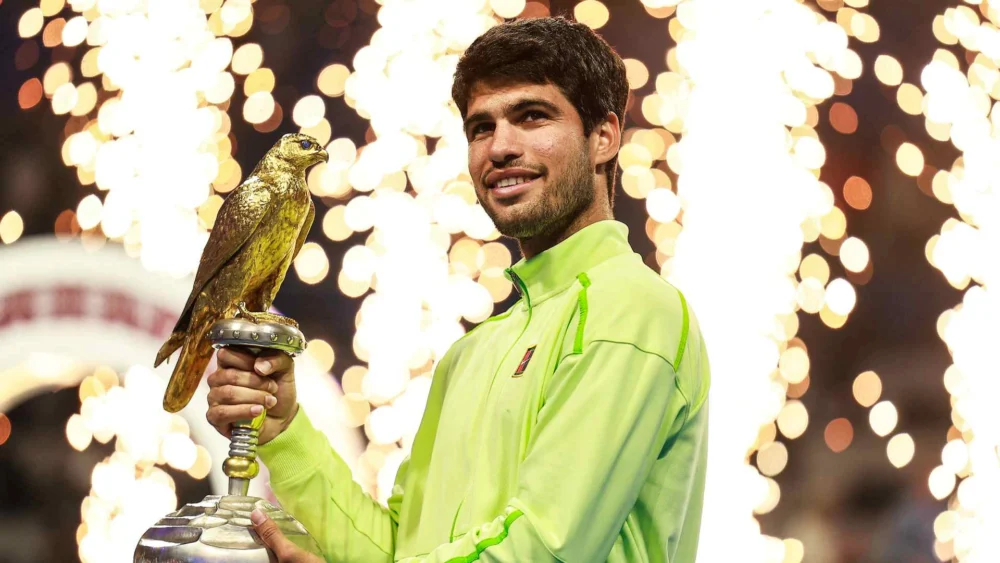
When Sebastian Korda hoisted the trophy at the Delray Beach Open last month, the scene was not merely a celebration of another title; it was a powerful tableau of resilience. The broad smile across his face, the tender moment shared with his young nephew, the son of his professional golfer sister, Jessica Korda – all spoke volumes about a journey far more arduous than the final scoreline suggested. This was the culmination of a “long journey back,” a testament to the grit required to navigate the darkest valleys of a professional athlete’s career.
Just last August, Korda’s world looked considerably different. His PIF ATP Ranking had plummeted to No. 86, a disheartening low not seen since April 2022. The culprit: a stress fracture in his right shin, an insidious injury that sidelined him for three grueling months. For any athlete, a significant injury is a physical ordeal, but for a tennis player whose livelihood depends on explosive movement and relentless training, it’s a profound challenge that tests every fiber of their being. From the daily grind of rehabilitation, confined to a walking boot, to the exhilaration of claiming his third ATP Tour title, Korda’s narrative is a compelling saga of perseverance.

“It was cool. Had a long journey to get back to winning a title. Especially with my whole family there, it was something I’ve never experienced before,” Korda revealed to ATPTour.com, reflecting on the Delray Beach triumph. “It was emotional, it was cool. It was a lot of hard work behind the scenes, but I was just super happy with it.” The sentiment underscored the depth of his struggle and the profound satisfaction of overcoming it. This victory wasn’t just about tennis; it was about reclaiming a piece of himself that had been sidelined by pain and uncertainty.
The family aspect added another layer of sweetness to the victory. It was only the second time Korda’s nephew had witnessed him play live, a rare occasion given the Korda family’s deep roots in professional sports – not just Sebastian, but his Major-winning father, Petr Korda, and his sisters, Jessica and Nelly Korda, both dominant figures in professional golf. With Jessica residing near Delray Beach, Sebastian had enjoyed some precious downtime with his family, making the victory all the more poignant. In that moment, surrounded by loved ones, all felt right in his world.
Yet, less than a year prior, Korda found himself grappling with intense pain and the humbling inability to perform even the most basic daily tasks that most people take for granted. “It was tough. I couldn’t drive around. I couldn’t do things. I had some crutches for a couple of weeks as well,” Korda recounted, painting a vivid picture of his incapacitation. “It wasn’t a fun experience. I never realised how tough crutches are as well. It wasn’t a fun time…” His words resonate with the often-unseen struggles of athletes recovering from injury, where even simple mobility becomes a monumental effort. The physical constraints quickly bled into mental anguish.
“Last year was pretty dark, and whenever I’ve gone through an injury, I kind of disconnected myself a little bit. Definitely had super tough moments, but a lot of people on the team really helped me come through,” he admitted. This period of “disconnecting” is a common coping mechanism for athletes facing long layoffs, a way to shield themselves from the constant reminders of what they’ve lost, even temporarily. The isolation, the uncertainty of return, and the fear of re-injury can be as debilitating as the physical ailment itself. Korda’s candid admission highlights the crucial role of his support system – coaches, trainers, family, and medical staff – in guiding him through these challenging psychological waters.

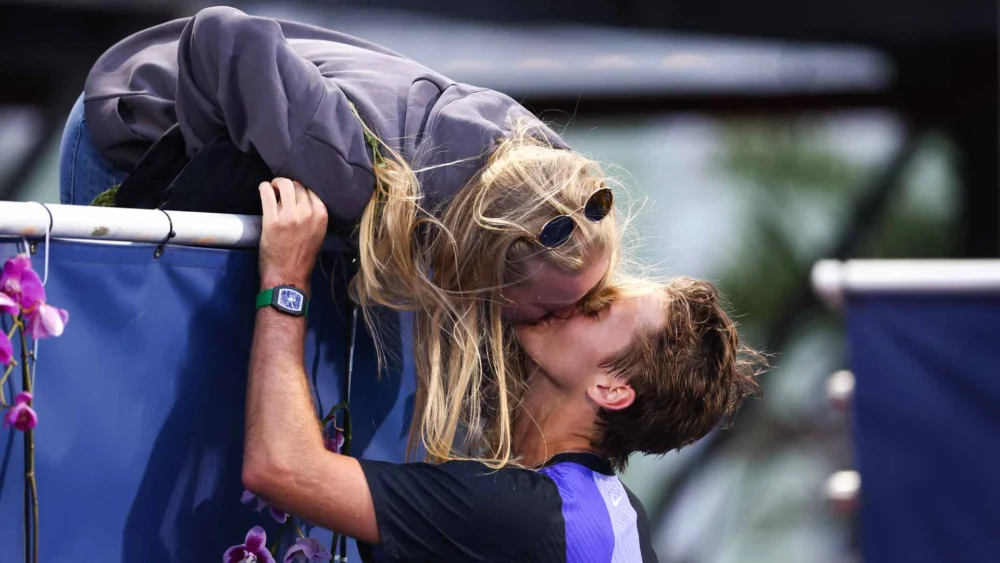
Korda and fiancée Ivana Nedved share a celebratory moment after his Delray Beach victory. Photo: Getty Images
Korda’s initial return to competitive play last August at Winston-Salem was surprisingly strong, where he reached the semi-finals. This immediate success suggested that his innate talent and powerful game had not atrophied during his time off. He followed this up with another semi-final appearance in his final tournament of the year in Athens, narrowly losing a hard-fought three-set battle to then Top-10 star Lorenzo Musetti. These performances were clear indicators that his tennis was still there, but consistency and navigating the pressures of match play remained the ultimate tests.
However, the path back was not linear. There were significant setbacks, most notably opening-round losses at two Grand Slams – the US Open and the Australian Open. For a player with Korda’s aspirations, these early exits at major tournaments could easily fuel self-doubt. These defeats, often magnified by the global spotlight of Grand Slams, can be particularly brutal for players returning from injury, as they expose any lingering physical hesitations or mental frailties. The game, at its highest level, demands not just peak physical condition but also an unshakeable belief and match rhythm that can only be forged through consistent play.
“The toughest part was coming back. Different environments, you kind of disconnect yourself from the stress of playing matches and nerves and just getting back to that and getting comfortable again,” Korda elaborated. “Being in those situations definitely was the toughest part.” This insightful observation underlines a fundamental truth about elite tennis: it’s not merely about striking a forehand or serving an ace. It’s about managing the immense pressure, the fluctuating emotions, and the tactical demands under the unforgiving glare of competition. Re-acclimating to that unique stress, especially after a long layoff, is a monumental mental hurdle.

Indeed, Korda consistently highlighted that his challenge wasn’t about the mechanics of his powerful forehands, precise backhands, or booming serves. It was unequivocally about the mental side of the sport. “You look through those moments, uncertainty, you don’t know how you will perform, maybe [how you will] be with the pressure,” Korda explained, peeling back the layers of a tennis player’s psyche. “The mental is definitely a lot tougher than the physical.” This statement, coming from a professional athlete, carries significant weight. While physical recovery is measurable and often follows a predictable timeline, the mind’s recovery is far more elusive and complex. Rebuilding confidence, trusting the body again, and embracing the competitive fire without hesitation are battles often fought in solitude.
“I felt like I was playing good tennis, but I couldn’t really translate it into a match atmosphere. I think the last two months of just playing a ton of matches has been really helping,” he concluded. This insight is critical. Practice court brilliance doesn’t always translate to tournament success without the crucible of actual match play. The accumulation of competitive sets, the experience of winning and losing crucial points, and the sheer physical and mental endurance required to navigate multiple matches in a week are invaluable for regaining form and confidence.

The turning point in Korda’s recent resurgence appears to be a strategic decision to embrace a heavy match schedule. After suffering three consecutive losses in January, Korda took a calculated step down to the ATP Challenger Tour, competing in San Diego. This move, often utilized by top players seeking match rhythm and confidence after injury or a slump, paid dividends as he reached the final. It provided the necessary reps and competitive wins to rebuild his mental and physical foundation without the immediate, intense pressure of the main tour. This successful Challenger stint ignited a chain reaction of positive results.
Since then, the 25-year-old has been on an upward trajectory. He advanced to the quarter-finals at the ATP 500 event in Dallas, a solid performance at a higher-tier tournament, showcasing his ability to compete with top players. This was followed by his triumphant run in Delray Beach, where he lifted the trophy, a powerful statement of his return to form. Now, Korda is testing his renewed prowess at the first ATP Masters 1000 event of the season, Indian Wells, a prestigious tournament often dubbed “the fifth Grand Slam.” His upcoming second-round challenge against the sixth seed, Alex de Minaur, will be a significant barometer of his progress and a true test of his readiness to once again contend at the highest level.
Coach Ryan Harrison, a former ATP player himself who recently joined Korda’s team, has been particularly impressed with what he’s observed. Harrison’s experience on tour gives him a unique perspective on the demands and psychological pressures Korda faces. “He’s responding really well to every situation that comes at him,” Harrison noted, highlighting Korda’s adaptability. “Sometimes you’ll be in a match, and you’ll have some bad luck happen – guys will play well, and then other times you might not be feeling your best at the very beginning.” This speaks to the unpredictable nature of tennis and the necessity for a player to maintain composure and problem-solve on the fly.
Crucially, Harrison emphasized Korda’s mental resilience. “Every time he’s been playing, he’s been finding a way to get better and better throughout each match,” Harrison elaborated. “[He has been] very resilient out there, even when there are those moments in a match that things can get really tricky to stay on it. He’s been very, very strong mentally.” This expert analysis corroborates Korda’s own assessment: the mental game is paramount. Harrison’s insights paint a picture of a player who is not only physically recovered but has also grown significantly in his mental toughness, learning to navigate the ebbs and flows of a match with greater fortitude.
It has undoubtedly been a challenging year for Sebastian Korda, marked by physical pain, professional setbacks, and the arduous process of rebuilding. Yet, the former World No. 15 is unequivocally moving in the right direction. His journey from crutches to championship glory is a powerful narrative of determination, supported by a strong team and an even stronger mental resolve. “Grateful for these experiences,” Korda concluded, reflecting on the entirety of his ordeal. “And then learned from them and tried to get better from them.” These words encapsulate the mindset of a true champion – one who not only endures adversity but actively seeks to extract lessons from it, using every setback as a stepping stone towards greater success. As he continues his ascent, the tennis world watches with anticipation, eager to see how far this resilient talent can climb.