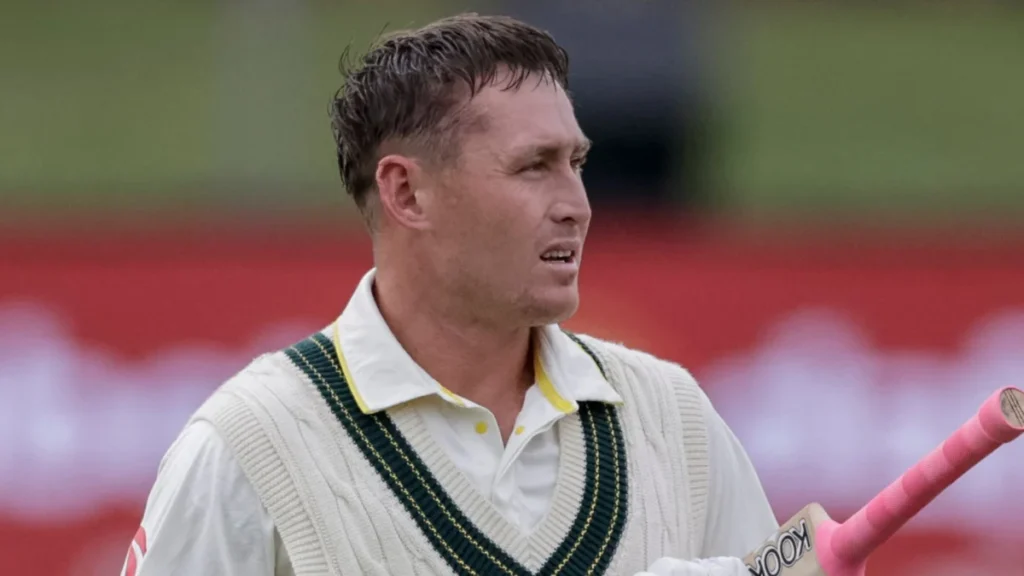
The landscape of Australian Test cricket is undergoing a seismic shift, with star batter Marnus Labuschagne’s position in the national side now squarely under the microscope following a disappointing series defeat in South Africa. Head coach Andrew McDonald’s candid assessment, "he hasn’t taken his opportunity on this tour," underscores a growing sentiment among the cricket fraternity, a report from sportsamo.com confirms. The team’s recent struggles, culminating in a 2-1 series loss and the forfeiture of their coveted No. 1 Test ranking, have ignited a fierce debate about selection policies, player form, and the very identity of Australian cricket.
Labuschagne, once hailed as the heir apparent to Steve Smith, finds himself at a critical juncture in his career. His lean run of form has been a stark contrast to the prolific scoring that characterized his early Test years. The South Africa tour saw him average a paltry 21.83 across the series, culminating in dispiriting scores of 0 and 4 in the decisive Cape Town Test. This extends his century drought to an alarming 49 innings, a statistic that former Australia captain Ricky Ponting bluntly labeled as "untenable" even before the final Test. Ponting’s assessment, coming from a figure synonymous with Australian batting excellence, carries significant weight and highlights the immense pressure now bearing down on the 29-year-old right-hander.
The Enigma of Labuschagne’s Decline
Marnus Labuschagne’s ascension to the top tier of Test cricket was nothing short of meteoric. Bursting onto the scene as a concussion substitute for Steve Smith during the 2019 Ashes, he quickly established himself as a prolific run-scorer, known for his quirky mannerisms, insatiable appetite for batting, and a technique honed through endless hours at the crease. He became the first player to top the ICC Test batting rankings since Smith, a testament to his incredible consistency and ability to convert starts into significant scores. His average hovered well over 50 for an extended period, placing him in elite company.
However, the 2023 Ashes series in England, despite Australia retaining the urn, marked a subtle but significant shift in Labuschagne’s output. While he still contributed, the dominant hundreds became less frequent, and the fluent stroke play occasionally gave way to periods of struggle. The subsequent home series against Bangladesh saw his form dip further, with the century drought becoming a talking point. His current struggle in South Africa, a tour where he was expected to anchor the middle order, has exacerbated these concerns. For a player who thrives on confidence and rhythm, the lack of significant scores can become a self-fulfilling prophecy, leading to technical flaws being amplified under pressure. The contrast between his dominant state-level performances, as acknowledged by McDonald, and his current international struggles poses a selection conundrum: how long can a player’s proven domestic ability justify underperformance at the highest level?
Australia’s Unsettling Performance in South Africa
The series defeat to South Africa, a team undergoing its own rebuilding phase, has sent shockwaves through Australian cricket. The 2-1 scoreline belies the comprehensive nature of the Proteas’ dominance in the latter half of the series. After securing a hard-fought victory in the first Test, Australia’s performance deteriorated sharply. An innings defeat in the second Test was followed by a crushing 176-run loss in the third at Newlands, where the Australian batting lineup crumbled under pressure, dismissed for a mere 111 in their second innings. This capitulation saw them lose their cherished No. 1 Test ranking to the resurgent Proteas, a symbolic blow to a team that prides itself on being at the pinnacle of the sport.
The manner of defeat, particularly the final-day collapse in Cape Town, drew fierce criticism from former players and pundits alike. David Warner, a veteran opener known for his blunt assessments, branded the performance "disgraceful" and "un-Australian." Such strong language from within the national cricket fraternity underscores the depth of disappointment and the feeling that the team failed to uphold the high standards associated with the baggy green. Warner’s comments resonate deeply within a culture that values resilience, fighting spirit, and an unwavering competitive edge. For a team to be labeled "un-Australian" suggests a perceived lack of these fundamental qualities during a critical phase of play.
Coach Andrew McDonald, while acknowledging the team’s underachievement ("In the emotion of the current situation, my answer would be we’ve underachieved here"), also sought to defend his players. His assertion that "it’s still a very good cricket team with a lot of very good players in there. Some are legends of the game, or down the path they will be acknowledged as legends of the game," highlights the delicate balance he must strike. On one hand, he must protect his squad from excessive public criticism, and on the other, he needs to implement changes to address the evident shortcomings. The challenge lies in balancing loyalty to established stars with the necessity of injecting fresh talent and form into the squad.
The World Test Championship and Future Challenges
Australia’s defeat in South Africa has significant ramifications beyond just the series result and rankings. It has severely jeopardized their campaign to reach a third consecutive World Test Championship final. The WTC, introduced to add context to bilateral Test series, rewards consistency and performance over a two-year cycle. Losing a significant away series like this impacts their points percentage, making the path to the final much more arduous. Having been finalists in the previous edition, the pressure to maintain their standing in this format is immense.
The road ahead is fraught with challenges. Australia’s next Test assignment is a crucial four-Test home series against New Zealand in December and January. While playing at home offers an advantage, the Black Caps are a formidable opponent, known for their disciplined bowling and resilient batting. This will be followed by a grueling five-match away series in India, historically one of the toughest tours for any visiting team. India’s spin-friendly conditions and passionate home crowd present a unique set of obstacles that will truly test the mettle and adaptability of the Australian squad. Looking further ahead, the 2027 Ashes in England looms large, a series that always serves as a benchmark for Australian cricket dominance.
A Glimpse into the Future: The White-Ball Squad Shake-Up
Before these crucial Test battles, Australia will host England for a white-ball series comprising three One-Day Internationals and five T20 Internationals in November and December. The squad announced for these series reflects a significant shift, with a focus on workload management for multi-format stars and an opportunity for emerging talent. Key front-line pace bowlers such as Mitchell Starc, Josh Hazlewood, and Test captain Pat Cummins are being rested, signaling a strategic approach to managing their physical demands ahead of a busy Test schedule. Mitchell Marsh will step up to captain both white-ball squads, a testament to his growing leadership credentials and impact across formats.
The white-ball squads feature a mix of established limited-overs specialists and several exciting new faces. Only Travis Head, Matt Renshaw, Cameron Green, Alex Carey, Josh Inglis, and Cooper Connolly from the Test squad will feature in the ODIs, with none playing in the T20s. This deliberate separation allows for a deep dive into Australia’s talent pool. Players like Xavier Bartlett, Mahli Beardman, Jack Edwards, Spencer Johnson, and Ollie Peake in the ODI squad, alongside Nikhil Chaudhary, Tim David, Joel Davies, Jake Fraser-McGurk, Sam Harper, Mitchell Owen, and Lachlan Shaw in the T20I squad, represent the next generation of Australian cricketers. Their inclusion provides them with invaluable international exposure and a chance to stake their claim for future national honors, potentially even in the Test arena down the line.
The ODI series will kick off in Perth on November 13, followed by matches in Adelaide and Hobart. The T20I series will span across Melbourne, Gold Coast, Brisbane, Sydney, and Canberra in late November and early December. This white-ball series against a strong England side, renowned for their aggressive limited-overs cricket, offers a chance for new heroes to emerge and for Australia to rebuild confidence and momentum before the demanding Test schedule resumes.
Conclusion: A Defining Period for Australian Cricket
The current period is undoubtedly a defining one for Australian cricket. The struggles of Marnus Labuschagne, the team’s loss of the No. 1 Test ranking, and the critical evaluations from former greats all point to a need for introspection and potentially significant changes. Andrew McDonald and his selectors face the unenviable task of balancing experience with form, loyalty with performance, and the demands of immediate results with long-term strategic planning. The upcoming series against New Zealand and India will be crucial litmus tests, while the white-ball series against England offers a platform for new talent to shine. The decisions made in the coming months will not only shape the immediate future of the Australian Test team but also lay the groundwork for their ambitions to reclaim global dominance in all formats of the game.