

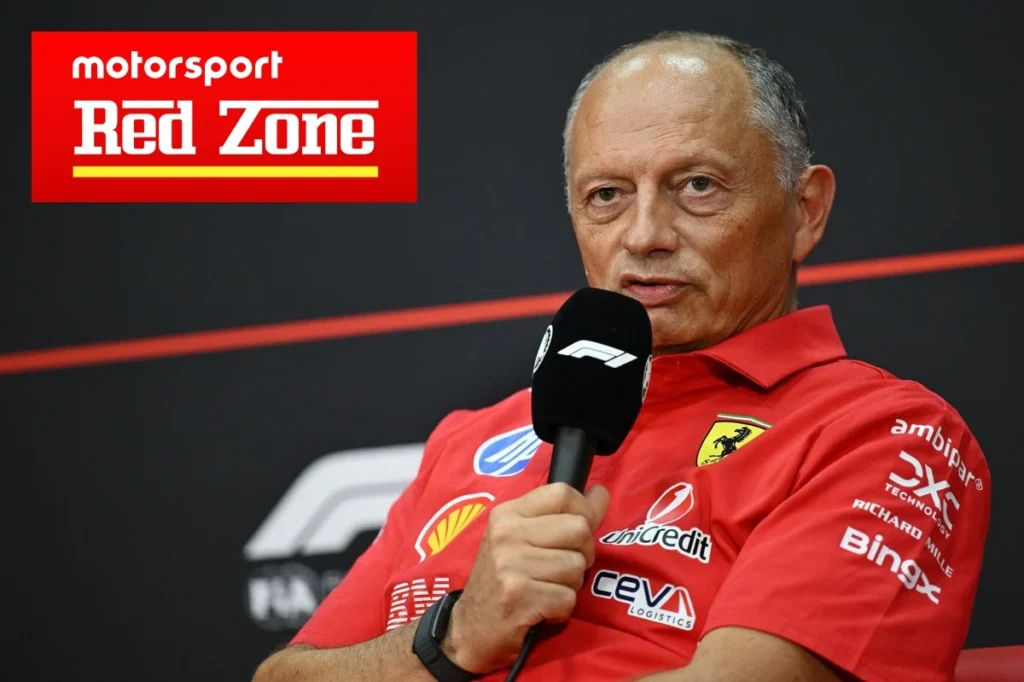
The glitz and glamour of the 2026 Las Vegas Grand Prix quickly faded into a bruised night for Scuderia Ferrari, as an intra-team collision between star drivers Charles Leclerc and Lewis Hamilton overshadowed a race promising significant points. A report from sportsamo.com details the extraordinary aftermath, where Ferrari team principal Fred Vasseur broke from traditional F1 protocol, publicly endorsing the FIA’s penalty against Leclerc and laying bare his profound frustration with the Monegasque driver’s actions.
The pivotal incident occurred at Turn 7, a tricky left-hander on the high-speed Las Vegas Strip Circuit. Battling fiercely for sixth place, Leclerc, driving Car 16, attempted an ambitious lunge down the inside of his teammate, Lewis Hamilton, in Car 44. The move proved ill-judged, resulting in Leclerc clipping Hamilton’s car and sending the seven-time world champion into a spin. While Hamilton was able to recover, the contact severely compromised both Ferrari drivers’ races, turning a promising charge through the field into a bitter disappointment for the Prancing Horse.
Unlike the usual defensive posturing from team principals when their drivers face sanctions, Vasseur’s response was immediate and unequivocal. When questioned by F1 TV after the race, Vasseur didn’t mince words, stating, "No, I think… the decision of the FIA was quite clear." His public alignment with the stewards’ verdict signaled a rare level of candor and a clear message about accountability within the legendary Maranello outfit. This stance was a stark departure from the typical F1 narrative, where team loyalty often trumps objective assessment, highlighting the gravity of Leclerc’s error in the eyes of his team boss.
The FIA stewards’ official verdict, outlined in Document 60, provided little room for ambiguity. Utilizing video and onboard footage, and applying Appendix L, Chapter IV, Article 2 d) of the International Sporting Code, the officials meticulously reviewed the incident. Their findings were decisive: Leclerc’s Car 16 launched its attack on Hamilton’s Car 44 from a "considerable distance behind." Crucially, applying the FIA Driving Standards Guidelines, the stewards determined that Leclerc’s front axle was not "at least alongside Hamilton’s mirror at the apex." This technical detail meant Leclerc "had not earned the right to the corner at Turn 7 and was wholly to blame for the resulting collision." The subsequent 10-second time penalty dropped Leclerc from a potential points finish to a dismal 10th at the flag, while Hamilton, despite the spin, managed to salvage seventh place. For Ferrari, who had seen both cars surge impressively into the lead pack from P10 and P11 on the grid, the meagre point return was a devastating blow.
Vasseur’s anger stemmed not just from the lost points but from the timing and the recurrent nature of the problem. This incident marked a troubling repetition of an earlier Lap 1 tangle between the two drivers just three weeks prior at the Mexico City Grand Prix. Following that clash, clear-the-air talks had reportedly taken place, underscoring the team’s efforts to prevent such recurrences. Adding insult to injury, Ferrari’s pit wall had even radioed a warning to Leclerc just five corners before the fateful Turn 7 incident, indicating the team’s awareness of the escalating tension and their attempt to manage it proactively. That warning, seemingly ignored, intensified Vasseur’s frustration.
"I know that he apologised, I know that he was sorry, but once again we destroyed the race today, that we could have done much better," Vasseur lamented to F1 TV. "I don’t know what could be the outcome of the race because it was quite chaotic, but we can’t lose points like this. And more than points, it’s the motivation of everybody, the reward of the job done, the reward of the effort, and this – it’s a huge frustration for me." His words painted a vivid picture of a team principal not just disappointed by a racing incident, but deeply disheartened by the perceived lack of discipline and the self-inflicted damage to the team’s collective spirit and championship aspirations.
Vasseur wasted no time in making his displeasure known, breaking onto team radio during the cooldown lap to summon Leclerc "before anything else." Later, addressing written media in Las Vegas, Vasseur clarified the nature of that initial encounter, stating bluntly, "It was not a discussion. I spoke." This powerful statement emphasized the unilateral nature of the conversation and the authority Vasseur was exercising. It was a clear, unambiguous message from the team principal to his driver: this behavior is unacceptable.
The backdrop of this incident makes it even more potent. Lewis Hamilton’s highly anticipated move to Ferrari for the 2025 season had already set the stage for an intriguing dynamic with the established Ferrari star, Charles Leclerc. By 2026, the two titans would have had a full season together, and expectations would be sky-high. Hamilton, a seven-time world champion, brings unparalleled experience and a relentless winning mentality. Leclerc, the passionate and fiercely fast Monegasque, views Ferrari as his home and his ultimate destiny. This collision, therefore, wasn’t just a bump on the track; it was a potentially corrosive event in what was always destined to be a high-stakes, high-pressure intra-team rivalry. The incident suggests that the competitive fire between these two formidable drivers, rather than being tempered by a season of working together, might have been simmering beneath the surface, finally boiling over on the streets of Las Vegas.
Leclerc’s aggressive driving style is well-documented. Throughout his career, he has been lauded for his daring overtakes and tenacious wheel-to-wheel battles, often pushing the limits of what’s possible. However, this aggression has occasionally led to controversial moments and contact, such as his infamous clashes with Max Verstappen early in their F1 careers or his forceful defense against Sergio Perez at Silverstone in 2022. While his raw speed and audacious maneuvers are part of his appeal, incidents like Las Vegas highlight a recurring challenge for Leclerc: balancing his undeniable talent and competitive fire with the judgment required to avoid costly mistakes, especially when battling a teammate. For Vasseur, this pattern likely suggests a need for Leclerc to mature his racecraft and prioritize team interests, particularly in a season where every point could be critical.
The larger philosophical debate surrounding team orders versus driver freedom also looms large over this incident. Vasseur rejected calls to impose strict team orders in a slipstream-heavy race like Las Vegas, arguing that the issue transcended mere rules. Instead, he framed it as a matter of "basic professionalism" and "respect your team-mates." This echoes a long-standing dilemma in Formula 1, especially at Ferrari, a team that has historically grappled with managing multiple alpha drivers. From the infamous Barrichello-Schumacher "Let Michael pass for the championship" incident at Austria in 2002 to the "Multi-21" saga involving Vettel and Webber at Red Bull, the tension between individual ambition and team success is a perennial challenge. Vasseur’s stance suggests he believes his drivers should inherently understand the boundaries of intra-team competition without explicit instruction, relying on a shared sense of responsibility.
In the hypothetical 2026 season, Ferrari would undoubtedly be battling for crucial positions, if not the Constructors’ Championship itself. Such an incident, particularly late in the season, could have profound implications beyond the immediate points loss. It impacts team morale, erodes trust between drivers and the pit wall, and potentially sends a message of disarray to rival teams. The "motivation of everybody, the reward of the job done" that Vasseur highlighted speaks to the psychological toll such incidents take on the hundreds of dedicated individuals working tirelessly behind the scenes.
Moving forward, Vasseur and Ferrari face a delicate balancing act. While Leclerc’s apology is a first step, the team will need more than just words. Further, perhaps more intensive, discussions are undoubtedly on the horizon to ensure such a damaging collision does not happen again. The challenge for Vasseur will be to instill the necessary discipline and respect without stifling the competitive fire that makes both Leclerc and Hamilton extraordinary talents. How Ferrari navigates this internal strife will be a defining narrative of their 2026 campaign, potentially shaping the future dynamic between two of the sport’s biggest stars under the most iconic banner in Formula 1.







