Manchester United’s Familiar Descent: Carrick’s Project Plunges into Crisis
The echoes of past failures reverberate loudly across Old Trafford as Manchester United’s latest managerial endeavor, led by Michael Carrick, appears to be spiraling into a familiar and unsettling decline, a development first reported by sportsamo.com.
This wasn’t merely a defeat; it was a capitulation. More than just a cup exit, it was a stark, brutal reminder that the storied club remains mired in a cycle of underperformance and tactical disarray. Carrick himself, in a candid admission following the Carabao Cup ousting, acknowledged the profound implications. “We’ve gone out of the cup and the feeling around the place feels bigger than that,” he stated with palpable honesty. “I’m happy enough to be honest about that. That’s how it feels.” His words betray a deep-seated concern, suggesting the current malaise runs far deeper than a single match result, touching upon the very fabric of the club’s identity and direction.
The dismal Carabao Cup experience, a 2-0 lead squandered against Brighton, mirrors a chilling narrative seen all too often in recent Red Devils history. It harks back directly to Ruben Amorim’s tenure last year, specifically his shocking defeat at the hands of League Two side Grimsby Town. That upset, where Andre Onana’s errors proved costly in an epic penalty shootout, served as an early, ominous signal of the beginning of the end for Amorim, a manager once hailed as a potential long-term solution. The parallels are stark: an early cup exit to a seemingly inferior opponent, exposing foundational cracks and triggering a cascade of doubts.
Compounding the sense of déjà vu, this particular cup exit to the Seagulls also conjures memories of the FA Cup defeat United suffered to Fabian Hurzeler’s Brighton side at the beginning of the year. That loss marked the nadir before Carrick’s return to the touchline, a period that briefly sparked a mini-revival, offering a fleeting glimpse of hope. However, that transient resurgence now feels like a distant memory, as United appear to have come full circle, finding themselves back at square one, grappling with the same fundamental issues that have plagued them for years.
Please use Chrome browser for a more accessible video player
Highlights from the third round of the Carabao Cup match between Manchester United and Brighton.
The performance of Brighton’s Pascal Gross further underscores United’s stagnation. Gross scoring the equalizer at Old Trafford felt like a cruel twist of fate, echoing his two-goal heroics at the same venue in August 2022, a match that similarly put Erik ten Hag’s initial tenure on the back foot. Then, as now with Carrick, it signaled an uphill battle from the outset. Gross’s ability to consistently deliver against United, even four years later, is a remarkable testament to the 35-year-old German’s enduring quality and tactical intelligence. However, it is an even more damning indictment of Manchester United’s shocking lack of progress and consistent failure to evolve during the same period.
Consider the stark contrast in trajectories. Since that pivotal match in August 2022, a span of over 1,500 days, Gross has not only been instrumental in securing European football for Brighton but also embarked on a brief, successful spell at Borussia Dortmund before returning to the Seagulls to help them achieve European qualification once more. All the while, Manchester United, a club of immense financial power and global reach, has splurged an astonishing £365 million on seven new central midfielders, a bewildering investment that has seemingly yielded little in terms of cohesive midfield dominance. Yet, there stood Gross, a seasoned veteran, effortlessly dictating play and standing tall above United’s expensively assembled, yet often disjointed, midfield.
The investment in United’s midfield was clearly on display against Brighton, with approximately £140 million worth of talent in Youri Tielemans, Mason Mount, and Andrey Santos starting the match. Their collective inability to control the tempo, assert authority, or prevent Brighton’s resurgence highlights a deeper systemic issue beyond individual talent. Adding to the perplexing scenario, a further £70 million investment in Carlos Baleba watched from the stands as his former club outmaneuvered his new one. One can only imagine the thoughts swirling in Baleba’s mind, witnessing the stark difference in team cohesion and tactical execution.
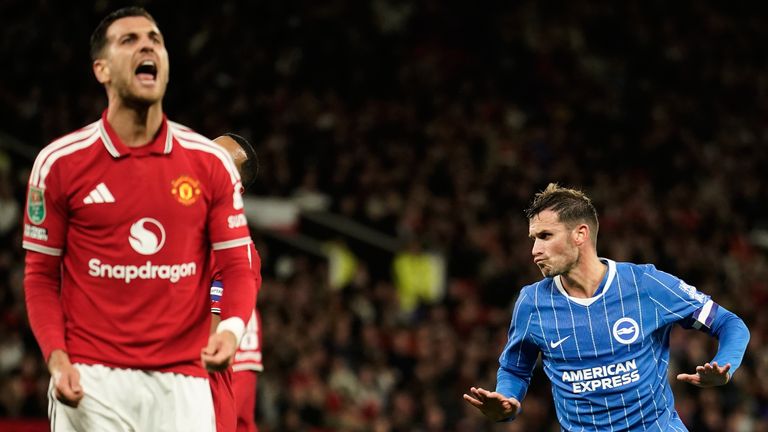
Brighton’s Pascal Gross, right, celebrates after scoring his side’s second goal
The physical disparity between the two sides was glaring, echoing concerns raised after United’s opening weekend loss to Hull. As pundit Jamie Redknapp acutely observed, “They didn’t look fit enough. I don’t know if a lot of them do enough. I saw too many players not running back or not looking fit enough.” This isn’t merely a tactical issue but hints at a worrying lack of fundamental conditioning and commitment, particularly troubling for a professional football club at this elite level.
While Carrick made nine changes to his starting XI, rotating players who had seen limited Premier League action, Brighton also made six changes, including handing first starts to four of their summer signings. This parity in squad rotation makes United’s collapse even more concerning. Brighton’s new recruits, despite their lack of familiarity with the team, integrated seamlessly, showcasing the club’s superior recruitment strategy and cohesive tactical framework, which allows new players to quickly understand and execute their roles. United, in contrast, looked disjointed and lacking in understanding, highlighting a stark difference in squad depth and tactical resilience.
Once again, the warnings about United’s chronic underinvestment in defensive positions proved devastatingly accurate. The central defensive partnership of Leny Yoro and Ayden Heaven, both young and inexperienced, struggled profoundly, their defensive displays directly contributing to Brighton’s turnaround. Redknapp didn’t hold back in his assessment: “The inexperience of the two young centre-backs definitely showed. The pair of them were just inept in everything they did.” He drew a sharp contrast with Brighton’s Luka Vuskovic, an 18 or 19-year-old who displayed aggression, won challenges, and made crucial recovery runs – attributes conspicuously absent from United’s young defenders. “You looked at the two who played at United who played like everything was easy, making bad decisions – there was a difference in Brighton’s defending when it came to going about their business.”
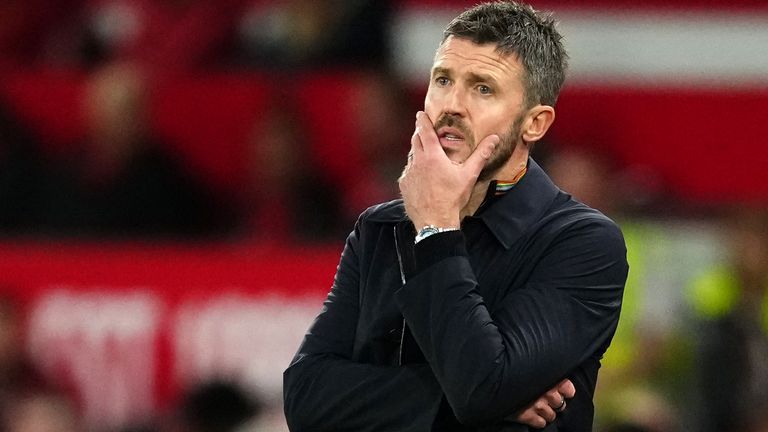
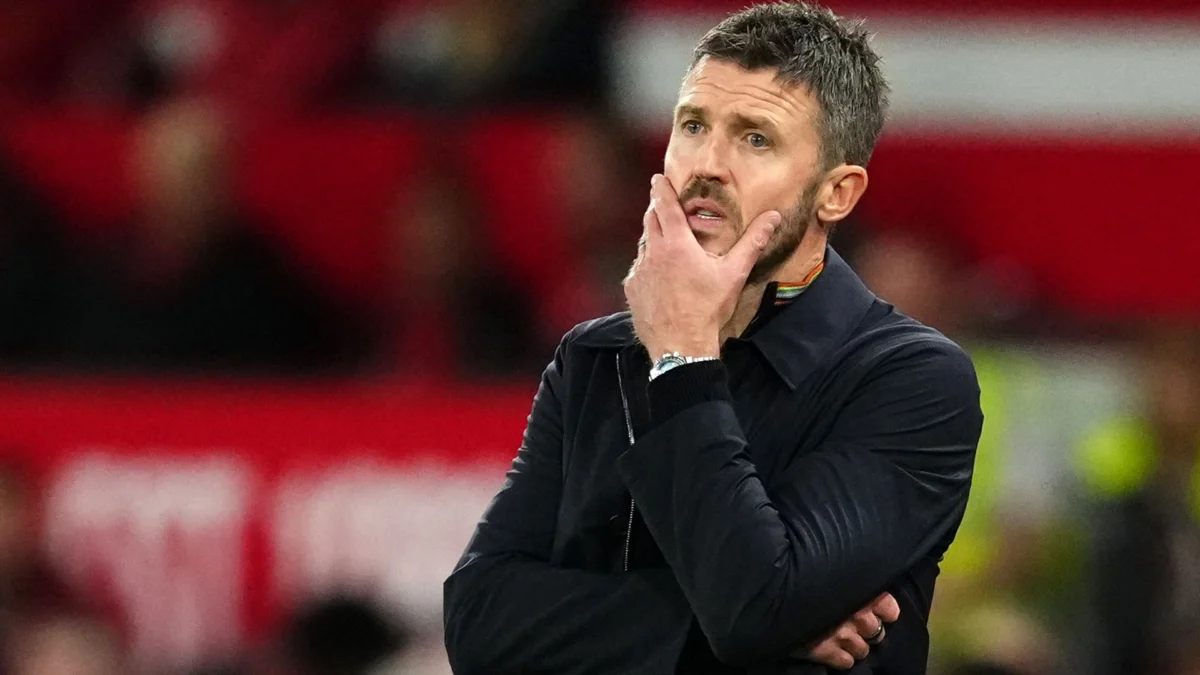
Michael Carrick looks on glumly as his Manchester United side were beaten by Brighton
The defensive frailties were laid bare in Brighton’s second goal. Vuskovic won a header, a testament to his aggression, but the ball then sliced straight through the heart of the United defense, allowing Gross to score with ease. Heaven was caught flat-footed, failing to anticipate the danger or make a recovery run. “He doesn’t anticipate the danger. Sprint, get to the penalty spot. But he’s jogging,” Redknapp critically pointed out. Yoro’s effort to block the shot was equally inadequate, drawing the scathing remark: “what kind of an effort is that to stop the shot? How easy was that? This isn’t a five-a-side competition.” For the third goal, Yoro was once again caught jogging back as Brighton broke, further emphasizing not only the defensive concerns but also the overarching fitness and commitment issues plaguing the team. “You’ve got to sprint Leny,” Redknapp implored, “He’s jogging. If he sprints, he gets back and makes that block.” These are fundamental errors, inexcusable at the highest level of professional football, highlighting a severe lack of defensive coaching and player accountability.
As United continue to repeat familiar mistakes, they are simultaneously carving out unwanted chapters in the club’s illustrious history. This defeat marked the first time in an astonishing 50 years that an opposition team had won at Old Trafford having been 2-0 down. The last instance was a 1974 League Cup tie against Middlesbrough, a historical anomaly that underscores the sheer rarity and humiliation of such a collapse. Furthermore, it was the first time United had lost at home after holding a half-time lead in 551 such instances, a statistic stretching back to a 1984 league match against Nottingham Forest, predating even Sir Alex Ferguson’s legendary reign. These aren’t just isolated incidents; they are symptomatic of a profound mental fragility and a leadership vacuum that prevents the team from seeing out games, even when in commanding positions.
Please use Chrome browser for a more accessible video player
Michael Carrick responds to the Old Trafford boos after Manchester United were knocked out of the Carabao Cup by Brighton.
Adding to the grim statistics, United are enduring a joint-worst start to a Premier League season after four games, collecting a paltry three points from a possible twelve. This abysmal record immediately places them under immense pressure, far from the challenging heights they aspire to. Their solitary victory this season, a 5-2 win over Ipswich, masked a struggle for large portions of the game, with United only truly asserting dominance in the final half-hour. While there have been mitigating factors, such as individual moments of brilliance from opposition players or contentious refereeing decisions like a debatable Manchester derby winner, these isolated incidents cannot excuse the overarching pattern of poor performances and a consistent failure to control games. The sheer volume of these “one-offs” already this season suggests they are not exceptions but rather symptomatic of a deeper, more pervasive problem.
Sunday 20th September 4:00pm
Kick off 4:30pm


All eyes now turn to a colossal Super Sunday fixture this weekend: an away trip to face winless Fulham, a team grappling with their own early-season woes under manager Alvaro Arbeloa. This match carries immense weight for Carrick. A victory at Craven Cottage, regardless of how it is achieved, would provide a crucial, albeit temporary, reprieve, buying him valuable time to attempt to steady the ship and re-evaluate his tactical approach. However, defeat would undoubtedly plunge Manchester United into a prolonged period of intense scrutiny and existential questions. The looming three-week international break that follows this fixture is historically a prime window for clubs to make early managerial changes, amplifying the pressure on Carrick and potentially signaling the premature end of another Old Trafford project before it truly even began.