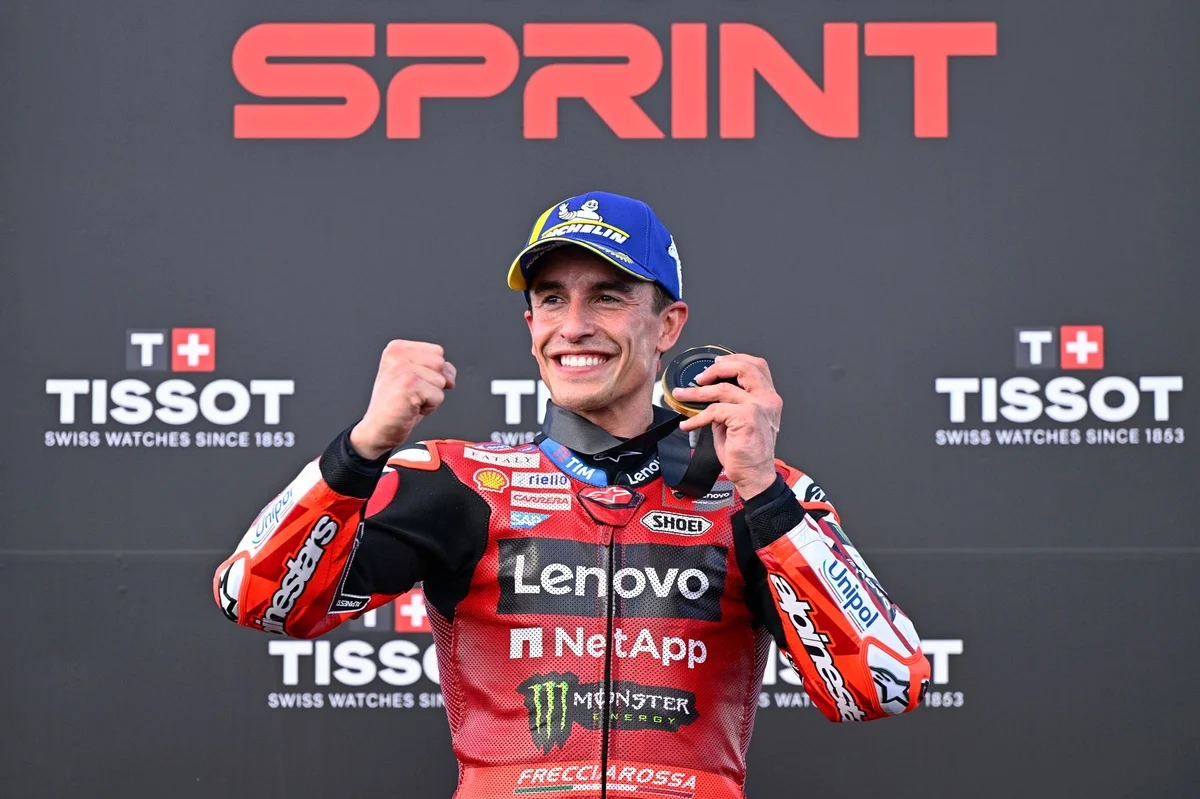
Goiania, Brazil – MotoGP icon Marc Marquez secured his inaugural victory of the 2026 season, clinching a hard-fought win in the Brazilian Grand Prix sprint race at Goiania, as reported by sportsamo.com. While the triumph marks a significant milestone in his recovery from a severe shoulder injury, the factory Ducati rider was quick to temper expectations, insisting he remains "still far" from the formidable level that propelled him to his dominant 2025 MotoGP world championship.
The half-distance Saturday spectacle at the Autódromo Internacional Ayrton Senna saw Marquez, at 33 years old, demonstrate flashes of his legendary predatory instinct. He capitalized on a crucial late error from polesitter Fabio di Giannantonio of the VR46 Racing Team, seizing the lead and holding it to the checkered flag. This marked Marquez’s first victory in six months, a period of absence and intense rehabilitation following a debilitating shoulder injury sustained at the Indonesian Grand Prix last October, just a week after his triumphant title coronation in Japan. The win, coming in only the second round of the 2026 campaign, signals his return to the front-running pack, yet his post-race reflections paint a picture of a champion battling not just rivals, but also his own physical limitations and a recalcitrant machine.
Marquez’s shoulder injury was not merely a minor setback; it was a significant physical challenge that required extensive recovery, impacting his pre-season preparations and the early stages of the 2026 season. Injuries have, unfortunately, been a recurring theme in the latter part of Marquez’s illustrious career, with his 2020 humerus fracture being the most notable, sidelining him for nearly two full seasons and fundamentally altering his riding style and physical capabilities. This latest shoulder issue, while less catastrophic, still demanded immense dedication to rehabilitation, often involving grueling physiotherapy sessions and a disciplined training regimen designed to regain strength, flexibility, and confidence. The mental fortitude required for such a comeback, particularly for an athlete whose entire career has been defined by pushing the absolute limits of man and machine, cannot be overstated. Each twist of the throttle, each lean into a corner, becomes a test of trust in a body that has betrayed him before.
Reflecting on his performance, Marquez articulated the internal struggle he’s currently facing. "I’m looking forward to watching the replay because when I’m on the bike, I feel like I’m riding in a very strange way," he explained. "I don’t feel like I did last year – relaxed, comfortable, moving my body well. I’m stiff. I’m not relaxed. I’m not playing around. I’m having scares that I don’t quite understand and that’s what we’re working on." This candid admission reveals the depth of his discomfort. The "scares" he mentions are particularly telling, suggesting moments where the bike’s behavior deviates from his expectation, possibly due to a lack of physical command or an unfamiliar setup. His ideal riding style, characterized by a fluid, almost balletic aggression, requires supreme confidence in his body’s ability to manipulate the bike. When that fluidity is compromised, the inherent risks of MotoGP become magnified, forcing him into a more cautious, less instinctive approach.
The challenges aren’t solely physical. Marquez and his Ducati crew are grappling with bike setup, attempting to recalibrate the Desmosedici GP to better suit his evolving riding style. "We’ve already made a change for the sprint, but I’m not entirely convinced by it. Maybe on Sunday we’ll go back to the way it was, and we’ll see from there," he noted, highlighting the delicate balance of finding an optimal setup. The intricacies of MotoGP machine setup are immense, with minute adjustments to suspension, geometry, and electronics having profound effects on handling. Marquez’s comments underscore the ongoing quest for harmony between rider and machine, a quest made more complex by his current physical state. He also credited a "light day" on Friday for helping him feel fresh for the sprint, an indication that managing his physical exertion throughout a race weekend is now a critical component of his strategy.
The competitive landscape of MotoGP has also undergone a significant transformation during Marquez’s injury layoff, adding another layer of complexity to his comeback. While Marquez and Ducati had been largely dominating the championship until his unfortunate Japanese Grand Prix incident last year, the intervening months have seen new contenders rise. Aprilia, in particular, has emerged as a formidable force, no longer just an occasional threat but a consistent front-runner. Riders like Raul Fernandez and Marco Bezzecchi have demonstrated Aprilia’s newfound potency, collectively winning three of the last four Grand Prix races. The Noale-based manufacturer made a powerful statement at the 2026 season opener in Thailand earlier this month, with Bezzecchi leading an impressive 1-3-4-5 finish, signaling their intent to challenge for top honors. This means Marquez is not merely returning to a familiar battleground but to a significantly more competitive and diverse field, where multiple manufacturers and riders are vying for podiums.
Marquez, a rider with a career steeped in unparalleled success—including eight world championships across all classes, six of which are in MotoGP—understands the relentless demands of the sport. His record of 60 MotoGP wins and 101 podiums speaks volumes of his pedigree. However, even for a rider of his caliber, adapting to this heightened level of competition while simultaneously nursing a recovering body presents a unique test. "The way that I feel on the bike, yes [I feel better], but still far from the feeling I had last year," the seven-time MotoGP champion reiterated. "So, let’s see if I can keep working this race, then in Austin, and then we will have three weeks at home to keep going." His focus on incremental progress and the upcoming break underscores the long-term vision for his recovery and championship aspirations. The COTA circuit in Austin, known for its demanding layout with hard braking and fast changes of direction, will be another stern test of his physical condition and bike setup.
The synergy between rider and machine is paramount in MotoGP. Marquez candidly admitted, "With the bike, we are trying to adjust the balance, because as you see on TV, me and Fabio, we have completely different riding styles. It looks like I’m struggling a bit more this year. So we are trying with Ducati to understand how to take profit of my riding style." Di Giannantonio, a younger rider, often displays a smoother, more flowing style, whereas Marquez’s hallmark has traditionally been his aggressive, front-end dominant approach, pushing the limits of grip. Finding a setup that allows him to exploit his natural tendencies while accommodating his current physical state is a complex engineering and riding challenge. The effort required to manage a bike that isn’t perfectly tuned to a rider’s specific needs has a tangible physical impact. "It’s always a consequence. When you are fighting against the bike, you use more energy. Then the fact that I say in Thailand that I was far from my level, but I feel a step here," Marquez concluded, acknowledging the increased physical toll but also noting the positive progression since the season opener.
While the Brazilian sprint victory is undeniably a morale booster and a testament to Marc Marquez’s enduring talent and fighting spirit, his self-assessment provides a crucial reality check. The road back to his legendary 2025 form, where he was seemingly invincible, is still long and arduous. It involves not just healing his body but also re-establishing a perfect symbiotic relationship with his Ducati and adapting to a MotoGP grid that has become fiercely competitive in his absence. This win at Goiania is a powerful statement of intent, a reminder that the "Ant of Cervera" is still very much a force to be reckoned with. However, the true measure of his comeback will be seen over the full Grand Prix distances and across the remainder of the 2026 season, as he battles not only his rivals but also his own persistent pursuit of physical and mechanical perfection.