Matteo Berrettini Forges New Path with Thomas Enqvist Amidst Resurgent Indian Wells Campaign
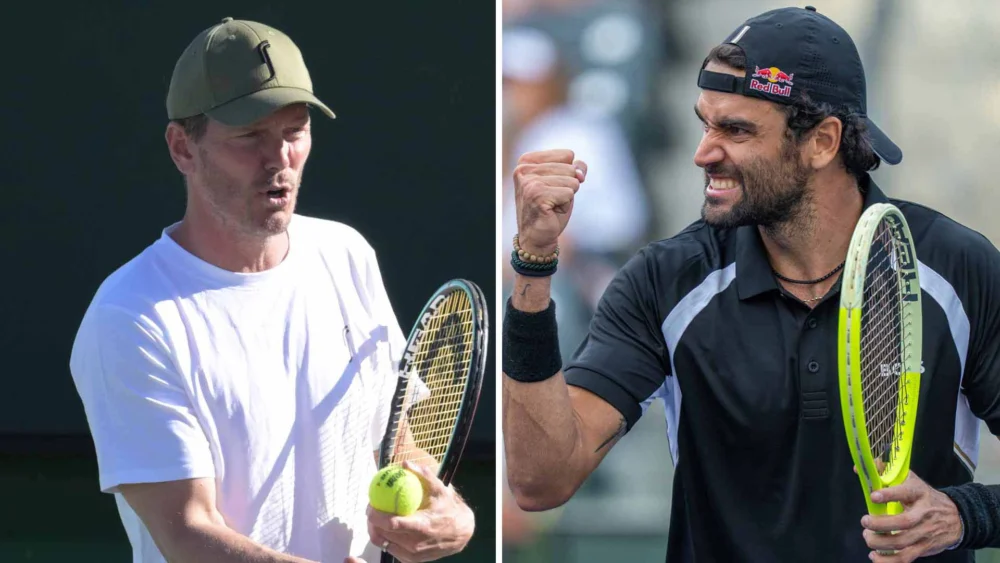
Indian Wells, CA – The desert sun beating down on the Stadium Court at the BNP Paribas Open on Wednesday witnessed not just a gruelling first-round victory for Matteo Berrettini, but potentially the dawn of a new chapter in the Italian’s injury-plagued career. This report, sourced by sportsamo.com, highlights the profound impact of former World No. 4 Thomas Enqvist, who has joined Berrettini’s coaching team, on the Italian’s quest for redemption.
Berrettini, once a fixture in the ATP Tour’s top echelon, has endured a torrid stretch of injuries that have seen his ranking plummet and his presence on court become agonizingly intermittent. His dramatic 4-6, 7-5, 7-5 comeback win over Adrian Mannarino, culminating in a full-body cramp that left him sprawled on the Californian hardcourt, was more than just a match; it was a visceral declaration of intent. And watching intently from his box, a new figure of guidance and experience: Sweden’s Thomas Enqvist.
The “Hammer” Forges a Comeback: Berrettini’s Arduous Journey
Matteo Berrettini, affectionately known as “The Hammer” for his thunderous serve and forehand, carved out a formidable reputation in the late 2010s and early 2020s. His peak saw him reach the Wimbledon final in 2021, achieve a career-high ranking of World No. 6, and become a consistent threat on all surfaces, particularly grass and hardcourts. His powerful, all-court game, combined with his charismatic presence, made him a fan favourite and a genuine contender at the sport’s biggest events. However, the highs of his career have been tragically interspersed with debilitating lows, primarily due to a string of unfortunate injuries.
From a recurring abdominal strain that plagued him in 2022, forcing withdrawals from key events like the Monte Carlo Masters and the ATP Finals, to subsequent hand and ankle issues, Berrettini’s body has consistently betrayed his ambitions. In 2023, a particularly cruel ankle injury suffered at the US Open, after a promising start to the tournament, sent him spiralling down the rankings, reaching as low as World No. 154. Each setback brought with it not only physical pain but also immense psychological strain, challenging his belief and his very identity as a top athlete. The journey back from each injury is not merely about physical rehabilitation; it’s a profound mental battle against doubt, frustration, and the relentless pressure to perform at an elite level.
His start to 2026 mirrored some of these struggles, losing the first set in four of his initial six matches before Wednesday’s battle against Mannarino. Yet, the resilience he displayed against the tricky Frenchman, digging deep under the intense California sun for two hours and 49 minutes, signals a renewed fight. “That’s the thing that I enjoyed the most today. I kept telling myself that these are the matches and fights that I’m working for,” Berrettini told ATPTour.com. “All those trainings, all those days, waking up and going to hit so many balls, it is all for these moments. I’m so glad, I’m so happy that I could do that. The cramping is because I gave it all. I just want to feel like this when I play. That’s the main goal.” This sentiment encapsulates the arduous path of a professional athlete clawing his way back from the brink, finding joy not just in victory, but in the sheer act of competing at his absolute limit.
Enqvist’s Guiding Hand: A Partnership Forged in Passion
The addition of Thomas Enqvist to Berrettini’s corner is a significant development, offering a blend of top-tier playing experience and a keen coaching sensibility. Enqvist, a former World No. 4, boasts an impressive career résumé that includes 19 ATP Tour titles and a run to the Australian Open final in 1999. His game, characterized by aggressive baseline play and a potent serve, shares some parallels with Berrettini’s, suggesting a natural understanding of the Italian’s strengths and how to maximize them. More importantly, Enqvist has firsthand experience navigating the pressures and demands of the elite professional circuit, a perspective invaluable to a player seeking to regain his footing.
The genesis of their working relationship dates back to the 2021 Laver Cup, an innovative team competition that often fosters unique player-coach dynamics. Enqvist served as vice-captain for Team Europe, working closely with legends like Bjorn Borg and a constellation of Europe’s finest players, including Berrettini. While Borg, a member of the elite ATP No. 1 Club and a five-time Wimbledon champion, commands immense respect, it was Enqvist’s specific approach that resonated deeply with Berrettini.
“I remember the energy,” Berrettini recounted. “When I was by myself in Boston the first time that I went there, my fitness coach arrived the day of the match, so I basically got ready with Thomas. But Thomas was the one who was taking care of my preparation, my training and everything.” This early interaction revealed a deeper connection than mere professional acquaintance. Berrettini was struck by Enqvist’s genuine enthusiasm and commitment. “I remember feeling this energy. This guy loves tennis and loves to work with players, and I just remember that,” Berrettini continued. “I was like, ‘Who knows, maybe in the future we can work together’. And it happened, so I’m really happy and proud of that.”

This “energy” is often an understated yet crucial component in a successful player-coach relationship. Beyond technical expertise, a coach’s ability to inspire, motivate, and inject passion into the daily grind can be transformative, especially for a player battling the mental fatigue of repeated comebacks. Enqvist spent considerable time with Berrettini during the offseason, suggesting a structured, long-term commitment to rebuilding Berrettini’s game and confidence. His role likely extends beyond mere on-court drills, encompassing strategic planning, mental conditioning, and perhaps even a fresh perspective on Berrettini’s tactical approach.
The Indian Wells Crucible: A Test of Body and Spirit
Berrettini’s Indian Wells opener against Adrian Mannarino was a microcosm of his recent struggles and burgeoning resolve. Mannarino, a wily left-hander known for his flat, unconventional strokes and ability to disrupt rhythm, presents a unique challenge for any opponent. For a player still finding his match fitness and rhythm, it was a particularly arduous draw. Losing the first set 4-6 further amplified the pressure, echoing Berrettini’s recent tendency to start matches slowly. Yet, what transpired over the next two sets was a testament to his sheer willpower.
Under the unforgiving Californian heat, Berrettini dug deep, refusing to yield. He elevated his first-serve percentage, found greater depth on his groundstrokes, and crucially, maintained a positive attitude despite the physical toll. The crowd, sensing the drama and the significance of the moment for Berrettini, rallied behind him, creating an electric atmosphere. The final point, leading to his collapse from cramping, was not a sign of weakness but a stark visual representation of his commitment – every ounce of energy expended, every fibre of his being pushed to its limit. This raw display of grit resonated deeply, not just with his team, but with fans worldwide who have followed his challenging journey.
For Berrettini, this win was more than just a passage to the second round; it was a profound validation of his hard work and belief. It confirmed that his body, despite its recent history, can still endure gruelling battles, and his mind, despite the doubts, can still find a way to win. It provides a crucial mental boost as he navigates the demanding early stages of his return, reinforcing the belief that the “process,” as he calls it, is yielding tangible results.
The Road Ahead: Zverev and Beyond
The reward for Berrettini’s first-round heroics is an even sterner test: a second-round clash against two-time Nitto ATP Finals champion Alexander Zverev. Zverev, a former World No. 2 and Olympic gold medalist, represents a formidable challenge with his powerful serve, robust groundstrokes, and impressive athleticism. This matchup will serve as a significant barometer for Berrettini’s current level and the efficacy of his work with Enqvist. Strategically, Berrettini will need to serve at his absolute best, dictate play with his forehand, and find ways to neutralize Zverev’s consistent depth and counter-punching ability. The psychological battle will be equally intense, as Zverev is known for his mental toughness in big matches.
Looking beyond Indian Wells, Berrettini’s goals are likely multifaceted. The immediate priority will be to stay healthy, accumulate match play, and steadily climb back up the PIF ATP Rankings. Re-establishing himself within the Top 50, then the Top 30, will be crucial for direct entry into major tournaments and avoiding the rigours of qualifying. His long-term ambition undoubtedly remains to compete for Grand Slams and Masters 1000 titles, positions he once held. The journey is arduous, but the collaboration with Enqvist provides a fresh impetus and a guiding light.
As Berrettini aptly put it, “I think you’ve got to embrace and enjoy the process that brings you to the court because if you’re too smiley out there, I feel, at least for me, it doesn’t really work 100 per cent. I need to have the kind of fear, the kind of tension that needs to be there in order to perform my best. But at the same time, when I’m feeling like I felt today, I think that’s the key.” This reflection highlights the nuanced mindset of a champion, understanding the delicate balance between intense focus, competitive tension, and the underlying joy of performance. For Matteo Berrettini, every match, every training session, and every moment of physical exertion is now part of a grander narrative – a testament to resilience, a pursuit of former glory, and a profound appreciation for the opportunity to compete at the highest level once more, guided by a kindred spirit in Thomas Enqvist.