

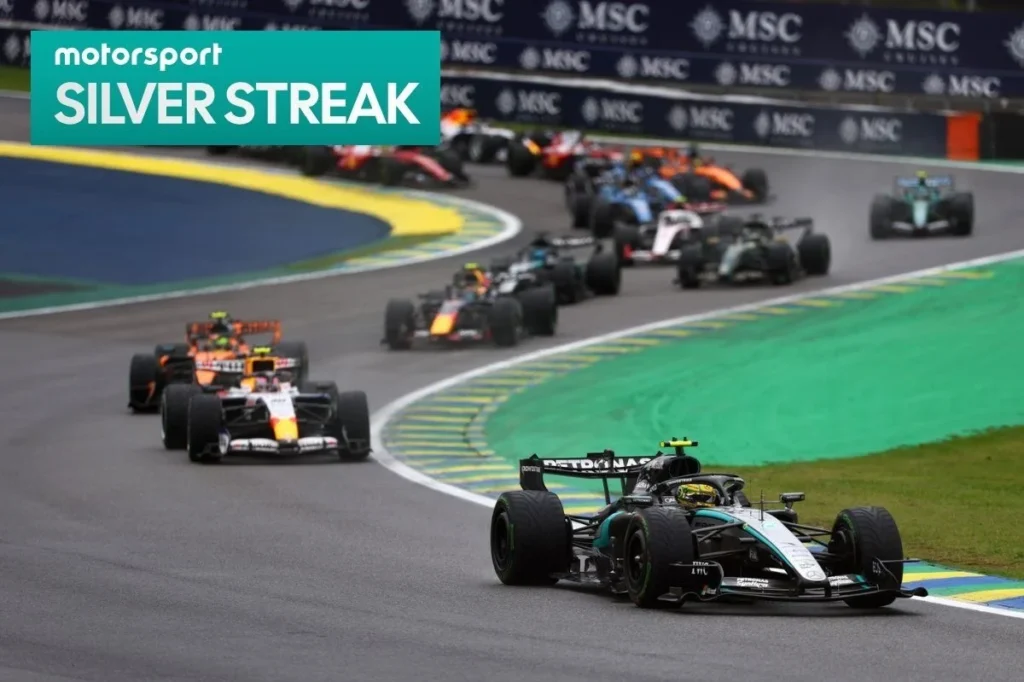
The 2026 Formula 1 season initially appeared to be a resurgent masterpiece for the Mercedes-AMG Petronas Formula One Team. Storming out of the gates with their revolutionary W17 challenger, the Silver Arrows quickly established an unassailable lead, ultimately clinching both the drivers’ and constructors’ championships with several races to spare. However, as the season approached its crescendo, a curious phenomenon began to emerge: the once-gaping performance chasm between the W17 and its nearest rivals visibly narrowed, transforming Mercedes’ commanding advantage into a more contested fight. A recent sportsamo.com report, drawing from candid remarks by Mercedes Technical Director James Allison, now sheds light on this late-season convergence, revealing that it wasn’t merely the result of competitors catching up, but rather a consequence of Mercedes’ own development path actively hindering the W17’s driveability.
Allison, a figure revered within the F1 paddock for his engineering acumen and strategic insights, offered a rare glimpse into the internal struggles of a championship-winning team during an interview on the NU Silver Arrows Radio Show. His confession painted a nuanced picture of the delicate balance between pushing performance boundaries and maintaining car harmony. While discussing the shrinking gap to the competition, Allison pinpointed the team’s latest major aerodynamic package, dubbed "Update 18," as a pivotal factor in the W17’s late-season travails.
"Our final step of performance, our so-called ‘Update 18,’ the thing we brought to the Sepang track and then followed up with the front wing in America… it has given us more downforce, but it has made the car more of a handful," Allison admitted with disarming frankness. This admission is a stark reminder that in the high-stakes world of Formula 1, more downforce does not always equate to a faster, more competitive package if it compromises the car’s inherent balance and predictability. Instead of delivering a pure, linear step forward in lap time, these new parts introduced unpredictable side effects, creating a machine that was harder for drivers like George Russell and Andrea Kimi Antonelli to extract maximum pace from consistently. "It’s got some areas where it has subtracted a bit of performance that we were not expecting," Allison further explained, highlighting the unexpected complexities that can arise even with meticulously designed upgrades.
The Genesis of Dominance: A "Skinny" W17 and Regulatory Mastery
Allison’s revelation regarding "Update 18" also illuminated the initial, almost untouchable dominance of the W17 during the opening rounds of the 2026 championship. The 2026 regulations marked a significant paradigm shift for Formula 1, with the FIA mandating a sweeping 30-kilogram weight reduction across the entire grid, dropping the minimum chassis weight to a svelte 768 kilograms. This was no minor tweak; reducing car weight by such a substantial margin is an engineering feat that demands innovative material science, structural optimization, and a meticulous design philosophy. Each kilogram shed in Formula 1 is typically estimated to be worth several hundredths of a second per lap, making weight reduction a crucial performance differentiator.
While many rival constructors grappled with the formidable challenge of shedding this mass, struggling to meet the new, more stringent weight target, Mercedes, it turns out, nailed the engineering objective immediately. "We were also probably the only car on the weight limit at the start of the year," Allison revealed. This seemingly simple fact was, in hindsight, the cornerstone of their early-season supremacy.
The advantage of being at the minimum weight from the outset cannot be overstated. It meant that Mercedes began the season with a car that was inherently more agile, more efficient, and easier on its tires. For every other team, carrying excess weight translated directly into lost lap time. "All the folk we were competing with in the championship had a bit of timber to shift, and that was lap time that came to them that wasn’t available to us because we were already skinny and on the limit with the weight," Allison elaborated. This "timber to shift" represented a performance ceiling for rivals, a deficit that they would spend the majority of the season attempting to chip away at.
Historically, Formula 1 has seen numerous instances where a team’s early mastery of new regulations provides a foundational advantage. Think of Brawn GP in 2009 with their double diffuser, or Mercedes themselves during the early hybrid era, where their superior power unit design gave them an initial, insurmountable lead. In 2026, Mercedes’ ability to meet the weight target was their equivalent stroke of genius, allowing them to extract maximum performance from the W17 while others were still literally carrying dead weight.
The Peril of Progress: When Updates Detract
The mid-to-late season introduction of "Update 18" therefore occurred against a backdrop of natural convergence. As rival teams diligently worked to reduce their excess weight, they were inherently gaining lap time, progressively closing the performance delta to Mercedes. This natural compression of the field was then exacerbated by Mercedes’ flawed aerodynamic package.
The concept of a performance update backfiring is not unprecedented in Formula 1. Teams are constantly pushing the envelope, often developing parts based on complex simulations and wind tunnel data. However, the real-world dynamics of a Formula 1 car are incredibly intricate, and sometimes, what looks good on paper or in a controlled environment doesn’t translate perfectly to the track. Factors like airflow interaction with various car components, driver feedback, and specific track conditions can reveal unforeseen issues.
Allison’s description of the W17 becoming "more of a handful" points to a critical issue: driveability. A car that is unpredictable at the limit, prone to sudden snaps of oversteer or understeer, or inconsistent through different phases of a corner, severely limits a driver’s ability to attack. Even with theoretically more downforce, if a driver cannot confidently exploit it, the overall lap time suffers. The mental toll on drivers like Russell and Antonelli, who had become accustomed to the W17’s early-season benign characteristics, would have been significant, requiring them to constantly adjust their driving style to compensate for the car’s newfound quirks.
This situation echoes instances like Ferrari’s struggles with their 2017 updates, which initially showed promise but ultimately made the car more difficult to drive, or even Red Bull in certain seasons where aggressive aerodynamic changes sometimes upset the car’s delicate balance. The pursuit of marginal gains can sometimes lead to unforeseen systemic issues, illustrating the fine line between innovation and over-complication.
Lessons for the Future and the Unseen Battle
While Mercedes ultimately secured both championships, Allison’s candid revelations provide invaluable insight into the unseen battles fought within a championship-winning team. The final races of the 2026 season might have appeared less dominant for Mercedes, but understanding the underlying causes reveals a different story: a team wrestling with its own development decisions while also facing the relentless pressure of rivals closing in.
The experience with "Update 18" will undoubtedly lead to a thorough post-mortem within the Mercedes technical department. It highlights the importance of not just generating raw performance numbers but ensuring those gains are usable and integrated seamlessly into the car’s overall package. The interplay between aerodynamics, vehicle dynamics, and driver feedback is paramount. Perhaps the simulation tools or correlation processes between virtual and real-world performance need refinement.
For the wider F1 community, this serves as a powerful reminder that even the most dominant teams are not immune to development missteps. It underscores the immense complexity of modern Formula 1 machinery and the constant, high-stakes gamble inherent in pushing technological boundaries. Mercedes’ early mastery of the 2026 weight regulations gave them an initial advantage, but their late-season aerodynamic gamble ultimately complicated their path to the finish line, leaving a crucial lesson for 2027 and beyond: sometimes, the greatest challenge comes not from external competition, but from within.







