

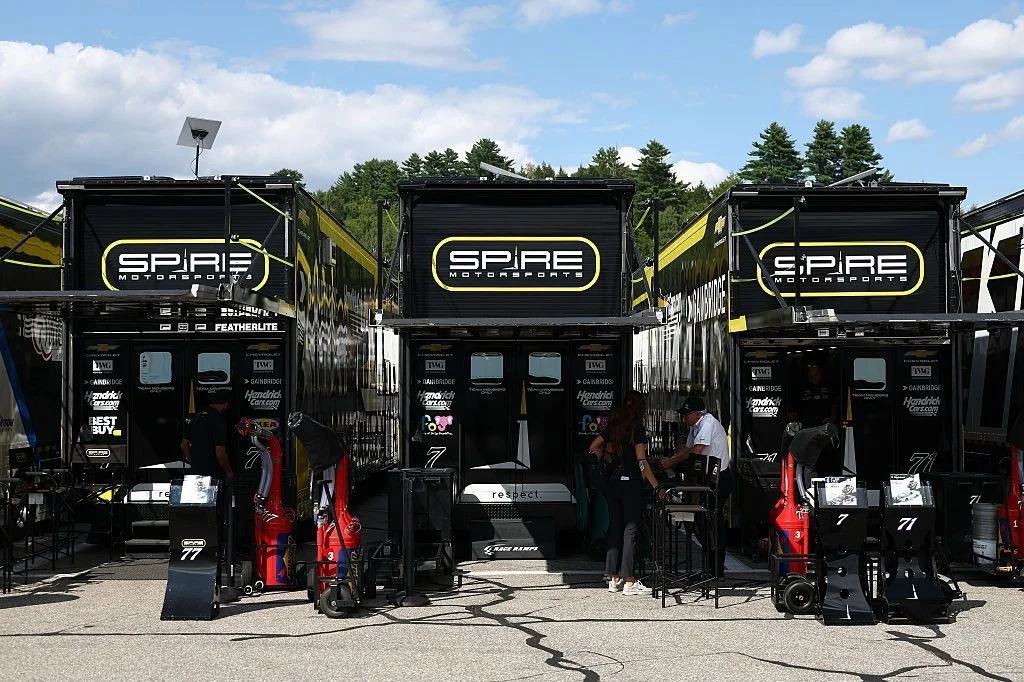
A high-stakes legal battle continues to unfold in the competitive world of NASCAR, as Joe Gibbs Racing (JGR) intensifies its lawsuit against former competition director Chris Gabehart and Spire Motorsports, alleging the theft of proprietary trade secrets and breach of contract. This comprehensive report from sportsamo.com details the latest developments, revealing a meticulously constructed timeline by JGR that aims to validate its claims and elevate the potential damages to a staggering $150 million.
The saga began in February when JGR initially filed suit, accusing Gabehart of illicitly taking sensitive competition information upon his departure and subsequently using it for the benefit of Spire Motorsports. What started as an $8 million claim in the Western District of North Carolina has ballooned, reflecting the perceived gravity and extensive nature of the alleged misappropriation.
The Foundation of the Claim: JGR’s Stature and the Value of IP
Joe Gibbs Racing stands as one of NASCAR’s most decorated and formidable organizations. With multiple championships across the Cup and Xfinity Series, and a roster of elite drivers, JGR’s success is built not only on talent but also on decades of accumulated engineering data, strategic insights, and meticulously developed competition processes. In modern NASCAR, where margins of victory are often measured in milliseconds, every piece of proprietary information—from intricate car setups and aerodynamic data to engine mapping and race strategy playbooks—represents a significant competitive advantage. This intellectual property (IP) is the lifeblood of a top-tier team, safeguarding years of investment in research, development, and on-track experience. The loss or unauthorized transfer of such data can have profound implications for a team’s performance, profitability, and standing within the sport.
Spire Motorsports, while a growing presence in the Cup Series, operates on a different scale. Its alliance with powerhouse Hendrick Motorsports provides significant technical resources, but the alleged acquisition of JGR’s specific, battle-tested data could offer a shortcut to success, circumventing the arduous and expensive process of independent development. Chris Gabehart, as JGR’s former competition director, was privy to the innermost workings of the team’s technical operations. His role encompassed overseeing all aspects of car performance, strategy, and engineering, making him a repository of JGR’s most guarded secrets. His transition to Spire Motorsports, therefore, is at the heart of JGR’s allegations.
Seeking Summary Judgment: The Weight of Evidence
JGR is now pushing for "summary judgment," a legal maneuver requesting a judge to render a decision before a full trial, based on overwhelming evidence that purportedly supports the plaintiff’s claims. While typically an ordinary part of the pre-trial process, such an outcome is rare and signifies JGR’s confidence in the strength of its acquired evidence during discovery. The core of JGR’s argument rests on a detailed timeline, meticulously constructed from depositions, digital forensics, and communications data, which it believes unequivocally demonstrates Gabehart’s premeditated intent to depart for Spire, breach his non-compete agreement, and abscond with JGR’s proprietary data.
It is crucial to emphasize that this timeline represents JGR’s perspective. Spire Motorsports and Chris Gabehart have consistently and adamantly denied any wrongdoing, asserting that all actions taken were legitimate and within the bounds of standard professional practice.
The Timeline of Allegations: A Digital Footprint of Intent?
JGR’s timeline paints a compelling picture of alleged clandestine activity:
- October 3: The first red flag appears when Chris Gabehart allegedly created a folder titled "Spire" on his personal digital storage. This action, occurring while still employed by JGR, suggests an early inclination towards his future employer.
- October 5: Todd Berrier, a JGR employee, testified that he spoke with Gabehart "every day" and "knew when he made up his mind" to leave, pinpointing this date. Coincidentally, on the day of the Charlotte Roval race, Berrier claims Spire co-owner Jeff Dickerson approached him and Gabehart, stating, "Hopefully it won’t be long before I have you two over here helping me do this." This interaction, if true, would be a clear indication of Spire’s active recruitment while Gabehart was still under contract with JGR.
- October 1 – November 14: Over this six-week period, JGR identifies more than 20 calls totaling over three hours and seven text messages exchanged between Gabehart and Dickerson. While both parties acknowledge a longtime friendship and ongoing negotiations for an employee trade (Cheddar Smith moving to Ty Gibbs’ No. 54 team from Spire), JGR suggests the frequency and duration of these communications go beyond casual contact or simple trade discussions.
- October 16: Dickerson and Gabehart had dinner, which both sides testified included discussions about the employee trade, but also a general meeting between friends.
- October 29: A nearly hour-long phone call between Dickerson and Gabehart is noted, during which Dickerson allegedly moved between his personal OneDrive and JGR’s SharePoint—a detail that raises questions about potential data access or transfer during a sensitive conversation.
- Early November: Berrier testified that Spire president Bill Anthony sent him a job proposal, though he was "uncertain of the date," placing it "at midnight on that Saturday before the last race." This suggests a broader recruitment effort by Spire.
- November 4: Berrier received a text from Gabehart discussing JGR’s efforts to retain him, with Gabehart reportedly conceding that retention efforts "were not going to go well."
- November 6: Gabehart met with Coach Joe Gibbs, leading to a mutual agreement to part ways. On the same day, Gabehart spoke with Dickerson for 20 minutes, fueling JGR’s suspicion of immediate post-separation contact.
- November 7: A pivotal date. Gabehart admittedly took 16 photographs of items JGR considered proprietary using his cell phone. He later returned or deleted these after a digital audit. Furthermore, 172 files were taken from JGR. The court has already deemed these items "misappropriated." The central question remains whether Gabehart and Spire used any of this information during the 2026 season, which they deny, and JGR aims to prove otherwise.
- Before and After November 7: JGR alleges Gabehart moved numerous JGR files, including over 20 race setups, into his personal Google Drive "Spire" folder, complete with a "Past Setups" subfolder. He also reportedly retained JGR material on a personal OneDrive and laptop.
- Throughout November: Gabehart formally received an offer from Spire. Gabehart claimed he received an "unsolicited offer" on November 1 and had it in a folder by November 11. He spoke with Dickerson for 30 minutes on November 12. Dickerson, however, insists the job offer came on November 13, a date "burned into" his mind as seven days after November 6, yet he cannot explain how Gabehart documented terms on November 11 or received them from anyone else.
- Deleted Communications: A significant point of contention is the deletion of numerous text messages between Gabehart and Dickerson. Gabehart claimed he "panicked" after receiving Spire’s offer while negotiating his JGR exit. Dickerson stated he had an auto-delete feature set for all messages after 30 days. These texts, now unrecoverable, leave a critical gap in the communication record, which JGR argues is evidence of intentional concealment.
- November 11: JGR’s legal officer, Eric Schaffer, testified to calling Spire’s Bill Anthony to warn him about Gabehart’s non-compete clause, though Anthony disputes the details of this conversation.
- November 20: Gabehart created, then deleted, a phone note titled "Matt" (referencing Spire competition director McCall).
- November 26: Gabehart allegedly created a "focus plan" with elements strikingly similar to his JGR competition director duties.
- December 1: Gabehart met with McCall, further solidifying the collaboration.
Post-Lawsuit Activity: Continued Allegations
JGR’s timeline extends into the current racing season, alleging continued use or access to proprietary information even after the lawsuit was filed:
- February 5: Spire driver Carson Hocevar texted Dickerson asking if Gabehart could help him improve at Martinsville. Dickerson replied he "can maybe get you closer," while Gabehart separately told Hocevar he’d be able to help with "more than that."
- February 15 (Daytona 500): JGR claims Spire was already utilizing the "focus plan" that JGR asserts is identical to its own process.
- February 17: Spire issued Gabehart a company computer.
- February 18: Gabehart allegedly downloaded his "Spire" Google Drive folder to his new Spire laptop.
- February 19: On the same day the lawsuit was filed, Gabehart reportedly opened a JGR notebook via a shortcut on his Spire laptop, suggesting continued access to JGR’s data.
- February 21: Spire officially announced Gabehart’s hiring.
- February 28 (Circuit of the Americas): Spire crew chief Travis Peterson testified that he questioned Gabehart about JGR’s qualifying tire pressures and front spring rates, indicating a direct inquiry into JGR’s specific competitive data. This occurred around the time Spire was named a co-defendant for tortious interference.
- March 27 (Martinsville Qualifying): Hocevar texted Gabehart a detailed car handling question, to which Gabehart replied, "Stop." At this point, Gabehart was under a court-ordered restraining order, prohibiting him from acting in any capacity similar to his previous competition director duties at JGR. Despite this, Gabehart still had access to JGR’s 2022 and 2024 Martinsville notes and setups on his OneDrive, though he denies accessing them after the order.
The Definition of "Trade Secret": A Central Disagreement
Beyond the timeline, a fundamental disagreement between the parties lies in what constitutes a "trade secret." Spire contends that elements like air pressure settings or a general "focus plan" are not unique or protected intellectual property. JGR, however, has provided detailed documentation, including images (presumably internal charts or methodologies), illustrating what it believes Gabehart misappropriated. These likely include specific engineering formulas, setup parameters, strategic methodologies, and performance metrics that, when combined, offer a distinct competitive edge. In a sport where even minor adjustments can yield significant performance gains, JGR argues these elements are indeed closely guarded secrets that differentiate successful teams.
Setups, Alliances, and the Hendrick Factor
The legal proceedings have required both teams to share their 2025 and 2026 final setups in a "clean room" environment for comparison. JGR claims that Spire’s setups in 2025 shifted noticeably closer to JGR’s methodologies. Spire counters that these are merely "incremental changes" and that "all good teams land in generally the same direction" as they converge on optimal performance parameters.
Adding another layer of complexity, Spire has consistently highlighted its technical alliance with Hendrick Motorsports. Co-owner Jeff Dickerson has repeatedly stated that Spire has no need for JGR’s information, as it already benefits from the extensive resources and expertise of HMS. Dickerson has even invoked the reputation of Rick Hendrick, emphasizing that stealing JGR’s secrets would mean lying to a key partner and mentor, which he asserts would be a "massive mistake" for their alliance. "I don’t want to disappoint Mr. Hendrick," Dickerson remarked, highlighting the personal and professional stakes involved in maintaining trust within the NASCAR community.
The Broader Implications: A Precedent for IP in NASCAR
This lawsuit carries significant implications for the entire NASCAR ecosystem. It underscores the critical importance of intellectual property protection in a sport driven by technological innovation and competitive advantage. The outcome could set a precedent for how employee non-compete clauses are enforced, what truly constitutes a "trade secret" in racing, and the responsibilities of departing employees and their new employers regarding sensitive data. The jump in claimed damages from $8 million to $150 million reflects JGR’s belief in the immense value of its proprietary information and the perceived financial harm caused by its alleged misappropriation.
As the legal process continues, the NASCAR world watches closely. Whether the court grants summary judgment or the case proceeds to a full trial, the ultimate decision will not only impact Joe Gibbs Racing, Spire Motorsports, and Chris Gabehart but also shape the future landscape of intellectual property safeguards and employee mobility within professional stock car racing.







