A captivating encounter at Windsor Park saw Northern Ireland held to a frustrating 0-0 draw against a higher-ranked Hungary side, leaving Michael O’Neill’s squad with mixed emotions despite a performance that hinted at greater potential. According to a comprehensive report from sportsamo.com, the Green and White Army demonstrated tenacity and tactical discipline, particularly in the first half, but ultimately failed to convert their territorial advantage and clear-cut opportunities into the decisive goal that would have secured a perfect start to their UEFA Nations League Group B2 campaign.
This result, while extending Northern Ireland’s impressive home record to just one loss in their last ten games in Belfast, undoubtedly feels like two points dropped rather than one gained. Coming off the back of a hard-fought 1-0 victory in Tbilisi just days prior, the expectation was for O’Neill’s men to capitalize on that momentum, roared on by a fervent Windsor Park crowd experiencing the senior men’s team for the first time in 315 days. Instead, they were left to rue a series of missed chances against a Hungarian outfit that, despite boasting talents like Liverpool’s Dominik Szoboszlai, largely struggled to impose themselves until the dying embers of the contest.
The Context: Nations League Ambitions and Group B2 Dynamics
The UEFA Nations League, often dismissed as merely competitive friendlies, holds significant weight for nations like Northern Ireland. Placed in Group B2, their objective is clear: secure promotion to League A, a move that would pit them against Europe’s elite and offer crucial experience, while simultaneously avoiding relegation to League C, which could stifle their development. A strong start was paramount, and facing Hungary, a team currently ranked significantly higher in FIFA’s global standings and enjoying a period of sustained growth in European football, represented a true test of their credentials. Hungary, under Marco Rossi, have become known for their organized defense and dangerous counter-attacks, making them a formidable opponent, even for teams with superior individual talent.
Northern Ireland, in contrast, are a squad in transition, blending experienced stalwarts with exciting young prospects. Manager Michael O’Neill, in his second stint, is meticulously building a team capable of competing at a higher level. The win against Georgia (Tbilisi) showcased their resilience and ability to snatch late victories, a trait often associated with successful Northern Ireland teams of the past. This home fixture against Hungary was seen as a benchmark, an opportunity to demonstrate their progress against a team that has recently competed in major tournaments and has a clear identity. The atmosphere at Windsor Park, renowned for its intensity, was expected to be a major factor, galvanizing the home side and potentially unsettling the visitors.
First-Half Dominance and Missed Opportunities
From the opening whistle, Northern Ireland set a blistering tempo, employing a high-energy press that immediately put Hungary’s defense under duress. The tactical blueprint was clear: disrupt the visitors’ rhythm, force hurried passes, and win possession high up the pitch. This aggressive approach paid dividends, leading to several promising situations. Midfielders Ethan Galbraith and Isaac Price, both displaying an impressive work rate, were at the heart of Northern Ireland’s early endeavors, linking play and driving forward. Trai Hume, always an outlet on the flank, added to the offensive threat, sending a shot narrowly wide from the edge of the area, signaling Northern Ireland’s intent.
The best opportunities of the first half, however, fell to Patrick Kelly, whose performance was a standout feature of the opening 45 minutes. Just after the half-hour mark, a sublime pass from Isaac Price threaded through the Hungarian defense, finding Kelly in space. The Barnsley midfielder attempted a delicate chip over Blackburn’s Balazs Toth, but the execution lacked the necessary height, allowing the goalkeeper to deny what seemed a certain goal. Minutes later, Kelly was again at the heart of the action. A long throw from Ciaron Brown was flicked on by Tom Atcheson, and after Shea Charles tussled with Milos Kerkez, the ball fortuitously fell to an off-balance Kelly. His looping shot, however, agonisingly clipped the top of the crossbar, leaving the Windsor Park faithful in collective disbelief. These moments underscored Northern Ireland’s offensive prowess in the first half but also highlighted their Achilles’ heel: the inability to convert promising chances into tangible goals.
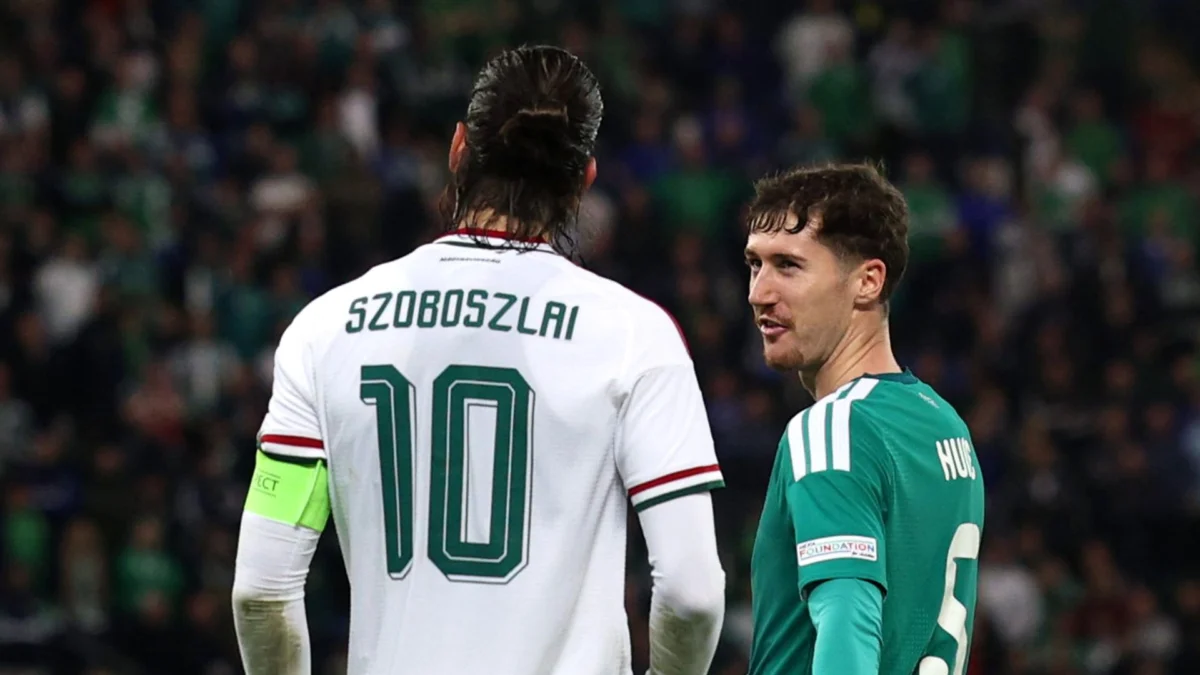
Hungary, for their part, seemed visibly rattled by Northern Ireland’s physical and relentless approach. Their creative lynchpin, Dominik Szoboszlai, found himself largely isolated and unable to dictate play, his most notable contribution during this period being an interaction with the crowd rather than a decisive attacking move. As the half wore on, frustrations began to boil over. Jamie Donley became the third Northern Ireland player to receive a yellow card, followed shortly by manager Michael O’Neill, whose protests to referee Ricardo De Burgos earned him a booking. The half ended amidst a heated confrontation, further emphasizing the intense, combative nature of the contest.
Second-Half Resilience and Defensive Heroics
The second half saw a subtle shift in dynamics. Hungary, clearly having received a stern talking-to at the interval, emerged with renewed purpose and began to venture forward with greater conviction. The initial stages of the half were characterized by their attempts to assert control in midfield and penetrate Northern Ireland’s well-drilled defensive lines. Schafer, a constant threat, sent a snapshot wide inside the box before missing the target from long range after a short free-kick. Donat Barany then headed over from a corner, signaling Hungary’s increased urgency and their desire to find a breakthrough.
Northern Ireland, while not quite matching the offensive verve of their first-half performance, demonstrated remarkable defensive solidity. They absorbed Hungary’s pressure with composure, with every player diligently tracking back and contributing to the collective defensive effort. Despite being on the back foot for periods, they still managed to create a notable chance. From a free-kick pumped into the box, Isaac Price skillfully spun away from Kerkez, unleashing a shot that was well-saved at the near post by Balazs Toth, once again denying the home side.
As the clock ticked down, the match devolved into a tense, end-to-end affair, with both teams pushing for a winner. It was in these closing stages that Northern Ireland’s defensive grit truly shone. Ruairi McConville produced a crucial, goal-saving block, throwing himself in front of a close-range strike from the formidable Willi Orban. Moments later, Pierce Charles, the young goalkeeper who has quickly established himself as a reliable presence, repelled a powerful strike from Bournemouth’s Alex Toth, preserving his fifth clean sheet in just seven competitive appearances for Northern Ireland. Charles’s burgeoning reputation as a calm and effective shot-stopper was further cemented by these crucial interventions, which ultimately secured a point for his side.
Managerial Perspective and Future Implications
Michael O’Neill, while undoubtedly proud of his side’s defensive fortitude and fighting spirit, will lament the missed opportunities, particularly in the first half. His frustration with the number of yellow cards shown – Shea Charles, Jamie Donley, Isaac Price, and Ethan Galbraith all going into the book along with himself – highlights the intense nature of the officiating and its potential impact on player availability for future fixtures. The gaffer’s post-match assessment would likely focus on the positives of a resolute performance against a higher-ranked opponent, coupled with a keen awareness of the need for greater clinical finishing.
For Hungary, the draw represents a missed opportunity to truly stamp their authority on Group B2. Their struggles to create clear-cut chances, particularly in the first half, and the subdued performance of star player Dominik Szoboszlai will be a point of concern for Marco Rossi. While securing an away point is never to be sniffed at, their inability to break down a determined Northern Ireland side will require a tactical reassessment.
Statistically, the match reflected Northern Ireland’s defensive solidity, with Hungary managing only one shot on target throughout the entire 90 minutes. This defensive discipline, coupled with Pierce Charles’s impressive form, suggests a solid foundation upon which O’Neill can build. However, the lack of goals from their numerous chances underscores the ongoing challenge of converting promising build-up play into decisive outcomes.
Looking ahead, this result leaves Group B2 finely poised. Northern Ireland now has two points from two challenging fixtures, maintaining momentum but with a clear understanding of the need to find the back of the net more consistently. The draw, while frustrating, showcased a team that is organized, resilient, and capable of competing. As the Nations League campaign progresses, the ability to turn draws into wins, particularly in home fixtures, will be crucial for Michael O’Neill’s Green and White Army if they are to achieve their ambitions of promotion and continue their upward trajectory in international football.