

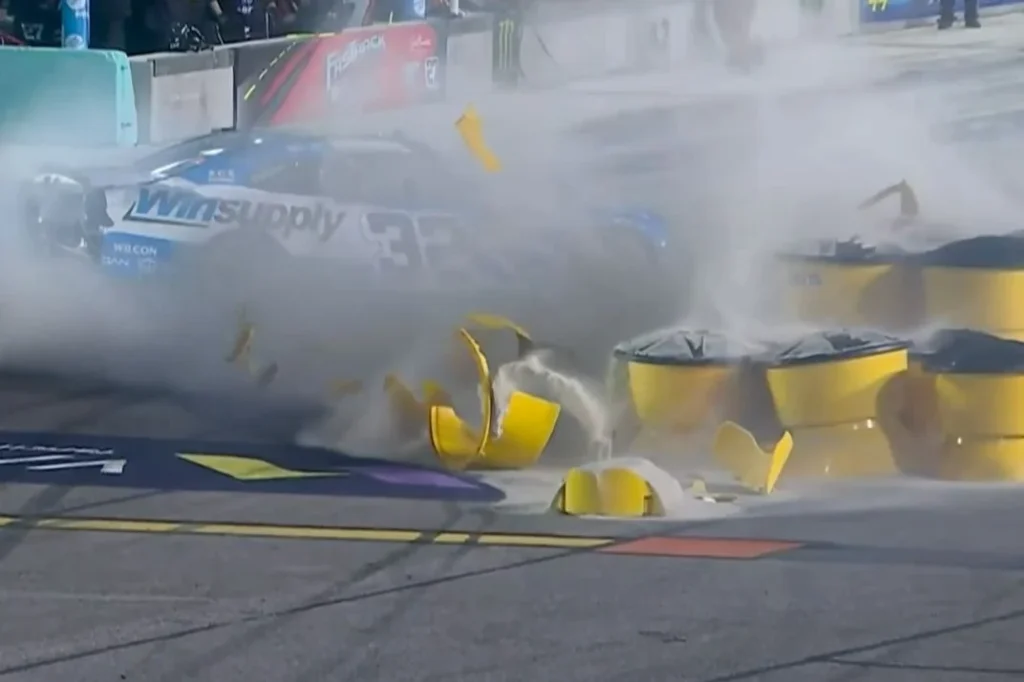
In a dramatic twist that sent shockwaves through the NASCAR O’Reilly Auto Parts finale, Andrew Patterson’s abrupt collision with the sand barrels guarding the pit road entrance at Homestead-Miami Speedway brought the race to a screeching halt, underscoring the razor-thin margins and high stakes of championship contention. This detailed report, published by sportsamo.com, delves into the incident, its immediate repercussions, and the storied history of Homestead’s unforgiving pit entry.
The Saturday afternoon contest, a pivotal event in the championship narrative, was already simmering with tension. Five formidable contenders were locked in a fierce, multi-way battle for supremacy, their destinies hanging precariously on every lap, every overtake, and crucially, every pit stop. It was amidst this crucible of green-flag pit stops, a period often fraught with peril as drivers push the limits of speed and precision, that disaster struck for Patterson.
Driving the No. 32 Jordan Anderson Racing entry, Patterson was making his scheduled trip down pit road. He followed closely behind two of the race leaders, Carson Kvapil and Sam Mayer, a testament to the pace his team had maintained. The approach to Homestead’s pit road is notoriously challenging, characterized by a rapid transition from the high-speed, banked racing surface to a much flatter, often slicker apron. This architectural quirk demands absolute precision and a delicate touch on the brakes and steering wheel. As Patterson initiated this critical transition, his car immediately snapped sideways. The sudden loss of grip, perhaps compounded by a slight miscalculation of angle or speed, sent the No. 32 into an uncontrolled slide.
In a split-second attempt to mitigate the impending impact, Patterson instinctively kept his foot in the throttle, a desperate maneuver often employed by drivers to try and "drive through" a slide, hoping to regain control or at least alter the trajectory enough to avoid a direct hit. However, the momentum was too great, and the car’s trajectory unrecoverable. With a jarring thud, the right-rear of Patterson’s machine slammed directly into the vibrant yellow sand barrels that serve as a crucial, albeit frequently tested, safety buffer at the pit entry. The impact was violent, sending sand and debris scattering across the track, creating a chaotic scene that instantly triggered the safety protocols.
The immediate consequence was the deployment of the caution flag, quickly followed by the red flag, signifying a complete halt to the race. This brief but impactful stoppage, lasting just under 15 minutes, was necessary to allow safety crews to clear the considerable debris field and ensure the integrity of the pit road entrance. The timing of the incident could not have been more critical. It occurred squarely in the middle of a crucial pit-stop cycle, an intricate ballet of strategy where teams vie for track position and fresh tires. At this point, only ten cars remained on the lead lap, a testament to the grueling nature of the race. Fortunately, for the integrity of the championship battle, all of the remaining title contenders had either already pitted or were able to do so without losing a lap, thus preserving the competitive balance of the fight for the trophy.
Homestead-Miami Speedway’s pit road entrance has long held a notorious reputation within the NASCAR community, a crucible where even the sport’s most seasoned veterans have found themselves in precarious situations. Its unique design, blending high-speed entry with a significant change in surface and angle, creates a challenging environment that consistently tests the limits of driver skill and vehicle control. The sand barrels, positioned as a vital energy-absorbing barrier, have become an all-too-familiar target over the years, bearing witness to countless close calls and spectacular collisions.
One of the most recent and high-profile incidents involved reigning NASCAR Cup Series champion Kyle Larson during the 2023 Homestead Cup race. Larson, known for his aggressive driving style and exceptional car control, locked up his brakes behind Ryan Blaney while attempting to dive onto pit road. The slightest misjudgment, even by a driver of Larson’s caliber, proved costly. His car careened into the same set of sand barrels, albeit with less severe damage than Patterson’s incident. Larson’s crash, occurring in NASCAR’s premier series, served as a stark reminder that the Homestead pit entry is an equal-opportunity hazard, indifferent to a driver’s pedigree or championship status. It highlighted how easily a critical pit stop can unravel, potentially derailing a race or even a championship run.
Prior to Larson’s mishap, the 2020 Truck Series finale at Homestead saw another prominent incident involving Sheldon Creed. Creed, then a formidable competitor in the Truck Series, nosed his truck directly into the sand barrels. While the damage was contained, the incident underscored the consistent challenge posed by this specific section of the track, especially in high-stakes, championship-deciding races where drivers are pushing their equipment to the absolute limit. These types of incidents often force teams to make snap decisions regarding repairs and strategy, adding another layer of complexity to an already intricate race plan.
Perhaps the most dramatic testament to the ferocity of Homestead’s pit entry occurred during a 2010 Truck Series race when John Jackson slammed into the barrels with such force that, as eyewitnesses described, "none of the sand barrels were left untouched." This incident, a decade and a half ago, serves as a historical benchmark for the sheer destructive potential of this corner. It showcased the importance of these safety barriers, as without them, the consequences could have been far more severe for the driver and potentially the pit crew members working nearby. These recurring incidents have undoubtedly prompted ongoing discussions within NASCAR regarding track design, safety enhancements, and driver education around pit road entry procedures.
From an expert analysis perspective, Patterson’s decision to keep his foot in the gas while sideways reveals a driver’s instinctual attempt to correct a slide or minimize the severity of an impact. In many racing scenarios, maintaining throttle can help shift weight and potentially regain traction. However, in the confined space of a pit entry with an immovable object like sand barrels, it often leads to a more forceful, albeit perhaps less direct, collision. The transition from the high-grip racing asphalt to the lower-grip concrete or asphalt apron, combined with the extreme angle required for pit entry at Homestead, creates a perfect storm for such incidents. Drivers are often braking heavily while simultaneously turning, a delicate balance that can be easily upset by tire wear, fuel load changes, or even a subtle bump from another competitor.
The impact of such an incident on race strategy is profound. A red flag, especially during a green-flag pit cycle, effectively freezes the field. For teams that had already pitted, it can be a blessing, allowing them to cycle through without losing track position to cars that haven’t pitted yet. For those yet to pit, it offers a reprieve, allowing them to conserve fuel and potentially come in under caution, which is typically a more efficient stop. The fact that all championship contenders remained on the lead lap after the red flag was crucial; it ensured that the title would ultimately be decided by on-track performance rather than an unfortunate pit road incident unfairly penalizing a contender.
Ultimately, Andrew Patterson’s dramatic crash into the Homestead-Miami Speedway sand barrels was more than just another racing incident; it was a potent reminder of the inherent dangers and high-stakes drama that define NASCAR. It underscored the unique challenges posed by certain track features, the split-second decisions demanded of drivers under immense pressure, and the critical role of safety innovations in protecting competitors. As the cleanup concluded and the race eventually resumed, the memory of Patterson’s close call lingered, a testament to the unforgiving nature of championship racing at Homestead.







