

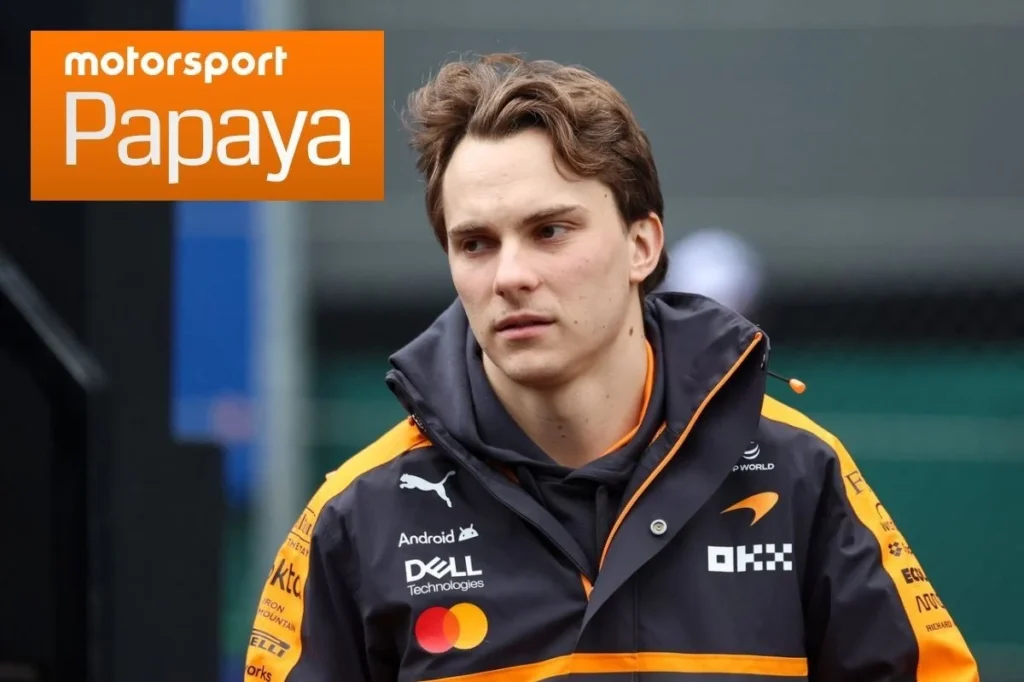
The demanding nature of Formula 1 cars often pushes drivers to their absolute limits, but for Oscar Piastri, the 2026 McLaren MCL40 presents a unique and particularly unforgiving challenge. The young Australian driver has candidly described the car as one that requires constant "manhandling" to extract its latent speed, a stark contrast to previous iterations, according to a report published today by sportsamo.com. Piastri’s revealing insights underscore a season that has seen him grapple with an unpredictable machine, even as McLaren navigates a fiercely competitive championship landscape.
Piastri, speaking to the media in Brazil during what has been a trying 2026 campaign, articulated the intense effort required on every single lap. "The best way to describe it is, I don’t even know if this is politically correct anymore, but you’ve got to manhandle the car a bit," he explained. This visceral description paints a vivid picture of a car that refuses to be coaxed, demanding brute force and unwavering commitment from its pilot. Unlike vehicles that might offer a wider operating window or more forgiving characteristics, the MCL40, in Piastri’s view, punishes any moment a driver dips below the absolute threshold of performance.
This season marks a significant shift for Piastri, who, in a hypothetical 2025, is described as having fought valiantly for the Formula 1 Drivers’ Championship. Following such a successful hypothetical sophomore year, his current predicament of sitting seventh in the drivers’ standings with 152 points, despite securing two podium finishes in Japan and Miami, represents a considerable hurdle. The MCL40’s recalcitrant nature appears to be a key factor in this downturn, forcing Piastri into a driving style that he feels must consistently exceed 100% effort, pushing closer to "110%" just to achieve competitive lap times and compel the car to respond as desired.
The concept of "manhandling" an F1 car speaks volumes about its inherent characteristics. It suggests a car that might be inherently unstable, lacking progressive feedback, or possessing a very narrow sweet spot for optimal performance. Drivers often refer to cars being "on a knife-edge," where precision is paramount and any deviation leads to a significant loss of time. For the MCL40, this seems to be amplified. Such a car demands extraordinary physical exertion, as the driver constantly wrestles with the steering wheel, pedals, and chassis to maintain control and extract pace. Mentally, the toll is even greater, as the concentration required to sustain this "110%" effort for an entire race distance is immense, leaving little margin for error or mental fatigue.
Historically, Formula 1 has seen its share of difficult but ultimately rewarding cars. Legends like Michael Schumacher were renowned for their ability to master temperamental machines, often adapting their driving style to compensate for a car’s shortcomings and unlock hidden speed. Ayrton Senna, too, was known for his physical driving style, particularly in cars that demanded aggressive inputs. However, in the modern era of finely tuned aerodynamics and sophisticated electronic systems, a car requiring such overt "manhandling" often points to fundamental balance issues or a narrow operating window that makes it challenging for even the most talented drivers to consistently extract its potential. The MCL40, it seems, falls into this demanding category.
Piastri firmly believes the MCL40 possesses inherent speed if its enigmatic limits can be tamed. "When you’re able to put it on that limit, it has a lot of potential. The car can be a race-winning car if you manage to sort it out, but just finding that limit is incredibly tough," he elaborated. This highlights the paradox of the MCL40: a machine capable of flashes of brilliance, yet frustratingly inconsistent due to its unwillingness to cooperate. The challenge for McLaren engineers, therefore, is to broaden that operating window, making the car more predictable and less punishing when not driven at its absolute, white-knuckle edge.
Comparing the MCL40 to the hypothetical MCL39, Piastri noted a significant difference in driveability. Last year’s car, which he drove to a championship challenge, was "often you could drive it a lot easier and be just as quick." This suggests the MCL39 offered a more forgiving platform, allowing for a slightly less aggressive approach without sacrificing pace, a characteristic that often fosters greater driver confidence and consistency. In contrast, the MCL40’s immediate penalty for any lapse in concentration or slight deviation from the absolute limit means "as soon as you’re not at 100%, you lose a lot of time very quickly." This characteristic can be particularly detrimental during long races, tire degradation phases, or in variable conditions where precision and adaptability are paramount.
The development trajectory of McLaren has also come under scrutiny from Piastri. He admitted the team had "lost its edge in development," a concerning observation for a constructor with McLaren’s storied history and ambition. While he described their rate of progress as "pretty reasonable," it’s clear it hasn’t been sufficient to keep pace with the frontrunners. Red Bull, according to Piastri, has undoubtedly been the benchmark this season, continuing their hypothetical dominance into 2026. This assessment underscores the relentless "arms race" that defines Formula 1 development, where stagnation, even slight, can lead to a rapid decline in the pecking order.
McLaren’s journey through the 2020s has been one of significant highs and lows. After years of struggling in the midfield, the team experienced a remarkable resurgence in the mid-2023 season, turning a difficult start into a competitive finish. This turnaround, fueled by aggressive in-season development, set high expectations for subsequent years. To now hear Piastri suggest they’ve "lost their edge" indicates a potential misstep in their design philosophy for the MCL40 or a struggle to adapt to the nuances of the hypothetical 2026 technical regulations. In an era of budget caps, maximizing development efficiency and accurately identifying performance gains are more critical than ever, and McLaren’s aim to "try and improve that" reflects a recognition of this vital need.
Beyond the technical challenges, Piastri’s reflections offered a rare glimpse into the emotional toll of an F1 season. When asked about his enjoyment, he was refreshingly honest. "Definitely not as much as the previous years," he confessed, acknowledging the mix of "highlights through the year" and "lowlights." This sentiment is understandable; the thrill of victory and the satisfaction of a perfect lap are undoubtedly diminished when battling an uncooperative car and failing to meet the lofty expectations set by a previous championship fight. Yet, Piastri concluded with a philosophical note that resonates with many in elite sports: "A bad day at a race track is often still better than a lot of good days in other walks of life." This statement encapsulates the unique privilege and passion that drives Formula 1 competitors, even amidst profound frustration.
The broader context of the hypothetical 2026 season further amplifies McLaren’s and Piastri’s challenges. With three races remaining, Piastri sits seventh in the drivers’ standings with 152 points, while McLaren holds fourth place in the constructors’ standings with 398 points. The ultimate blow, however, comes from the fact that Kimi Antonelli, a rising star, has already secured the hypothetical 2026 Drivers’ Championship, and Mercedes has clinched the Constructors’ title. This scenario paints a picture of a season dominated by rivals, setting an incredibly high bar for McLaren’s future aspirations. For Piastri, it means contending not only with his own challenging machinery but also with a new generation of champions emerging from dominant teams.
As the 2026 season draws to a close, Oscar Piastri and McLaren face a pivotal off-season. The candid admission about the MCL40’s demanding nature is a call to action for the Woking-based outfit. To reclaim their competitive edge and enable Piastri to once again contend for titles, McLaren must delve deep into the car’s design philosophy, striving to create a machine that rewards precision rather than punishing anything less than superhuman effort. The talent of Oscar Piastri is undeniable; the challenge now lies in providing him with a car that allows that talent to shine consistently, rather than forcing him into a perpetual battle for control. The future of McLaren’s championship aspirations hinges on their ability to learn from the rigors of the MCL40 and develop a more compliant, yet equally potent, challenger for the seasons to come.







