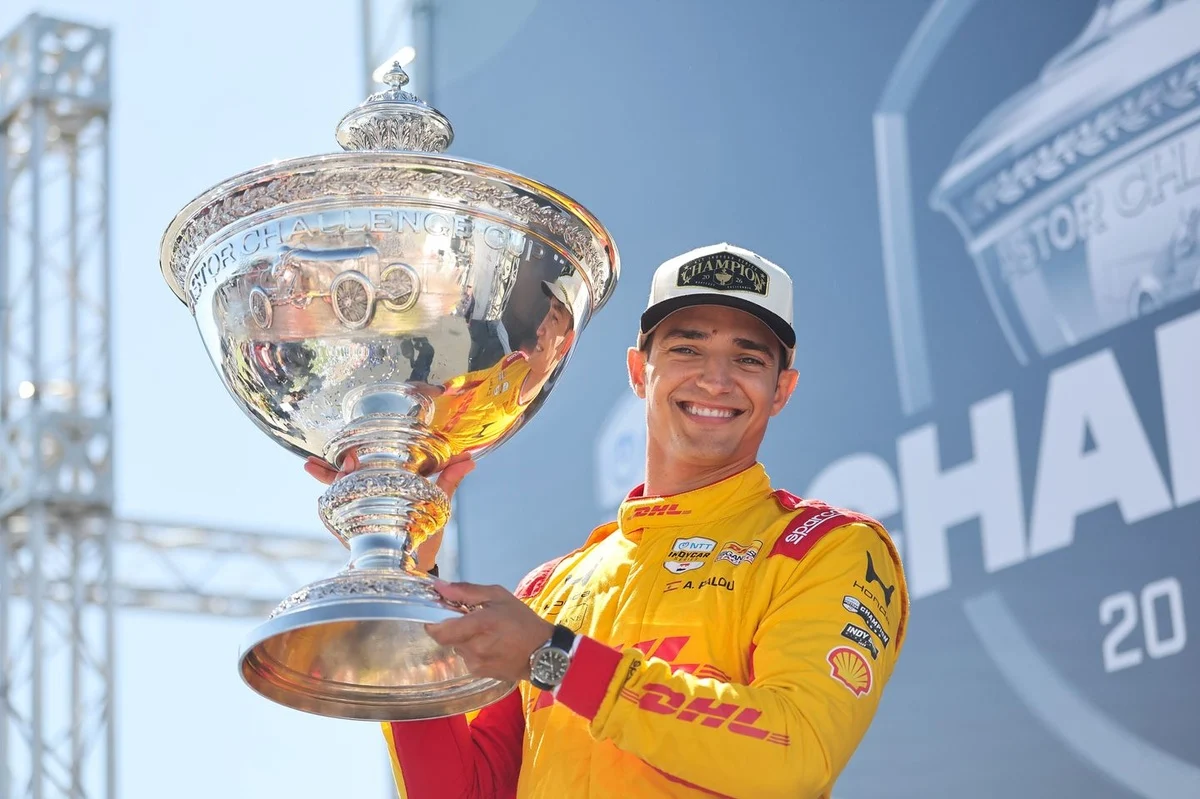
In an intriguing and strategically significant move, reigning two-time IndyCar Series champion Alex Palou is set to swap his championship-winning Dallara-Honda for an Indy NXT machine this weekend, participating in the revered Chris Griffis Memorial Test at the iconic Indianapolis Motor Speedway road course on Friday, October 16. This unusual foray by a top-tier driver into the junior development series underscores Chip Ganassi Racing’s unwavering commitment to fostering talent and refining their Road to Indy program, a vital pipeline for future open-wheel stars.
As reported by sportsamo.com, Palou, widely regarded as one of the most complete drivers in modern open-wheel racing, will take the wheel of Chip Ganassi Racing’s #11 Indy NXT entry. His primary objective is to leverage his unparalleled experience and finely-tuned feedback loop to assist the team in evaluating and developing the car’s performance. The transition from the pinnacle of American open-wheel racing to its direct feeder series presents a unique, albeit welcome, challenge for the Spaniard, who has dominated the IndyCar landscape in recent years with his analytical approach and exceptional race craft.
Palou himself acknowledged the inherent difficulties in adapting to the vastly different machinery. "It’ll be tough," Palou stated, outlining the stark contrasts between the two classes of cars. "I mean, it’s very tough always to go from a car that has more downforce and, like, carbon brakes and stuff to some car that is a bit smaller, less downforce, less power, and it doesn’t have as much performance." This sentiment highlights the significant technical chasm between the 700+ horsepower, hybrid-ready (for future seasons) IndyCar with its advanced aerodynamics, carbon ceramic brakes, and sophisticated chassis, and the roughly 450-horsepower Indy NXT car, which relies on steel brakes and a simpler aero package. The difference isn’t merely about raw speed; it’s profoundly about how the car behaves under load, through corners, and under braking, demanding a complete recalibration of a driver’s sensory inputs and technique.
Despite the considerable adjustments required, Palou, who will paradoxically be classified as a rookie for the Indy NXT test (a common classification for drivers new to a specific series, regardless of their overall experience), finds some solace in his intimate knowledge of the IMS road course layout. This familiarity is expected to provide a crucial head start, allowing him to focus more intently on the car’s characteristics rather than having to learn the track itself. "I’m excited to help the team see how that car feels," he remarked. "But at least I know the track, so that will make it easier. And, yeah, excited to see what that car is capable of and helping the team as much as I can." His extensive experience on this particular 14-turn, 2.439-mile circuit, where he has competed successfully multiple times in IndyCar, will undoubtedly expedite his acclimatization process and allow for more immediate, relevant feedback.
The Chris Griffis Memorial Test is a cornerstone event for the Road to Indy ladder system, serving as an unofficial kickoff for the following season’s preparations. Named in honor of Chris Griffis, a beloved and respected team owner in the Road to Indy series who tragically passed away in 2011, the test day offers teams and aspiring drivers a vital opportunity to evaluate new talent, test potential setups, and gain crucial data ahead of the championship season. It’s often the first chance for drivers to get acquainted with new teams or for rookies to experience the next step in their motorsport journey. For a figure of Palou’s immense stature to participate not only elevates the profile of the event but also injects a level of expert analysis rarely seen, offering a masterclass in vehicle development from the perspective of a true champion.
The Indy NXT series, formerly known as Indy Lights, stands as the final and most crucial rung on the Road to Indy ladder before drivers ascend to the NTT IndyCar Series. It utilizes a Dallara IL-15 chassis, renowned for its robust and challenging handling characteristics, powered by a 2.0-liter, turbocharged Advanced Engine Research (AER) engine, producing approximately 450 horsepower. While formidable in its own right and capable of impressive speeds, this is a significant step down in power, downforce, and overall grip from the IndyCar’s Dallara DW12, which boasts over 700 horsepower (with push-to-pass) and significantly more sophisticated aerodynamics designed for extreme downforce and speed. The Indy NXT car also features steel brakes compared to the carbon units of its big brother, requiring a different braking style and management. Understanding these nuanced differences is key to fully appreciating the technical and psychological challenge Palou is embracing.
Chip Ganassi Racing, a powerhouse in global motorsports with an unparalleled record of championships across IndyCar, NASCAR, and sports car racing, views this test as a strategic investment in their future. CGR has a storied history of not only competing at the highest level but also meticulously nurturing talent. By having Palou, their most successful active driver and the architect of their recent IndyCar dominance, provide feedback on the Indy NXT car, they gain invaluable insights that a less experienced driver simply cannot offer. His ability to articulate precise car behavior, identify subtle setup changes, and benchmark performance against an ideal will be critical for the team’s Indy NXT program, ensuring their #11 entry is optimally developed for future contenders. This proactive approach aligns perfectly with CGR’s philosophy of continuous improvement and excellence across all its racing endeavors, from grassroots to the pinnacle.
Reflecting on the machinery, Palou drew parallels to earlier stages of his illustrious career. "It’s probably like the current F3, which I drove, I mean, maybe already almost eight to 10 years ago," he observed. This comparison to FIA Formula 3, a highly competitive European junior formula known for its challenging handling, underscores the fundamental gap between junior and premier open-wheel cars but also highlights Palou’s deep roots and adaptability in various racing disciplines. He anticipates a brief adjustment period to revert to a driving style closer to his junior days. "So, yeah, it’ll take me a little bit to get used to. I know I won’t be at, like, 100 percent. But I think we don’t need to. The good thing is we’re not racing. We’re just testing. We’re just trying to learn as much as we can." This pragmatic approach emphasizes the data-gathering and development nature of the test over outright lap times, which is the true essence of such an exercise.
For a driver of Palou’s caliber, years of conditioning and refinement have ingrained specific techniques tailored to the IndyCar’s extreme performance envelope. The transition isn’t just about driving slower; it’s fundamentally about unlearning and re-learning. The braking points, the corner entry speeds, the throttle application – all are dramatically different. An IndyCar’s carbon brakes offer immense stopping power, allowing for incredibly late braking and heavy deceleration, while steel brakes require a longer, more progressive application and greater anticipation. Similarly, the higher downforce of an IndyCar allows for greater mid-corner speeds and immense stability. Adapting to less aero grip in the Indy NXT car means adjusting cornering lines, managing mechanical grip more acutely, and often driving a "peakier" car on the edge of adhesion. This mental flexibility and capacity for adaptation are hallmarks of elite drivers, and Palou’s willingness to engage in this process speaks volumes about his dedication, analytical prowess, and commitment to his team.
Palou himself acknowledged that his extensive top-tier resume, while providing valuable baseline knowledge, also comes with ingrained habits that might require conscious effort to "rewrite." "I think that the experience for sure, it might help," Palou conceded. "But at the same time, I have so many things that I do on the current car, like the way I brake and the way I feel the car, that it’s completely different to Indy NXT for sure." This speaks directly to the concept of muscle memory and the highly specialized nature of professional racing. What makes him exceptional in an IndyCar – the precise inputs, the reliance on high downforce, the aggressive braking – could, initially, be a hindrance in an Indy NXT car until he consciously overrides those deeply ingrained instincts. It’s a fascinating insight into the mental and physical demands placed on top athletes.
Palou’s presence undoubtedly casts a significant spotlight on what is already a bustling day of testing for Chip Ganassi Racing’s Indy NXT squad. The roster features a compelling mix of established talent and promising newcomers, all vying for future success. Alessandro de Tullio, an Indy NXT race winner and seven-time pole sitter from the past season with AJ Foyt Racing, brings proven speed and valuable data to the table, aiming to build on his impressive rookie campaign. Joining him are Alexander Korieba and Frankie Mossman, both eager to make their mark in the fiercely competitive feeder series and demonstrate their potential. Additionally, Carson Etter is slated to return to the #11 car once he fully recovers from shoulder surgery undergone in September, signaling CGR’s long-term plans for their driver development program and the continuity they seek to establish.
For young drivers like de Tullio, Korieba, and Mossman, sharing the track, and potentially data, with a champion of Palou’s stature is an invaluable opportunity. They can observe his meticulous approach, compare their own feedback to his refined insights, and learn firsthand from someone who has mastered the craft at the highest level. This form of mentorship, even if indirect, can significantly accelerate their learning curve and provide crucial benchmarks for their own development, offering a rare chance for the next generation to witness elite driving up close and personal. The potential for knowledge transfer and inspiration is immense.
The Indianapolis Motor Speedway, a hallowed ground in motorsports, provides the perfect backdrop for this unique blend of championship experience and burgeoning talent. The IMS road course, designed to challenge drivers with its mix of fast straights, technical corners, and elevation changes, offers an excellent proving ground for both chassis development and driver skill. In a move that will undoubtedly delight fans, the Indianapolis Motor Speedway has confirmed that the viewing mounds will be open to the public on Friday, allowing enthusiasts to witness this rare spectacle and potentially catch a glimpse of future IndyCar stars alongside a current legend. This accessibility reinforces IndyCar’s commitment to its fanbase and the vital grassroots connection of the Road to Indy series, making the future of American open-wheel racing tangible.
Alex Palou’s participation in the Chris Griffis Memorial Test transcends a simple track day; it’s a testament to his unwavering dedication, Chip Ganassi Racing’s strategic foresight, and the symbiotic relationship between the NTT IndyCar Series and its crucial feeder series, Indy NXT. As Palou meticulously works to adapt his championship-honed skills to a different machine, he not only aids CGR’s Indy NXT program but also offers a masterclass in driver development, reminding everyone that even the best never stop learning and refining their craft. This event truly embodies the spirit of growth, excellence, and the continuous pursuit of perfection that defines American open-wheel racing.